




Net storage space in warehouse logistics
Table of contents
- Net storage space: The core factor for efficiency in logistics
- Definition and Definition: Gross vs. Net
- The logistics property: Where space is "lost"
- Calculation basics: The mathematics behind logistics
- Special features in contract logistics
- Practical check: What influences usability?
- FAQ – Questions from practice
- Conclusion for decision-makers
Net storage space: The core factor for efficiency in logistics
In the world of logistics real estate and supply chain management, many terms circulate: gross floor area, rental area, usable area. But for the logistics manager and the contract logistics provider, one key figure counts in the end: the net storage area. It decides how many pallet spaces can actually be realized and how high the process speed in the hall is. This guide sheds light on the topic from a technical, economic and real estate law point of view.
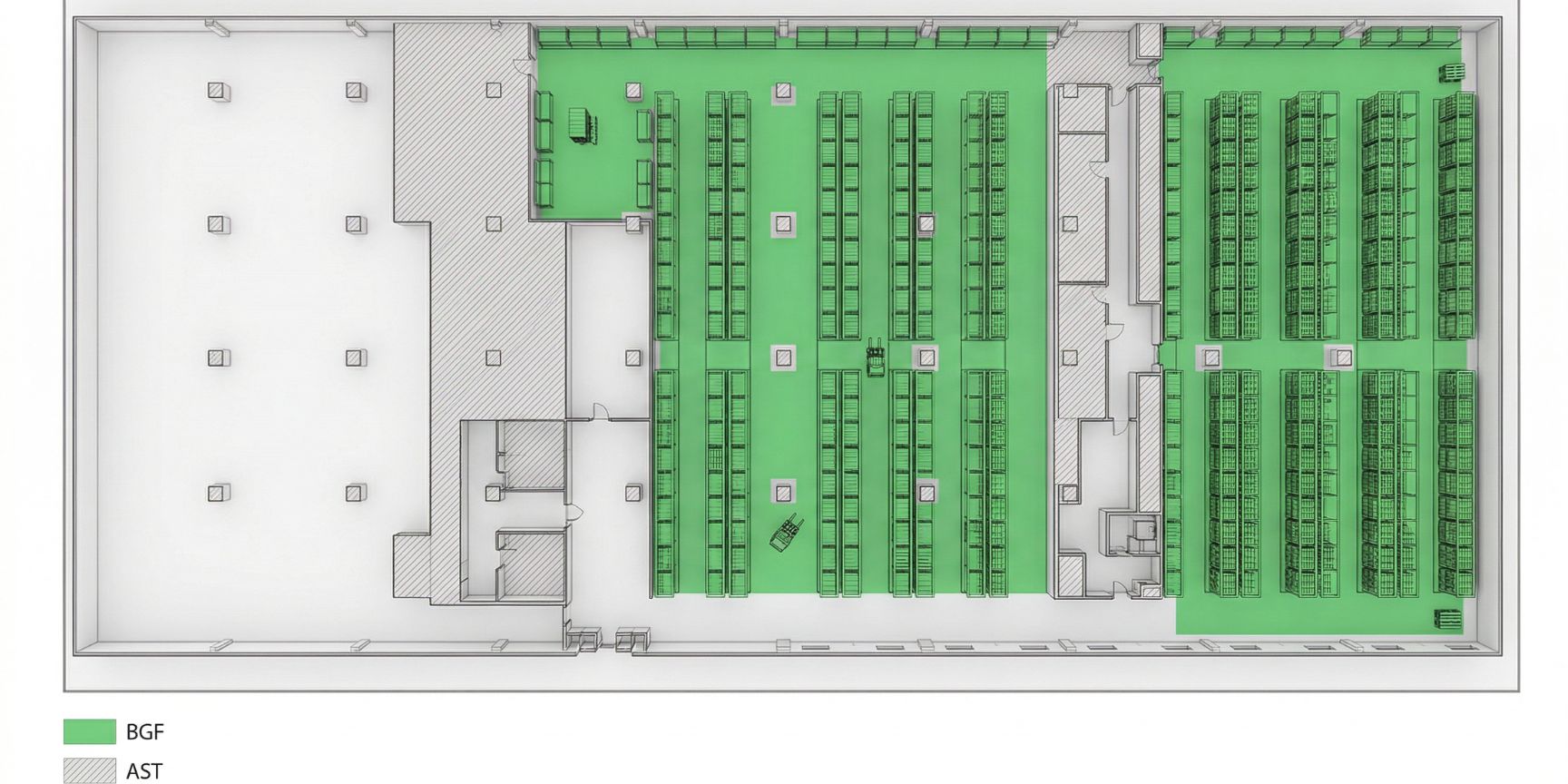
GFA (BGF) – gross floor area
AST – Aisle Width
Definition and Definition: Gross vs. Net
In order to understand the net storage area, it must be distinguished from the gross floor area (GFA). While the GFA comprises the sum of all floor areas of all floor planes of a building, including the outer walls (according to DIN 277), the net storage area is reduced to the space that is exclusively available for the storage and handling of goods.
In practice, this means that all areas that are not directly used for storage are deducted from the total area of the logistics property. These include:
- Construction surfaces (pillars, interior walls).
- Functional areas (boiler rooms, sprinkler control centres, electrical rooms).
- Social and office areas.
- Circulation areas, provided that they are purely used for the development of the building (stairwells, elevators).
The logistics property: Where space is "lost"
When building or renting a logistics hall, the net storage area is often significantly less than the area shown in the lease. Two factors play a role, especially in modern logistics properties:
- The column grid: In a standard hall, there are concrete or steel columns every 12 to 24 meters. Each support not only takes up physical space (approx. 0.5 to 1 m²), but also creates "blind spots" in the shelf arrangement. An unfavorable column grid can reduce net storage capacity by up to 5-8%.
- Fire protection and escape routes: Legal requirements require routes and passageways that must be kept clear at all times. Although these are part of the traffic area within logistics, they reduce the pure parking space.
Calculation basics: The mathematics behind logistics
In logistics planning, net warehouse space is often evaluated by the space utilization rate formula:
The following applies to the net storage area in a shelving or pallet racking system:
- Shelf space: The actual footprint of the shelves.
- Aisle width (AST): The space between the racks that is necessary for picking and access by industrial trucks (e.g. reach trucks).
Facts & Figures: In a conventional wide-aisle warehouse, the sheer shelf footprint often accounts for only 40% of the total hall space. In a narrow-aisle warehouse, this value can rise to over 60%, which massively increases the net storage area per square meter of hall floor space.
Special features in contract logistics
For contract logistics service providers, the net storage area is the basis of their calculations. Since they often charge per square meter occupied or per pallet, precise knowledge of the net area is essential for survival.
- Mixed calculation: The service provider often pays the landlord of the property a rent based on the GIF area (Gesellschaft für Immobilienwirtschaftliche Forschung), which covers almost the entire gross interior area.
- Margin pressure: If the service provider rents 10,000 m² but can only use 8,500 m² of net storage space efficiently due to unfavourable hall geometry, the costs for the remaining 1,500 m² (pillars, technology, manoeuvring areas) must be allocated to the remaining space.
Practical check: What influences usability?
Not every square meter of net storage space is worth the same. The following factors determine the quality of the area:
- Floor load capacity: A net area is of no use if the point loads are not sufficient for high racks (5–7 tons per m² are common).
- Clear height (UKB): In modern logistics, people think in cubic meters. An area with a clear height of 12 meters offers almost 20% more storage capacity than a hall with a height of only 10 meters for the same net floor area.
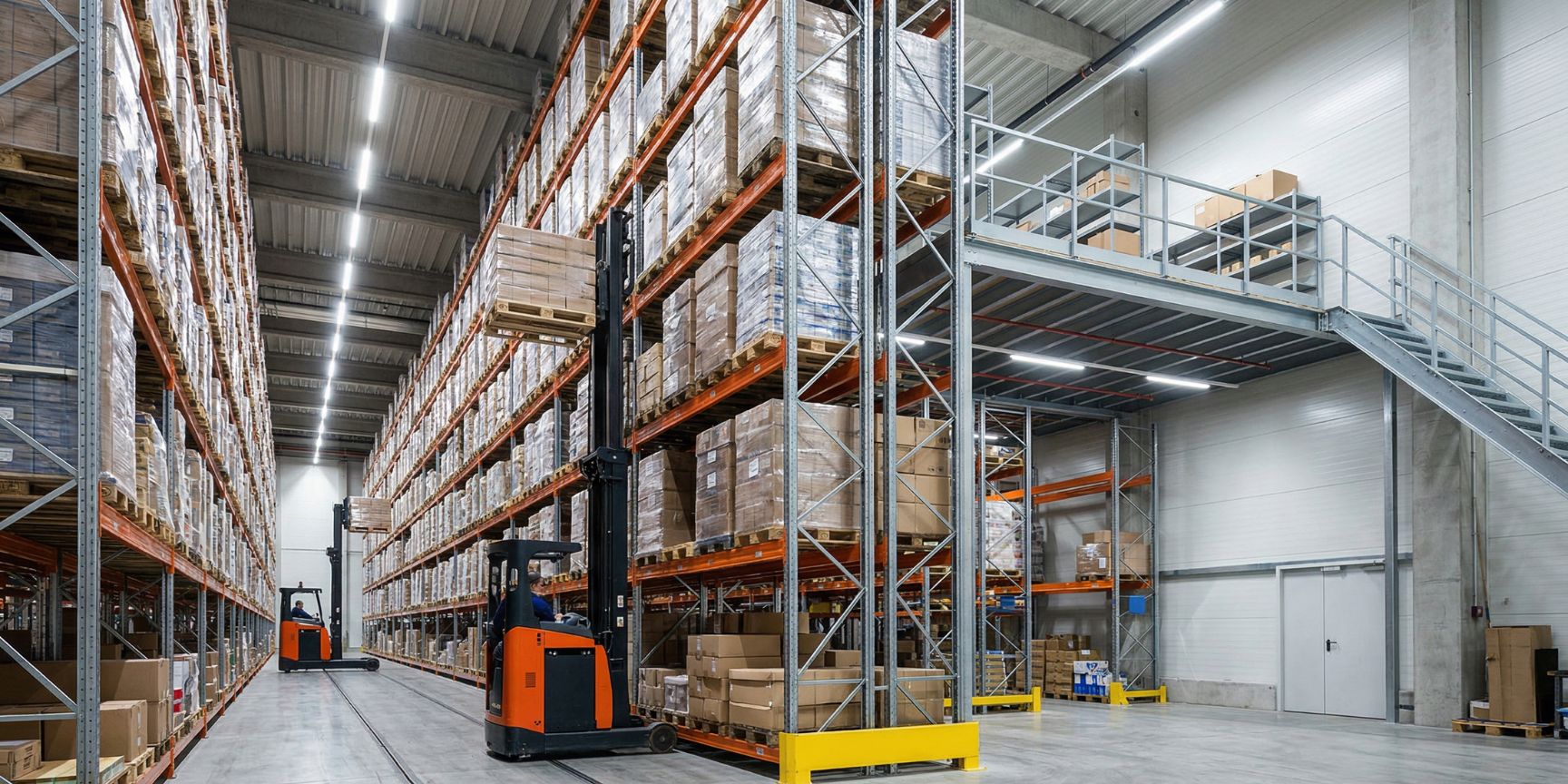
- Mezzanine areas: These intermediate levels increase the net storage area without increasing the environmental footprint (property sealing). They are ideal for Value Added Services (VAS) or small parts warehouses.
FAQ – Questions from practice
Question: Do the routes of the forklifts belong to the net storage area?
Answer: That depends on the perspective. In real estate valuation, they are counted as usable area. In operational logistics planning, a distinction is often made between pure storage space (under the rack) and functional area (routes). However, for a holistic view of the net warehouse logistics area, the work steps are included, as they are functionally inseparable from the rack.
Question: What percentage of the gross area can be used as net storage space on average?
Answer: In modern standard logistics halls, the utilization rate (net warehouse to gross hall) is usually between 85% and 92%. The remaining 8–15% is accounted for by walls, columns, technical centres and necessary circulation areas outside the racks.
Question: Why is the difference between DIN 277 and the GIF standard important?
Answer: Leases for logistics properties today are almost always based on the GIF standard. This is often "less favourable" for the tenant, as it partially includes areas such as technical rooms or pillars in the rental area, which do not represent net storage space from a strict logistical point of view.
Conclusion for decision-makers
Anyone planning or renting a logistics property should not be blinded by gross square footage. The decisive factor is the "layout capability" of the area. An efficient column grid, a high floor load and an optimized arrangement of gates and sprinkler units maximize the net storage space. In times of rising land prices and scarce new construction space, the optimisation of this net area is the greatest lever for reducing logistics costs.