




Small parts in warehouse logistics
Table of contents
- What are small parts in logistics? A definition
- The importance of small parts in warehouse and contract logistics
- Requirements for the logistics property for small parts
- Storage systems for small parts: From manual to fully automatic
- Picking strategies: The heart of small parts handling
- The role of container conveying technology and sorting
What are small parts in logistics? A definition
In logistics, the term small parts refers not only to the physical size of an item, but also to its handling unit. Typically, these are items that can be picked up and moved by a person without technical aids. The term "C-part" is often used for this purpose, which comes from the ABC analysis and describes articles with a low value content, but a high quantity and procurement frequency.
The exact definition varies depending on the company and industry, but the rule of thumb is items that can be stored and picked in standardised small load carriers (KLT), cartons or containers. The weight is usually in the range of a few grams to approx. 20 kg. Examples range from screws and seals in production logistics to electronic components in e-commerce and medicines in pharmaceutical logistics.
Question & Answer:
- Q: Is there a fixed standard for what is considered a small part?
- A: No, there is no universal norm. The classification depends heavily on the respective assortment and the storage and conveyor technologies used. An item that is considered a small part in one company can already be treated as bulky goods in another due to other processes.
The importance of small parts in warehouse and contract logistics
Small parts are at the heart of many modern logistics operations, especially in e-commerce, spare parts logistics and production supply. They often account for 80% of the article masters, but only 20% of the stock value (Pareto principle). Their importance derives from the complexity of their handling:
- High SKU number: Companies often manage tens of thousands to hundreds of thousands of different small parts.
- High picking frequency: The number of accesses to small parts is enormously high, which makes picking the most personnel-intensive and cost-intensive process in the warehouse.
- Susceptibility to errors: Distinguishing between similar small parts (e.g. different screw sizes) is a common source of error.
For contract logistics service providers, competence in small parts handling is a decisive differentiating feature. They must be able to offer flexible and scalable solutions for different customers with a wide range of requirements – from simple shelving to highly automated systems.
Requirements for the logistics property for small parts
The storage of small parts places specific demands on the logistics property. While the focus in pallet storage is on pure height and floor load, other factors are decisive for small parts:
- Floor quality: For the use of automated systems such as shuttle systems or automated guided vehicles (AGVs), an extremely high level of flatness of the hall floor (according to DIN 18202 or VDMA guidelines) is essential.
- Mezzanine capability: In order to make optimal use of the hall height, multi-storey mezzanines are often installed. The statics of the hall, in particular the point loads of the columns, must take this into account from the outset. A typical floor load for such areas is 500 to 750 kg/m².
- Technical building equipment (TGA): Automated systems have a high energy requirement and require an appropriate electrical installation as well as often emergency power generators. In addition, fire alarm and sprinkler systems must be adapted to the specific storage technology (e.g. shelf sprinklers).
- Layout and delivery: The hall requires sufficient space for incoming goods, packaging, consolidation and outgoing goods, which are logically connected to the material flows of the small parts.
Question & Answer:
- Q: Why is a standard logistics hall not always suitable for an automated small parts warehouse?
- A: Standard halls are often optimized for maximum space efficiency for pallet racking. However, an automated small parts warehouse (AS/RS) requires specific foundations, higher soil quality and more complex building services. Retrofitting is often uneconomical or technically impossible, which is why these requirements are ideally taken into account in the planning phase of a property (build-to-suit).
Storage systems for small parts: From manual to fully automatic
Choosing the right storage system is the key to efficiency. The systems can be roughly divided into three categories:
- Manual systems:
- Shelving shelves: the classic. Flexible, cost-effective to purchase, but with low storage density and long travel times for order pickers. Ideal for low to medium turnovers.
- Flow racks (Kanban): Goods are stored on one side and roll on the other for removal. This ensures the FiFo principle (first-in, first-out) and is often used in production supply.
- Semi-automatic systems:
- Mobile racking: Rail-mounted shelving or pallet racking that can be pushed together to save aisles. Increases storage density, but access is not possible simultaneously.
- Carousel racks (paternoster): The goods rotate vertically to the operator. Ideal for high space utilization in a small footprint, but with limited throughput.
- Fully automatic systems:
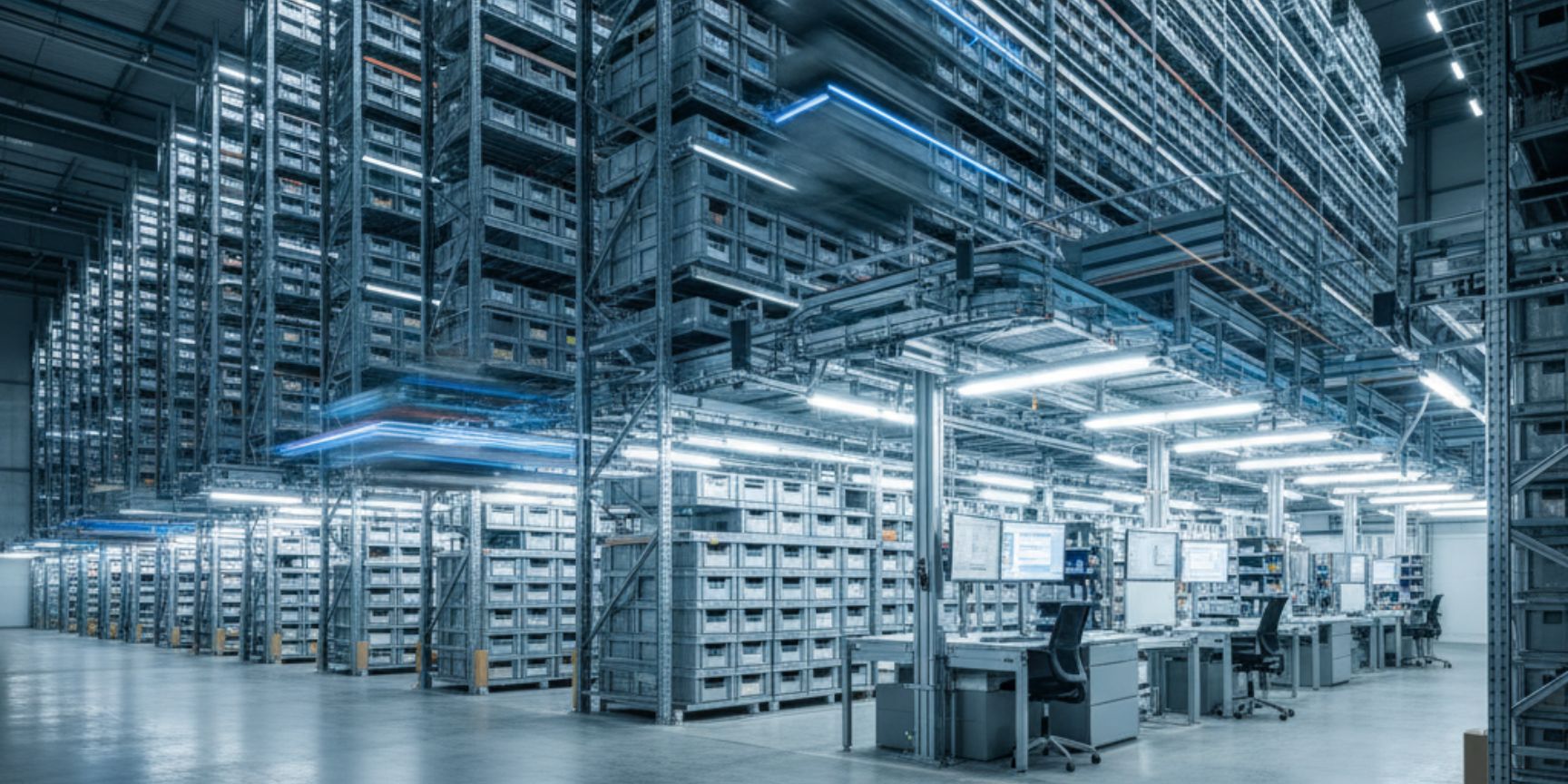
- Automatic small parts warehouse (AS/RS): Storage and retrieval machines (SRMs) store and retrieve containers, trays or cartons fully automatically. High storage density and high throughput. The throughput of a typical stacker crane is 80-120 double cycles per hour.
- Shuttle systems: Instead of one stacker crane per aisle, autonomous shuttles run on every rack level. This enables extremely high scalability and a significantly higher throughput than with the AS/RS (up to 1,000 container movements per hour and aisle). They are the technology of choice for highly dynamic e-commerce warehouses.
Picking strategies: The heart of small parts handling
Picking accounts for up to 55% of a warehouse's total operating costs . The right strategy is therefore crucial.
- Man-to-goods (static): The employee moves to the storage location. Low investment costs, but inefficient due to long walking distances. Supported by technologies such as pick-by-scan, pick-by-voice or pick-by-light.
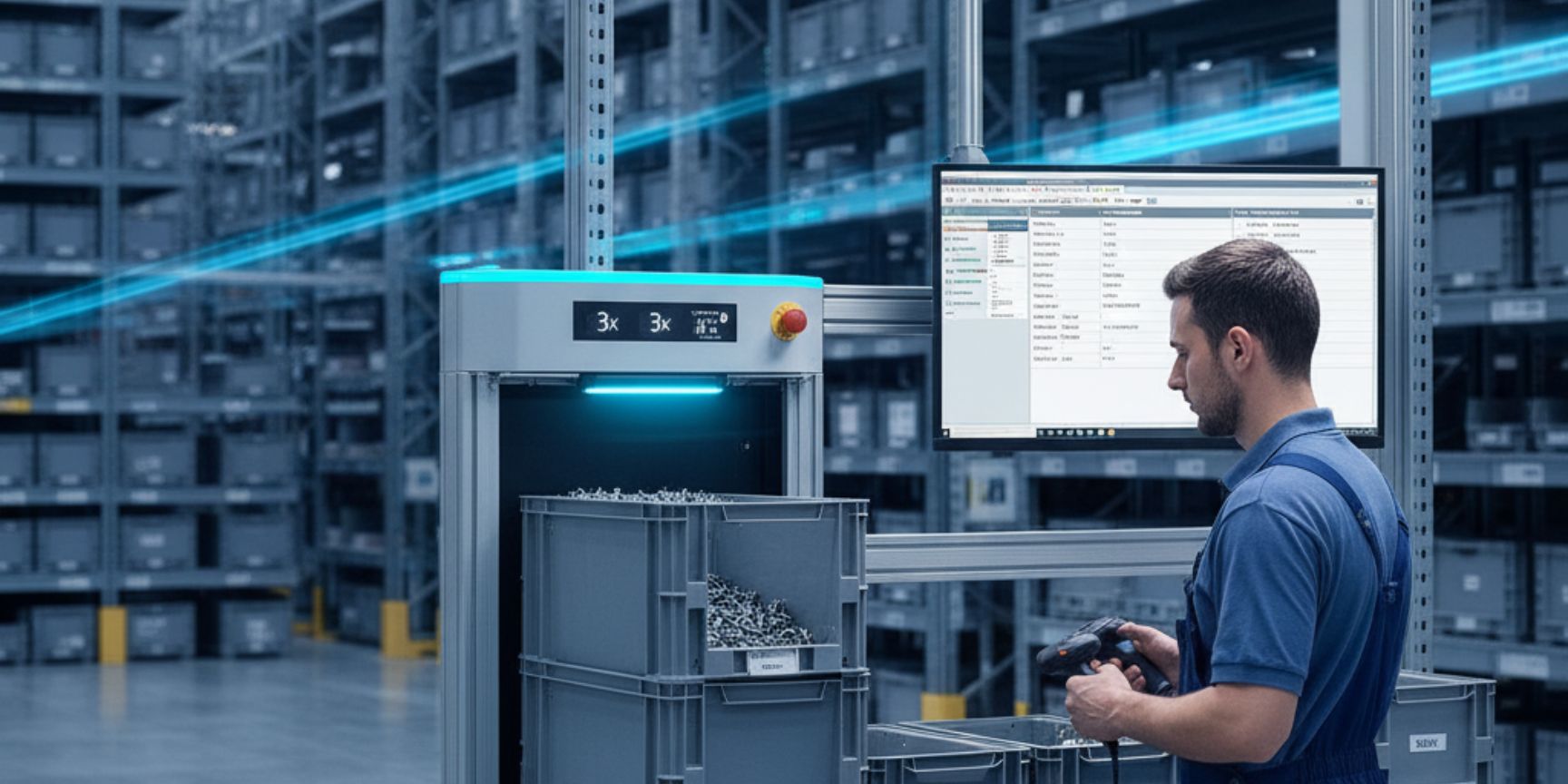
- Goods-to-man (dynamic): The storage system (e.g. AS/RS, shuttle) automatically brings the required container to a fixed picking workstation. This almost completely eliminates walking distances, maximizes pick performance (up to 1,000 picks per hour per workstation) and improves ergonomics.
Question & Answer:
- Q: When is it worthwhile to switch from "man-to-man" to "goods-to-man"?
- A: It's difficult to give an exact metric, but as a guideline, once the labor costs for picking exceed the annual depreciation and operating costs of an automated system, and high, steady throughput is required, a goods-to-person system becomes profitable. The return on investment (ROI) is often 3 to 7 years.
The role of container conveying technology and sorting
An automated small parts warehouse is only as good as its connection to the upstream and downstream processes. This is where container conveyor technology comes into play. It connects the incoming goods, the small parts warehouse/shuttle, the picking stations, packing stations and the outgoing goods department to form an integrated overall system. Modern conveyor technology is modular, energy-efficient (often with 24V technology) and intelligently controllable to avoid traffic jams and enable dynamic routes.
After picking, the small parts must be assigned to the respective customer orders. For high order volumes, sorters are used here (e.g. pocket sorters, cross-belt sorters), which automatically feed items to the correct end destinations (e.g. packing stations or shipping stations) and thus massively accelerate the consolidation process.