




Kanban system in the warehouse
Table of Contents
- What is a Kanban system? A basic definition
- The core principles: How does Kanban work in practice?
- Kanban in warehouse logistics: More than just filling a shelf?
- What concrete advantages does Kanban offer for contract logistics?
- The impact of Kanban on logistics real estate: What is changing in the hall layout?
- Key figures and success measurement: When is a Kanban system successful?
What is a Kanban system? A basic definition
The Kanban system is a method for the decentralized control of production and material flows. The term "Kanban" comes from Japanese (看板) and means "card" or "signal". The system was originally developed by Taiichi Ōno for the Toyota Motor Corporation to organize the efficiency of production along the lines of supermarkets.
The core idea is that a point of consumption (e.g. an assembly line or a picking station in the warehouse) sends a signal to the upstream source (e.g. a buffer warehouse or a supplier) when needed to replenish material. In other words, only what is actually and immediately needed is produced or provided. This pull principle is in contrast to the traditional push principle , in which material is "pushed" into the system based on forecasts and plans, often resulting in excess inventory.
The core principles: How does Kanban work in practice?
A Kanban system is based on a few but fundamental rules that control and visualize the process:
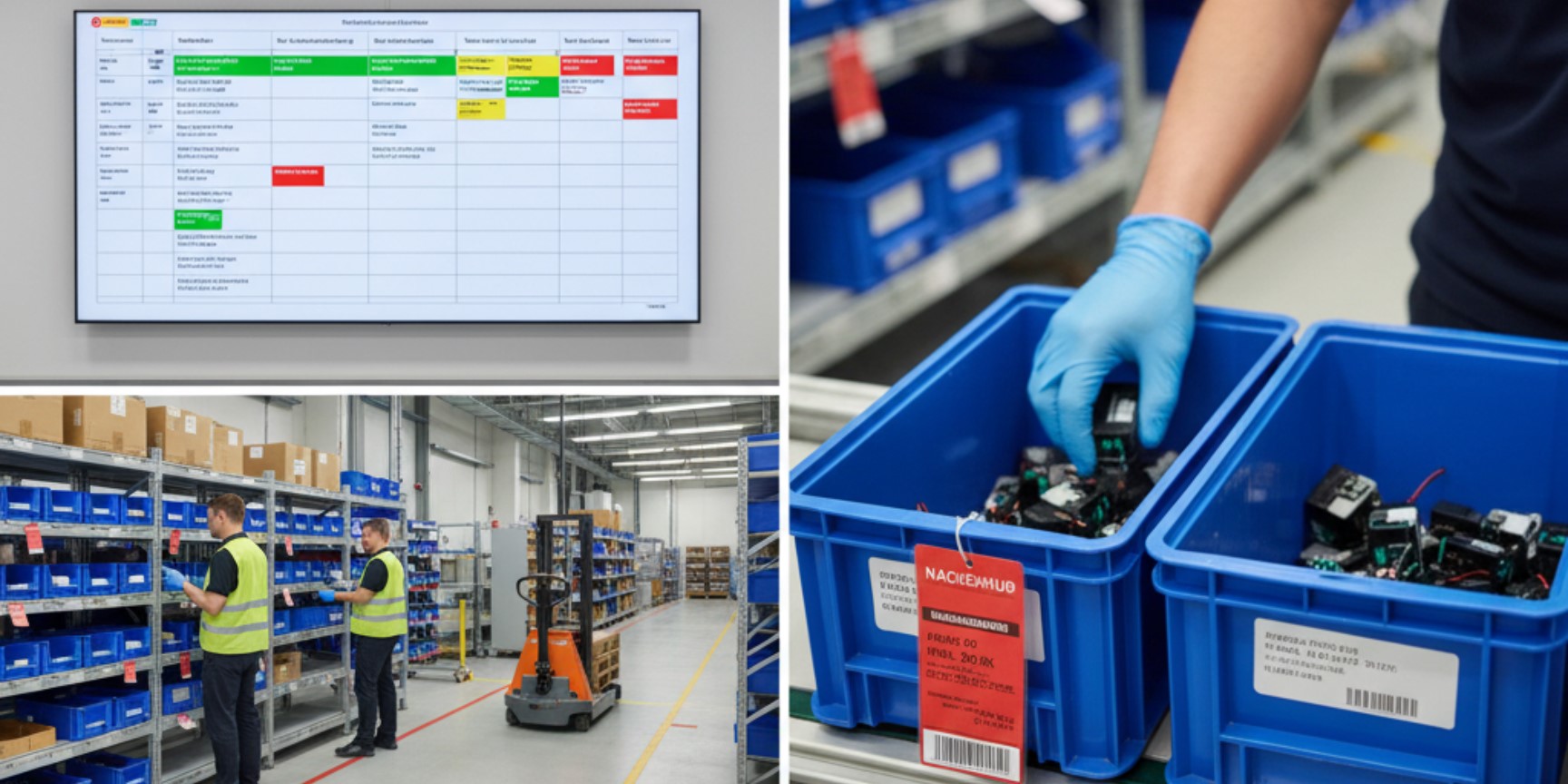
- Visualization of the workflow: All work steps and material stocks are made visible. This is often done through physical or digital Kanban boards and cards.
- Work in Progress (WIP): For each process step, an upper limit is set for the amount of material or tasks. A new order is only requested from the source when a container or a defined quantity has been consumed at the point of consumption.
- Control of the flow: The goal is a uniform and continuous flow of material and value creation. Bottlenecks and blockages are immediately recognizable through the visualization and can be eliminated in a targeted manner.
- Continuous improvement (Kaizen): The system is not static. Teams are encouraged to constantly analyze the process flow and gradually improve it based on key figures (e.g. throughput times).
A classic example is the two-container system: At the point of consumption, there are two containers with identical material. If the first container is empty, its Kanban card (or the empty container itself) is sent to the source as a signal for refilling. During the replenishment period, the second container is used. When the full container arrives, the cycle is closed.
Kanban in warehouse logistics: More than just filling a shelf?
In warehouse logistics , Kanban unfolds its full strength by drastically reducing capital tied up in inventories and increasing efficiency. Instead of storing large quantities on the basis of uncertain forecasts, buffer and picking warehouses are controlled according to actual consumption.
- Inventory reduction: Companies that consistently implement Kanban report inventory reductions of 20% to 50%. This frees up tied-up capital and reduces storage costs (rent, insurance, shrinkage).
- Avoidance of missing parts: Clearly defined reorder levels and replenishment cycles reduce the risk of "out-of-stock" situations, which increases delivery capability and customer satisfaction.
- Optimized processes: The distances of employees are shorter and the picking processes more efficient, as the materials are always available in the right place in the right quantity in a standardized manner.
What concrete advantages does Kanban offer for contract logistics?
For contract logistics service providers who provide complex logistics and value-added services to their customers, Kanban is a crucial tool for increasing efficiency and quality.
For example, a service provider that takes over production supply for an automotive manufacturer can use Kanban to precisely control just-in-sequence or just-in-time delivery. The customer's Kanban signal directly triggers the picking and delivery process in the service provider's warehouse. This results in:
- Greater process transparency for the customer and the service provider.
- Increased flexibility in the event of fluctuations in demand, as the response is not to a rigid plan, but to actual consumption.
- Reduced administrative effort, as reorders are triggered automatically by the system and do not have to be scheduled manually.
The impact of Kanban on logistics real estate: What is changing in the hall layout?
The implementation of a Kanban system has a direct physical impact on the design of a logistics property. A hall that is operated according to lean and Kanban principles is very different from a traditional warehouse.
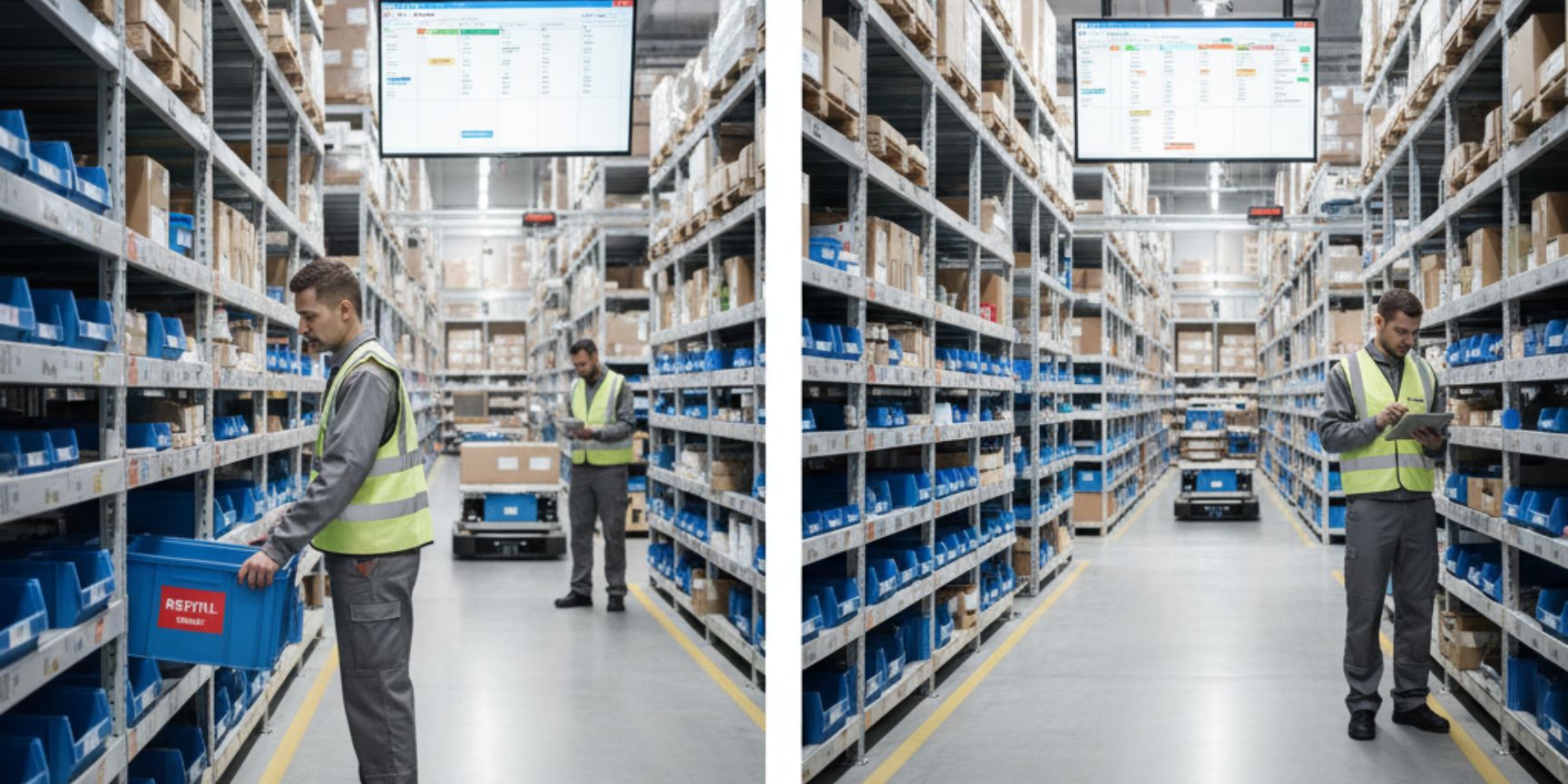
- Establishment of "Kanban supermarkets": These are clearly defined buffer zones or shelf areas close to the point of consumption (e.g. packaging, packaging). They store a precisely defined amount of material and are filled by a central warehouse or directly by the supplier according to the pull principle.
- Optimized material flow paths: The hall layout will be designed in such a way that the transport routes between the "supermarket" and the point of consumption are minimal. This reduces travel times for industrial trucks and sidewalks for employees.
- Space requirements: While Kanban reduces the overall inventory and thus potentially the space required, it also requires dedicated space for the buffer warehouses (supermarkets) and clearly defined transfer points. The use of space is planned more intensively and in a more process-oriented manner.
Key figures and success measurement: When is a Kanban system successful?
The success of a Kanban system is not only felt, but measured by hard numbers, data and facts . The most important key performance indicators (KPIs) are:
- Inventory turnover frequency: An increase shows that capital is being used more efficiently.
- Lead time: The time from the triggering of the Kanban signal to the re-availability of the material. Shorter times mean greater agility.
- Delivery reliability / service level: The percentage of replenishment orders fulfilled on time and in full.
- Inventory value: The absolute reduction in capital tied up in inventories.
A system is successful if these key figures improve measurably and the process runs stably and without bottlenecks at the same time.