



Kit formation in warehouse logistics
Table of Contents
What is Kitting? A definition
Kit formation is the compilation of two or more individual but related articles into a new, single unit – the so-called kit. This kit is given its own SKU (Stock Keeping Unit) and is managed as a single item in the warehouse management system (WMS). An everyday example is a cooking box, where all the ingredients for a dish are packed together in pre-portions. In industry, it could be an assembly kit for a specific component that contains all the necessary screws, seals and small parts. The goal is to massively simplify and accelerate downstream processes – be it in production, e-commerce fulfillment or service technology – as there are no longer many individual parts to handle, but only a single kit.
Goals and Core Benefits in Warehouse Logistics
The implementation of kitting processes pursues clear economic goals. The benefits are measurable and are directly reflected in the key figures.
- Process acceleration: In production or assembly, the time-consuming search for individual parts is no longer necessary. Studies show that kitting can reduce material supply time on assembly lines by up to 50%. The worker receives a perfectly prepared set and can concentrate on his core task.
- Error reduction: The picking of many individual parts is prone to errors. By centralizing this process in a dedicated kitting area, often supported by pick-by-light or pick-by-voice systems, the error rate decreases significantly. Once correctly assembled, the kit is a guarantee of completeness.
- Inventory optimization: Kitting ensures greater visibility and accuracy of inventory. Since the components are "consumed" into a kit, it is immediately visible when a critical part is running low. This prevents expensive production stops.
- Space saving: At the assembly line or at the packing table, significantly less space is required for the storage of individual parts. The space can be used for value-adding activities or slimmer lines.
The kitting process in practice: step by step
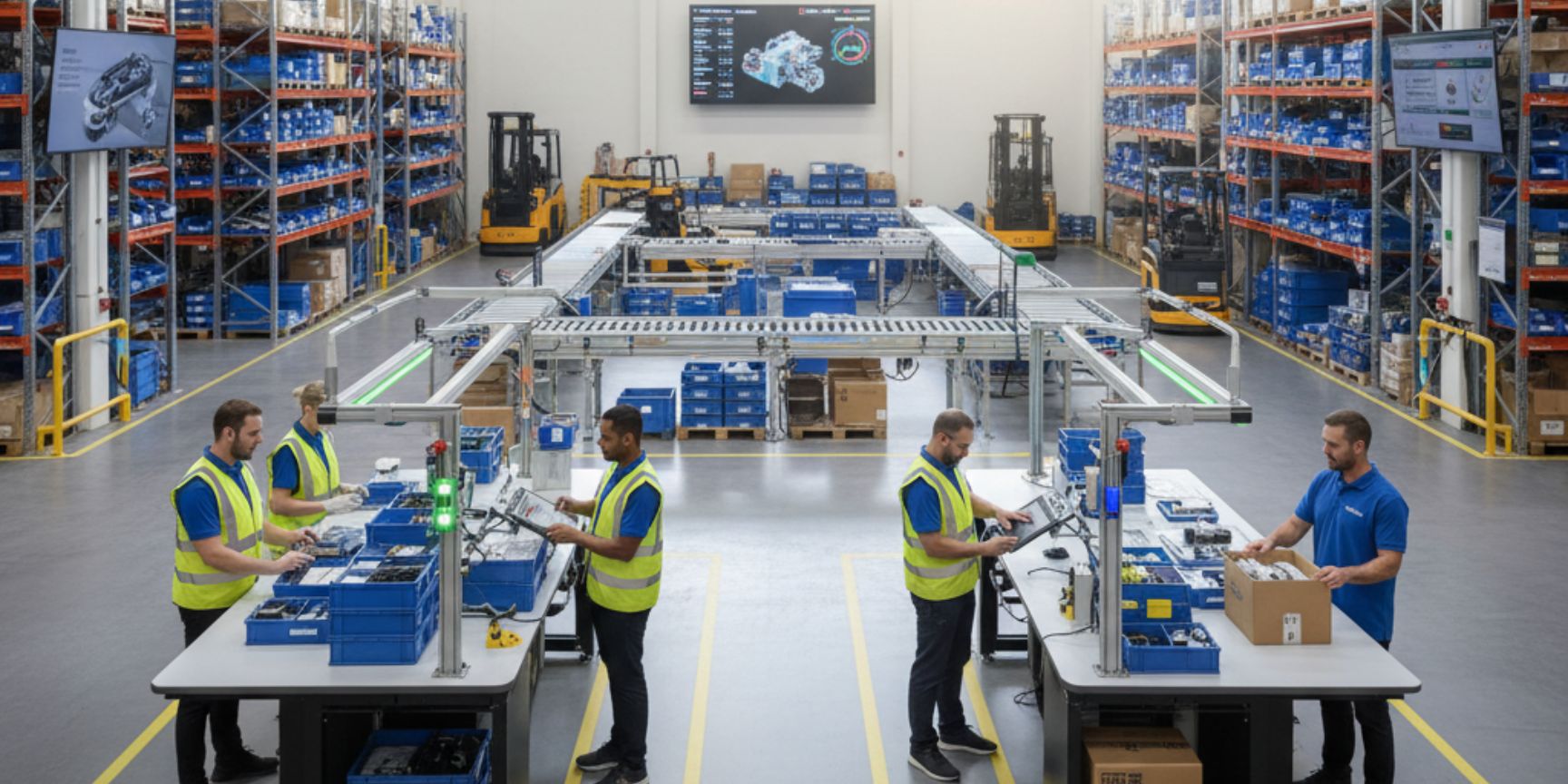
A typical kitting process in a modern logistics center takes place in clearly defined steps that are controlled by a warehouse management system:
- Order Receipt: The system generates a kitting order based on a customer order or production plan.
- Picking the components: A warehouse employee collects the individual parts (picks) according to the parts list of the kit stored in the WMS.
- Assembly & packaging: At a specially equipped workstation (kitting station), the components are checked for completeness and assembled into the kit. This can be done in a bag, a cardboard box or a special container (e.g. small load carriers, small load carriers).
- Quality Control: A crucial step in which the finished kit is inspected. Is everything included? Are the right components installed?
- Storage or provision: The finished kit is either stored for later retrieval or transported directly to its destination (production, shipping).
Requirements for the logistics property and the hall
Kitting is not a process that can be efficiently implemented in any warehouse. It places specific demands on the logistics property:
- Dedicated zones: It's not enough to just have shelf space. Kitting requires special value-added service (VAS) areas. These areas must be designed flexibly and offer space for work tables, packaging material and intermediate buffers.
- Ergonomics and lighting: Since manual, concentrated work takes place here, well-lit workplaces and ergonomic processes are crucial for quality and employee satisfaction.
- IT infrastructure: Complete Wi-Fi coverage for mobile data acquisition devices (MDE), connections for terminals, printers and possibly cameras for quality control are essential.
- Optimal location: The kitting zone should be strategically placed in such a way that the distances from the removal points of the components are short and the distances of the finished kits to production or outgoing goods are also minimized.
A pure transshipment hall is therefore less suitable. A modern contract logistics property is designed to seamlessly integrate such value-adding services.
Kit formation as a value-added service in contract logistics
For many companies, outsourcing logistics to a third-party logistics (3PL) service provider is a strategic step. Kit formation is a classic value-added service (VAS). The contract logistics provider not only takes care of storage and transport, but also integrates kitting deep into the customer's supply chain. He provides the expertise, the personnel, the IT systems and the right property. This enables the customer to concentrate on its core business, while the logistics partner ensures a highly efficient and flexible supply of materials.
Frequently Asked Questions (FAQ) on Kit Formation
Question: What is the difference between kitting and assembly?
Answer: Kitting is the preparatory step of assembling loose parts into a set. Assembly is the subsequent step in which these parts (or others) are assembled into a working final or partial product. Kitting delivers the perfect kit, Assembly assembles it.
Question: At what point is it worthwhile to introduce kitting processes?
Answer: Kitting is particularly worthwhile for products with a large variety of variants, complex parts lists or recurring orders of identical article combinations. If the sum of the individual picking times and the susceptibility to errors in production are high, the potential for savings through kitting is usually enormous.
Question: What are the biggest challenges in kitting?
Answer: The biggest hurdles are exact master data maintenance (parts lists), 100% inventory reliability of the individual components and the design of a lean, error-free process at the kitting workstation itself. Without a clean data foundation and disciplined processes, kitting can quickly become inefficient.
Your Ideal Logistics Warehouse
Browse listings for warehouse space, logistics real estate, industrial land, and contract logistics solutions.
Browse Exposés
Maximize Exposure for Your Warehouse Space
Showcase your logistics properties and attract qualified inquiries.
Discover Products