




Crane Technology in Warehouse Logistics
Table of Contents
- Crane Technology in Logistics: The Foundation for Efficiency and Structure
- Classification: Which cranes dominate the logistics hall?
- The symbiosis of crane and logistics property: structural analysis and planning
- Technical Metrics: What Professionals Need to Know
- The crane in contract logistics: flexibility as a competitive advantage
- FAQ: Frequently asked questions from practice
- Cost-benefit analysis and lifecycle
- Conclusion: The crane as the backbone of heavy lift logistics
Crane Technology in Logistics: The Foundation for Efficiency and Structure
Cranes are much more than just hoists; they are an integral part of the building infrastructure and play a key role in determining the flexibility and utility value of a logistics property. While storage and retrieval machines and conveyor technology often dominate in the classic e-commerce warehouse, the crane is the central element in heavy-duty logistics, mechanical engineering and contract logistics. In this guide, we dive deep into the technical and planning aspects.
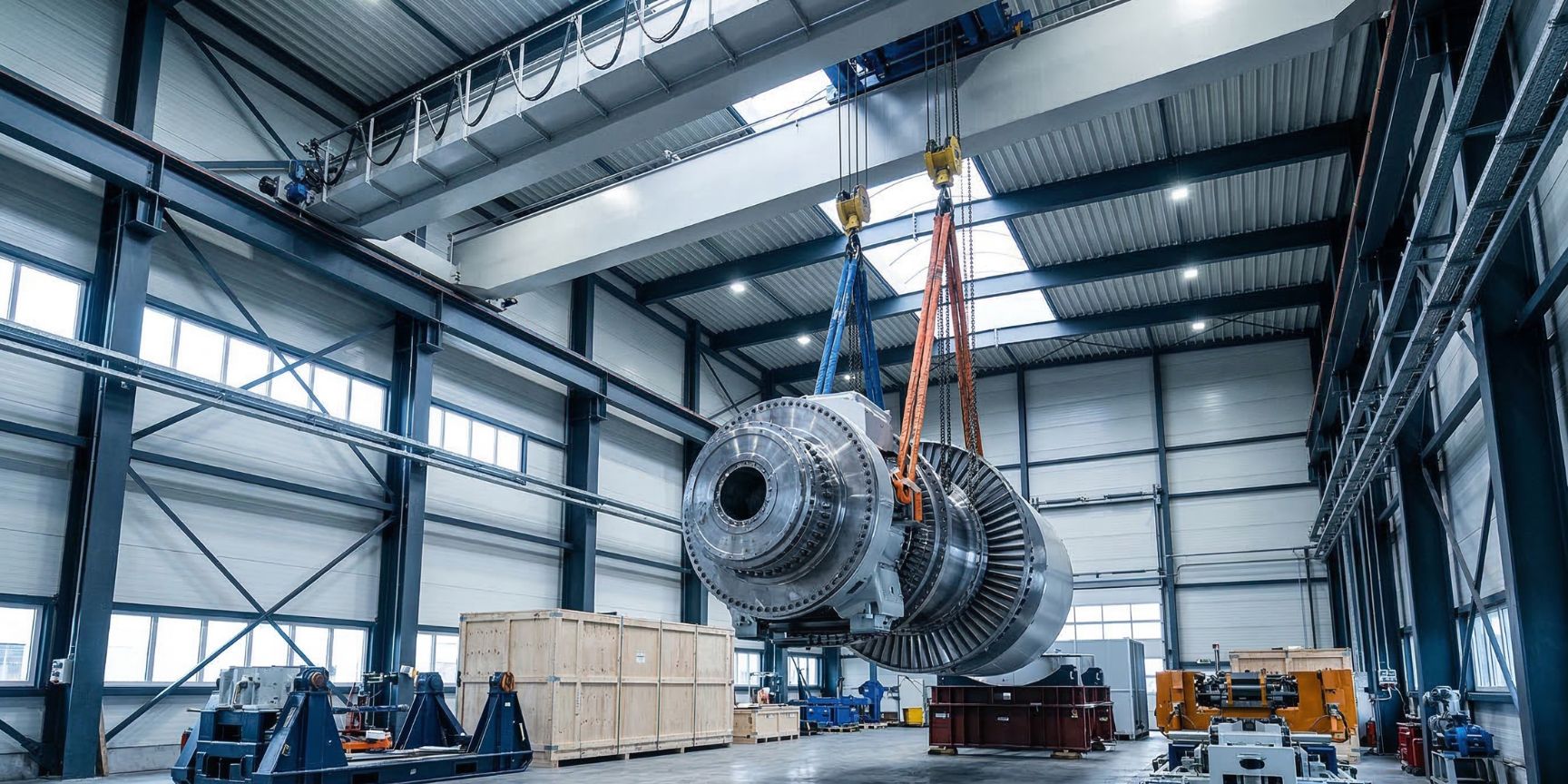
Classification: Which Cranes Dominate the Logistics Hall?
In logistics real estate, we primarily encounter three types of systems that differ in their design and radius of action:
- Single-girder overhead crane: The most economical solution for loads up to approx. 16 tonnes and spans of up to 30 metres. It is characterized by a low dead weight, which minimizes the load on the hall statics.
- Double-girder overhead crane: For heavy loads (up to over 250 tonnes) and large spans. The trolley riding on the beams achieves a greater lifting height, as the hook can be pulled up between the beams.
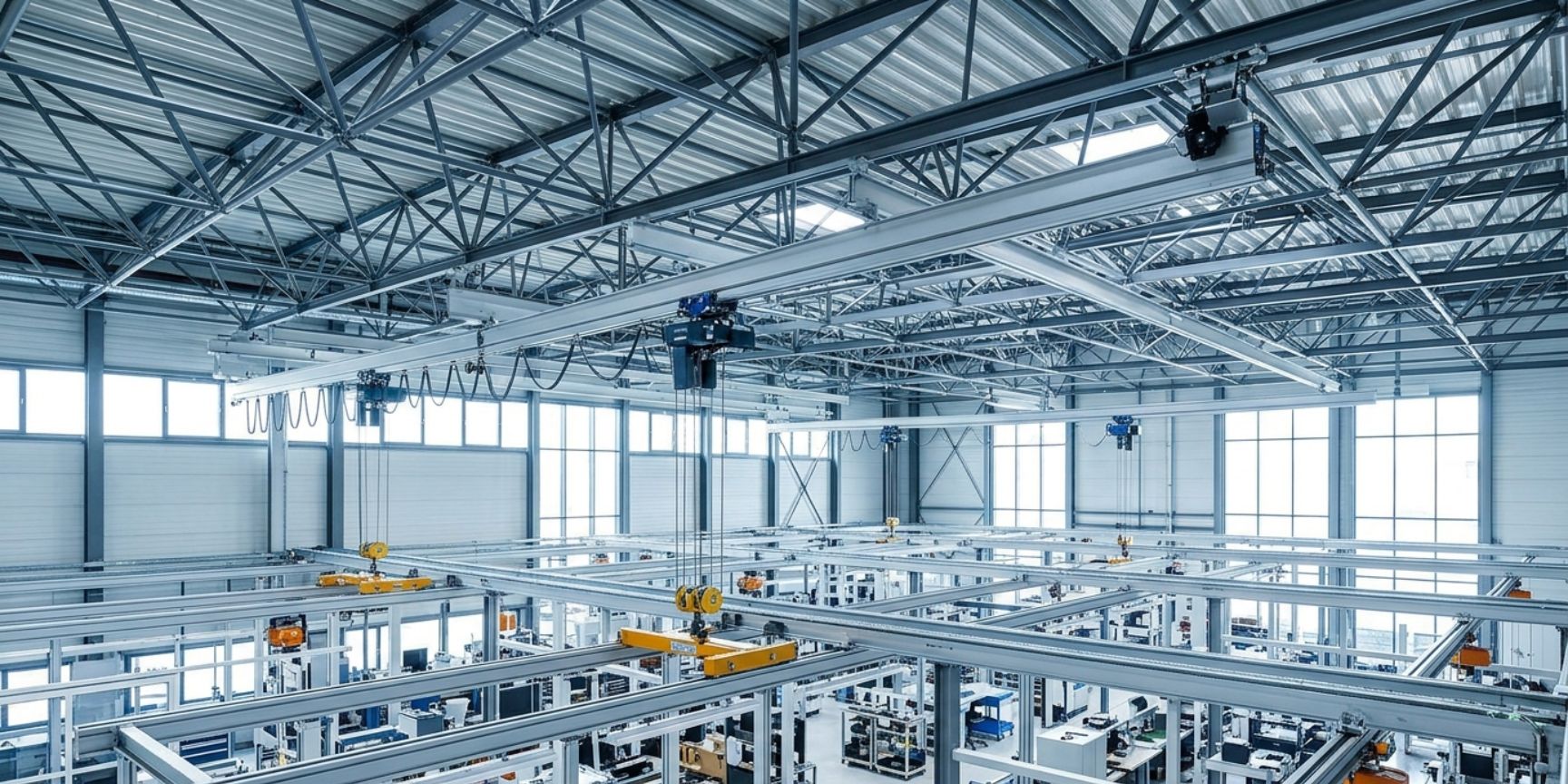
- Suspension cranes (overhead cranes): Here, the crane runways travel directly under the hall ceiling. This saves space on the ground, but requires an extremely resilient roof construction.
- Wall-mounted jib cranes & column slewing cranes: They often serve as workstation cranes in contract logistics to support assembly or picking areas locally without blocking the main crane.
The Symbiosis of Crane and Logistics Property: Structural Analysis and Planning
Anyone planning a logistics hall with a crane has to think "from the hook". A crane has a fundamental influence on architecture:
- Crane runway girders: The rails on which the crane travels must absorb enormous horizontal and vertical forces. The downforce and cornering forces that occur during acceleration and braking play a role here.
- Hall height (UK truss): The clear height of the hall must be calculated in such a way that the maximum stacking height of the goods plus a safety distance is still guaranteed under the crane.
- Foundation: The point loads under the hall supports that support the crane runway are many times higher than in standard halls. Bucket foundations or pile foundations are often necessary here.
Technical Metrics: What Professionals Need to Know
To evaluate the performance of a crane, tonnage specifications are not enough. The following data is crucial in tenders and planning:
- SWL (Safe Working Load): The rated load that the crane is allowed to lift safely.
- Classification according to DIN EN 13001 or FEM: This classifies the crane according to load spectrums (how often is the maximum load lifted?) and time classes (how many hours does the crane run per day?). A crane in contract logistics with 3-shift operation requires a higher classification (e.g. FEM 2m or 3m) than a maintenance crane (FEM 1am).
- Lifting speed and trolley speed: These determine the cycle time diagram and thus the throughput per hour.
The Crane in Contract Logistics: Flexibility as a Competitive Advantage
In contract logistics, requirements often change with customer projects. A permanently installed crane can be both a curse and a blessing here.
Pros:
- Space utilization: Since cranes use the airspace, the floor space is left free for shelves or assembly areas.
- Versatility: With load handling devices such as trusses, magnets or vacuum lifters, almost any goods can be handled – from 12m long steel beams to finished machine modules.
Challenge:
A column-free grid is more difficult to implement in crane halls. Contract logistics companies often prefer halls with a high load capacity of the floor slab in order to be able to use mobile cranes or heavy-duty forklifts as an alternative if the fixed crane technology is not sufficient for a new project.
FAQ: Frequently asked Questions from Practice
Question: Can I retrofit a crane in an existing logistics hall?
Answer: This is difficult and costly. In most cases, the statics of the supports and foundations are not sufficient. One solution is "free-standing crane runways", which have their own support system and are only connected to the hall at certain points.
Question: How often does a crane need to be serviced?
Answer: According to DGUV Regulation 52 (formerly VBG 9), an annual inspection by an expert is mandatory. In addition, the remaining theoretical useful life (SWP - Safe Working Period) must be documented.
Question: What role does automation play in indoor cranes?
Answer: In modern warehouses, semi-automated or fully automated cranes are becoming more and more common. By means of pendulum damping and destination control, they can approach storage locations with centimetre precision, which increases safety and minimises damage to the goods.
Cost-benefit Analysis and Lifecycle
The investment in crane technology (CAPEX) is high, but the operating costs (OPEX) are often lower compared to a fleet of heavy-duty trucks. A crane has a lifespan of 20 to 30 years.
| Factor | Indoor crane | Heavy-duty forklifts |
| Power source | Electricity (green possible) | Diesel / Electric (Battery) |
| Space requirements | Minimal (airspace) | High (driveways) |
| Maintenance costs | Medium | High (Wear Parts) |
| Flexibility | Location-bound | High |
Conclusion: The Crane as the Backbone of Heavy Lift Logistics
In the niche of heavy-duty and contract logistics, the crane is the crucial tool for moving heavy loads safely and efficiently. For developers of logistics real estate, the integration of crane technology means specialization that massively increases the value of the property for certain user groups, but requires precise advance planning of the static loads.