




Collision protection in warehouse logistics
Table of contents
- Definition and relevance: Why collision protection is systemically relevant
- Legal basis: The "must" regulations (DGUV & DIN)
- Material Discussion: Steel vs. High-Performance Plastics
- Critical zones in the logistics hall
- Cost-effectiveness: TCO (Total Cost of Ownership) consideration
- FAQ – Frequently asked questions and answers about collision protection
- Assembly and retrofitting during operation
- Conclusion & Practical Tip
Definition and relevance: Why collision protection is systemically relevant
In the hectic everyday life of warehouse and contract logistics, where industrial trucks such as forklifts and high-speed forklifts operate under high time pressure, collisions are statistically not a question of "if", but of "when". Collision protection (often also called impact protection) refers to all structural devices that protect stationary equipment (shelves, supports, walls, gates) and people from the kinetic energy of impacting vehicles.
For operators of logistics properties and contract logistics companies, the relevance goes far beyond personal protection. A damaged shelf leg can lead to the collapse of an entire pallet rack (domino effect). A damaged hall door can paralyze incoming goods for days. The collision protection is therefore a direct investment in business continuity.
Legal basis: The "must" regulations (DGUV & DIN)
In Germany, the use of collision protection is not a "nice-to-have", but strictly regulated. The most important standard here is DIN EN 15635 ("Stationary steel shelving systems – Application and maintenance of storage equipment").
Essential facts for the practitioner:
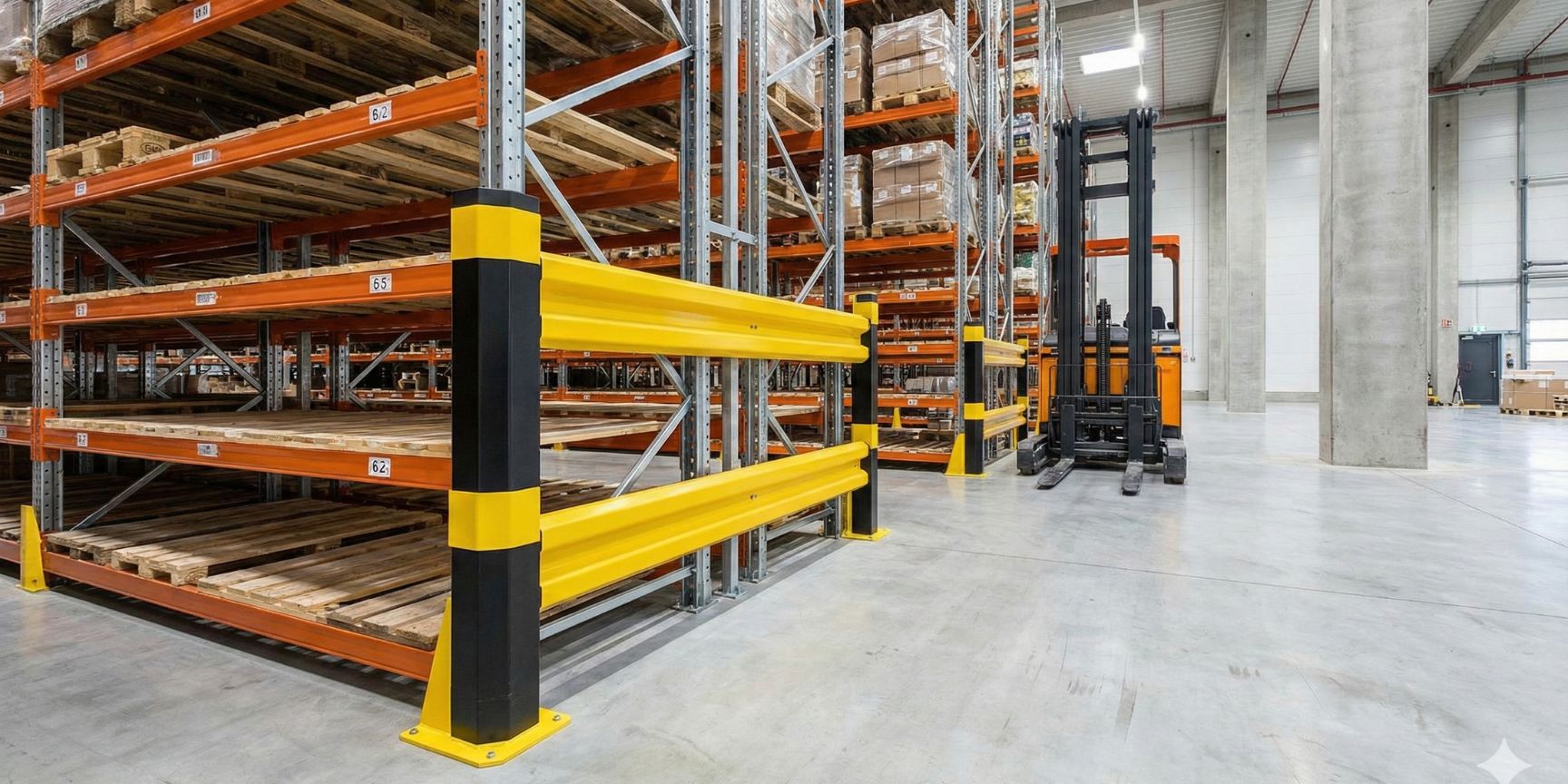
- Mandatory area: Collision protection is mandatory at all corner areas of racks that are passed by industrial trucks.
- Dimensions: The protection must be at least 400 mm high .
- Independence: It must not be connected to the shelf so as not to direct the impact energy directly into the shelf structure.
- Visibility: A yellow and black hazard signage (often according to ASR A1.3) is standard to maximize visual perception.
In addition, DGUV rule 108-007 (formerly BGR 234) applies, which specifies that the collision protection must be able to absorb an energy of at least 400 Newton metres (Nm) without damaging the object behind it.
Material Discussion: Steel vs. High-Performance Plastics
For a long time, steel was the measure of all things. However, a paradigm shift is taking place in modern logistics real estate.
The classic steel collision protection:
- Advantage: Cheap to buy, extremely robust with light scratches.
- Disadvantage: Steel deforms permanently in the event of an impact. Worse still, since steel is rigid, the impact energy is conducted directly into the base plate (hall floor) via the ground anchors . This often leads to concrete chipping ("bursting") around the dowels. The renovation of industrial floors is extremely expensive and massively disrupts operations.
The flexible polymer collision protection:
- Advantage: These plastics have a "memory effect". They deform on impact, absorb the energy and return to their original shape.
- The "game changer": Since the energy is absorbed in the material and not conducted into the floor, the hall floor usually remains undamaged. This is particularly essential in rental properties (contract logistics) in order to avoid discussions about soil damage when moving out.
- Disadvantage: Higher initial costs compared to simple steel angles.
Critical zones in the logistics hall
A holistic protection concept must cover different zones. We distinguish between the protection of the property and the protection of the furnishings.
- Shelf supports: The corner areas of pallet racks at the aisle ends are particularly at risk. Here, forklift curves often cut the radius.
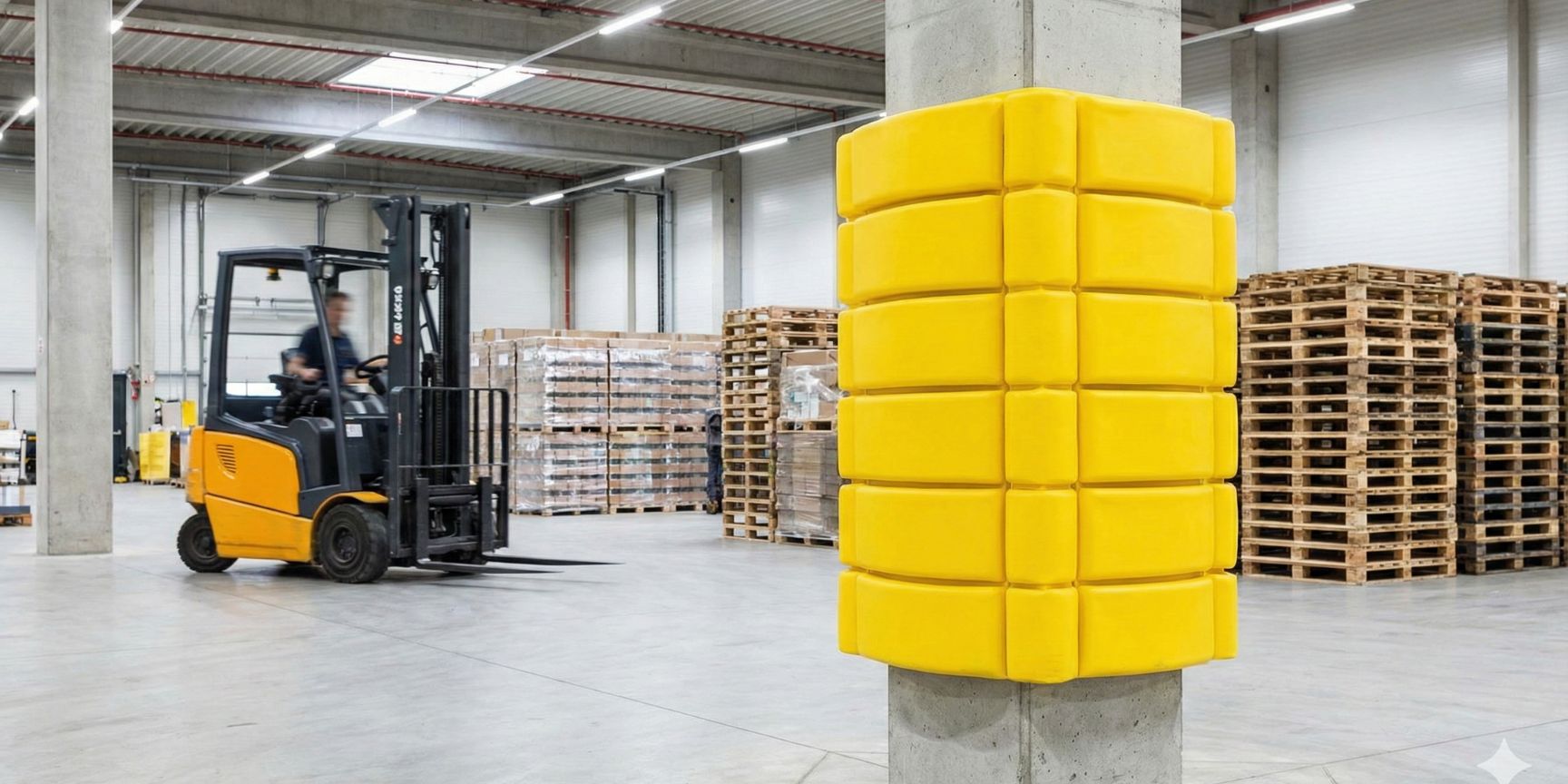
- Hall columns & pillars: In large logistics halls, load-bearing concrete columns are elementary. A serious impact can endanger the statics of the building. Fully enclosing column protection systems are often used here.
- Loading gates & dock levellers: A neuralgic point in contract logistics. Trucks docking backwards generate enormous forces. Rubber start-up buffers or sliding steel plates are standard here.
- Technical systems: Control cabinets, sprinkler control panels or charging stations for lithium-ion forklifts must be protected separately by bollards or planks.
Cost-effectiveness: TCO (Total Cost of Ownership) consideration
In the calculation for logistics projects, often only the purchase price (CAPEX) is seen. However, a TCO analysis shows a different picture.
Imagine a forklift driving at 5 km/h against a collision guard.
- Scenario A (steel): The protection is bent (must be replaced = material costs + assembly). The ground anchor has been torn out (soil remediation = high costs + dust pollution + closure of the corridor).
- Scenario B (Flexible): The protection springs back. No repair costs, no downtime.
Practical data show that the use of high-quality, flexible collision protection in highly frequented transshipment halls (e.g. cross-docking terminals) often pays for itself after the second avoided damage. For investors in logistics real estate, it ensures third-party usability, as the ground remains intact.
FAQ – Frequently asked questions and answers about collision protection
Question: Does every shelf leg have to be protected?
Answer: No. DIN EN 15635 prescribes protection only at "corner areas of aisles" and passageways. However, many operators ("best practice") also decide to protect the intermediate supports with so-called "rack armour" (attachable plastic trays), as this massively increases the longevity of the racks.
Question: Can I repair collision protection myself?
Answer: The following applies to steel collision protection: Once deformed, it has lost its protective effect (energy absorption) and must be replaced. A "bending back" is not permissible from a safety point of view. Ground anchors must be professionally rehabilitated (composite mortar, etc.) if the concrete is cracked.
Question: What about fire protection walls and panel walls?
Answer: Caution is advised here. A bumper should never be attached directly to a sandwich panel wall or a lightweight partition. It must be anchored in the ground free-standing. In the case of fire doors, care must be taken to ensure that the collision protection does not impair the closing mechanism or escape route widths.
Question: Does floor marking also count as collision protection?
Answer: No. Floor markings are organisational measures for separating traffic routes, but do not offer physical protection (passive safety). They are a supplement, not a replacement.
Assembly and retrofitting during operation
In contract logistics, customers and layouts change frequently. A modular collision protection system is therefore preferable. Installation is usually carried out using heavy-duty anchors or adhesive anchors in the concrete floor. Important in planning: The distance between collision protection and the object to be protected must be large enough to absorb the "deflection" (in the case of flexible protection) or the deformation (in the case of steel) without touching the object (usually 30-40 cm distance recommended, often less possible for shelf corners, so choose stiffer systems or direct protective shoes there).
In the case of deep-freeze warehouses, special attention must be paid to the floor reinforcement in order to avoid cold bridges in the floor structure.
Conclusion & Practical Tip
Collision protection is the life insurance of your logistics property. Those who save here will pay twice later – through soil remediation and shutdown. For modern, high-frequency storage areas, it is advisable to switch to hybrid or fully elastic polymer systems in order to protect the building fabric in the long term.
Your Ideal Logistics Warehouse
Browse listings for warehouse space, logistics real estate, industrial land, and contract logistics solutions.
Browse Exposés
Maximize Exposure for Your Warehouse Space
Showcase your logistics properties and attract qualified inquiries.
Discover Products