




CEP services in logistics
Table of contents
- Definition: What are CEP services? (courier, express and parcel services)
- The CEP market in figures: e-commerce as a driver
- Warehouse logistics interface: CEP at outgoing goods
- Integration into contract logistics: CEP as a strategic service
- The impact of CEP on logistics real estate
- FAQ: CEP services in logistics practice
- Future trends: automation and sustainability
Definition: What are CEP services? (courier, express and parcel services)
CEP services are the acronym for courier, express and parcel services. They form a central segment of the logistics industry that specialises in transporting shipments with a relatively low weight and volume. Although often used interchangeably, the three segments differ significantly:
- Parcel services (standard): This is the mass business. Shipments are transported in a highly standardized and system-supported manner (often via central sorting centers/hubs). The focus is on cost efficiency and volume. Delivery usually takes place within 24-48 hours (national), but without time guarantee. This is the core business in B2C e-commerce (e.g. DHL, Hermes, DPD, GLS).
- Express services: Here, the focus is on speed and, above all, the delivery guarantee. Express shipments are prioritized and often delivered overnight (overnight express) or even same-day (same-day). These services are more expensive and essential in the B2B sector (e.g. spare parts, documents) as well as for time-critical B2C shipments (e.g. food). (e.g. UPS Express, DHL Express, FedEx/TNT).
- Courier services: This is the most individualized form. A courier usually transports a shipment directly from the sender to the recipient, without going through a distribution center. This is used for extremely urgent or sensitive local shipments (city courier) or for special on-board couriers in international traffic.
The CEP market in figures: e-commerce as a driver
The CEP market is a seismograph of consumer behaviour. The boom in e-commerce has led to explosive growth.
According to the BIEK study (Federal Association of Parcel and Express Logistics), around 4.05 billion CEP shipments were transported in Germany in 2023 . Even though this represents a slight decline after the pandemic record years, volume remains at an extremely high level. The B2C sector (shipping to private customers) accounts for the lion's share of over 80% of parcel shipments. The "Big Five" (DHL, Hermes, UPS, DPD, GLS) dominate the market, with DHL Parcel being the market leader in the B2C sector. These figures illustrate the immense physical load that CEP services handle every day, which originates directly in the warehouse and contract logistics centres.
Warehouse logistics interface: CEP at outgoing goods
For warehouse management, the CEP process is the pacesetter of outgoing goods. A modern warehouse, especially in e-commerce or B2B trade, is physically and process-wise optimized for CEP handling.
The decisive factor is the cut-off times. This is the contractually agreed time at which the CEP service providers pick up the collected parcels of the day (e.g. 16:00). All orders received by an internal deadline (e.g. 2:00 p.m.) must be picked, packed, labeled and prepared by the cut-off time.
For warehouse logistics, this means:
- Process speed: The throughput (picking, packing, labeling) must be extremely fast to deliver on the "next-day delivery" promise.
- Packaging: The packaging must be CEP compliant (drop-proof, sorting belt capable).
- Labeling: The warehouse management system (WMS) must be directly connected to the systems of the CEP service providers via interfaces (APIs) in order to generate completely correct, scannable shipping labels.
- Outgoing goods zone: The buffer zone at the outgoing goods area must be able to accommodate thousands of parcels, often pre-sorted by service provider or routing code, before they are loaded into the trucks or swap bodies.
A mistake in this process (e.g. a missed cut-off) inevitably means a 24-hour delay for the end customer.
Integration into contract logistics: CEP as a strategic service
In contract logistics (3PL – Third Party Logistics), CEP shipping is moving from a pure transport service to an integrated strategic service component. The 3PL provider operates the warehouse for its customer (client) and takes over the complete shipping process as a "value-added service".
The decisive advantage for the client is the volume bundling. A 3PL provider that operates a multi-user warehouse bundles the shipping volume of all its tenants. With this consolidated volume (e.g. 10,000 parcels/day instead of 500), he can negotiate fundamentally different conditions (prices) for CEP services than the individual client could ever do.
In addition, the contract logistics company manages a multi-carrier strategy:
- Standard B2C packages go through Service Provider A (cost focus).
- Heavy B2B parcels via service provider B (handling focus).
- International express shipments via service provider C (network focus).
The WMS of the 3PL provider automatically selects the best carrier (based on weight, destination, service level) (carrier decision engine). The client receives "Logistics as a Service" including optimized CEP costs without having to worry about the complex management and negotiation themselves.
The impact of CEP on logistics real estate
The CEP industry has specific and extremely high requirements for logistics properties (halls). A clear distinction must be made between two types:
CEP depots (transshipment halls / cross-docks):
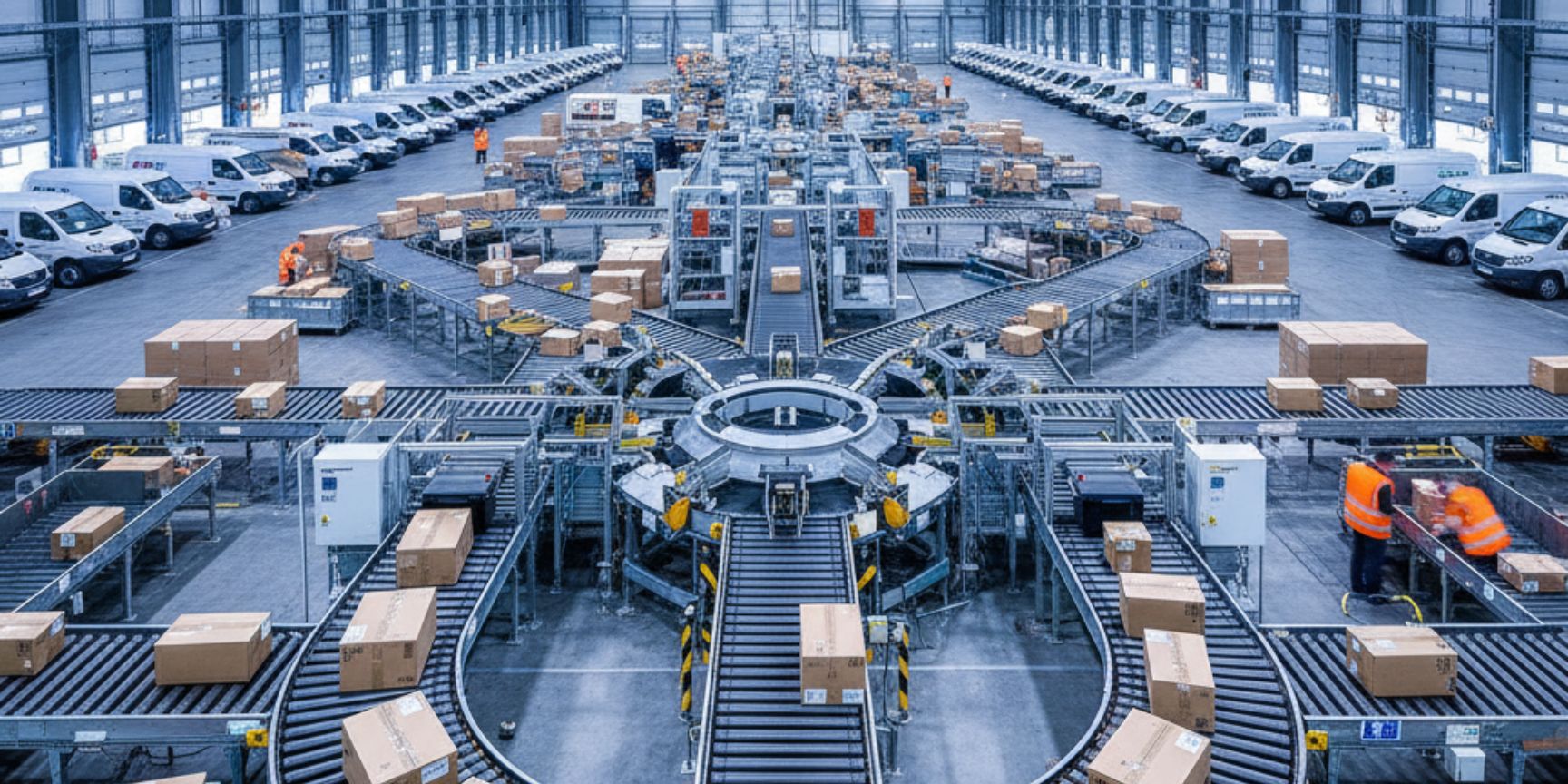
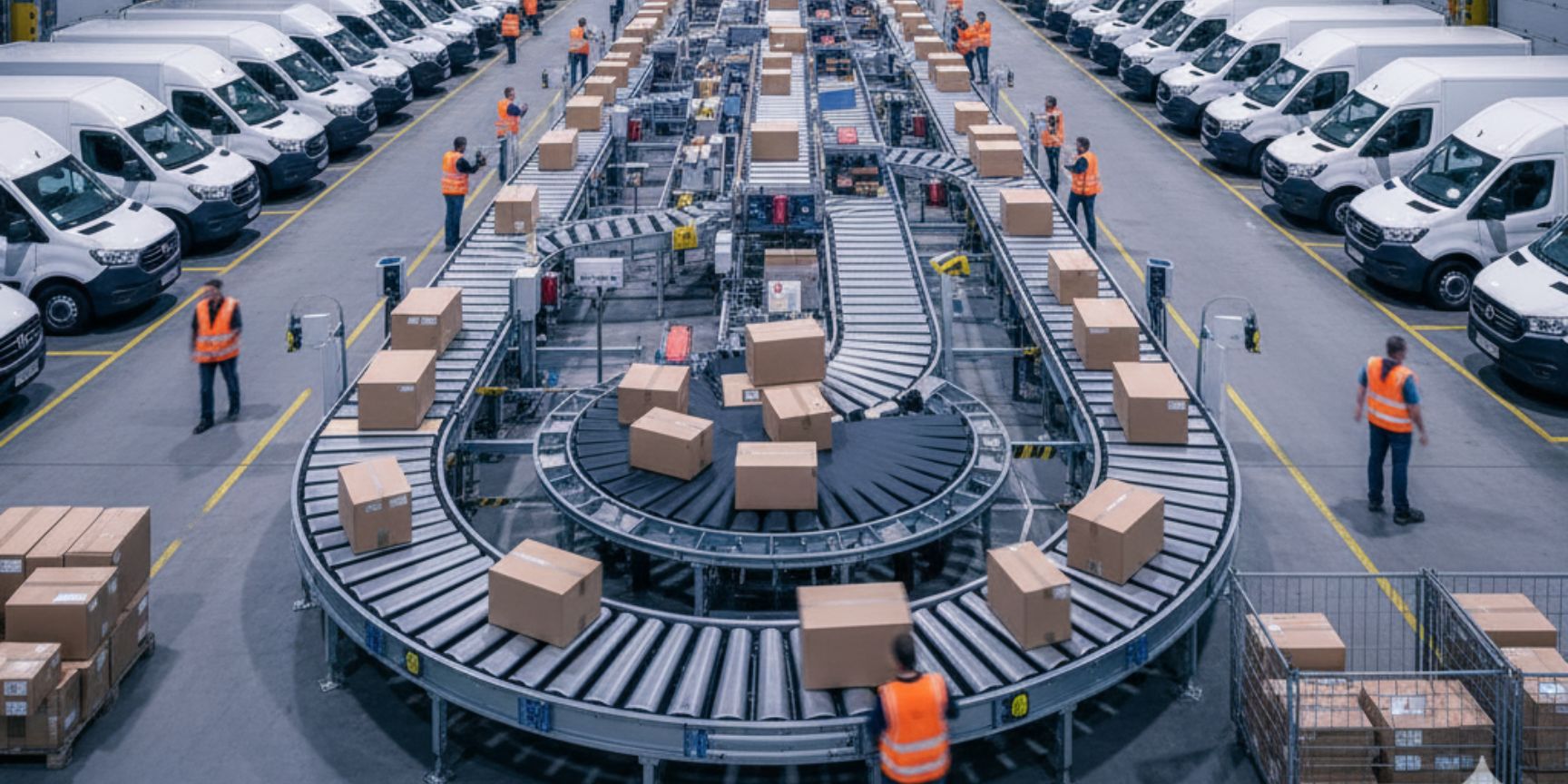
These properties are the backbone of CEP networks and are not used for storage, but for pure transshipment. The shipments arrive at night from the major hubs, are sorted and loaded directly onto the delivery vehicles (the "last mile") in the morning.
- Requirement: The number of goals is decisive. These halls require an extremely high number of gates for vans (so-called vans). Sprinter gates or "van gates"), often in a ratio of 1 door per 100-150 m² of hall space. Classic truck ramp gates (for 40-tonne trucks) are only necessary for goods receipt (long-distance transport).
- Shape: Often "L" or "U" shape (or "comb shape") to realize maximum number of goals in a minimum area.
- Location: Due to the "last mile" orientation, it is imperative to be close to the city (conurbation). This is the biggest conflict factor, as land there is scarce and expensive.
Fulfillment centers (warehouse logistics):
These are the halls from which (contract) logistics companies serve e-commerce.
- Requirement: The ratio of storage space to outgoing goods area is decisive here. While classic warehouses may need 10 truck gates, an e-commerce warehouse also needs a massive CEP loading zone.
- Equipment: Automatic sorting systems (sorters) are often integrated in order to assign the parcels to the CEP service providers. This places high demands on the floor load capacity and the (often expensive) conveyor technology.
- Returns: A massive problem in e-commerce. The logistics property must provide separate space and processes for returns logistics (checking, processing, re-storage), which can often take up 20-30% of the operational space.
FAQ: CEP services in logistics practice
Question: What is the main difference between a CEP parcel center and a contract logistics fulfillment center?
Answer: The dwell time of the goods. In a CEP parcel center (transshipment hall), the dwell time (throughput time) of the shipment is ideally only a few hours (max. < 24 hours) – it is a pure sorting and distribution process. In a fulfillment center, the goods are strategically stored (days, weeks, months), picked and only processed into a CEP package when called.
Question: Why is the "last mile" so expensive and challenging?
Answer: The "last mile" (delivery from the depot to the end customer) is the most personnel- and vehicle-intensive part of the chain. Here, there is no longer bundling (economies of scale), but isolation. Every stop (arrival, parking, ringing, handover) costs time and money. In urban areas, traffic, lack of parking spaces and delivery attempts (recipients not present) exacerbate costs.
Question: What does "brownfield" mean in the context of CEP real estate?
Answer: Since CEP services (see above) absolutely need areas close to the city for their depots, but these are hardly available ("greenfield" = greenfield), they are increasingly switching to "brownfields". These are revitalised brownfield sites, i.e. formerly industrial or commercial properties (e.g. old factory sites) that are being renovated and redeveloped.
Future trends: automation and sustainability
The CEP industry is facing massive challenges: a shortage of drivers, rising costs on the last mile and the call for sustainability. The answers to these questions will continue to change logistics:
- Automation: In the halls, the automation of sorting and picking (e.g. by robotic sorters, AMRs) will continue to increase in order to speed up the processes up to the cut-off time.
- Sustainability: E-vehicles (e-Sprinter) and cargo bikes (cargo bikes) are becoming standard in urban depots.
- Out-of-home delivery: Parcel stations and parcel shops (pick-up points) are gaining in importance as they consolidate the "last mile" for CEP services and reduce expensive doorstep delivery.