



Consignment stock in logistics
Table of Contents
- What is a consignment stock? (Definition and basic principle)
- The core processes in warehouse logistics (WMS & inventory management)
- Questions and answers (FAQ) about the consignment stock
- Consignment in Contract Logistics: The Role of the 3PL Service Provider
- Requirements for the logistics property and hall
- Advantages and disadvantages at a glance
- Legal and accounting pitfalls (in-depth)
- Conclusion: Efficiency gains through partnership risk
What is a consignment stock? (Definition and basic principle)
A consignment warehouse (also known as a supplier warehouse or Konsi warehouse) is a warehouse that a supplier (consignor) sets up and maintains on the company premises or in the immediate vicinity of his customer (consignee).
The essence of this concept lies in the transfer of ownership:
- Storage: The supplier delivers the goods to the consignment warehouse. However, the goods remain completely the property of the supplier.
- Storage: The customer has direct and quick access to the goods as if they were their own inventory.
- Withdrawal: As soon as the customer removes goods from the warehouse (e.g. for his production), he reports this withdrawal.
- Transfer of ownership & payment: Only with this removal does the ownership of the goods pass to the customer. At the same time, the obligation to pay (invoicing) is triggered.
This model is often used for A/B parts with high or steady consumption (e.g. in the automotive industry) or for C-parts (screws, seals) to simplify procurement processes.
The core processes in warehouse logistics (WMS & inventory management)
The operation of a consignment warehouse places high demands on warehouse logistics and especially on IT systems. The mere physical provision of the goods is not sufficient; the flow of information is crucial.
Systemic separation: The warehouse management system (WMS), often referred to as the Warehouse Management System (WMS) in Germany , must be able to physically and systemically separate the consignment stock from the customer's own inventory. It is "third-party inventory" in the customer's books.
Withdrawal Posting (The Trigger): The most critical process is the withdrawal posting. This must take place in real time and automatically trigger two things:
- The consumption report to the supplier (for invoicing).
- The replenishment process.
Replenishment: The consignment stock often goes hand in hand with Vendor Managed Inventory (VMI). In this case, the supplier is responsible for proactively replenishing the stocks in the Konsi warehouse on the basis of consumption data or defined reorder stocks (min/max). The customer no longer has to place orders.
Inventory: The obligation to take inventory remains with the owner (supplier). In practice, however, the inventories are often recorded as part of the customer inventory (as "third-party inventory") or joint cut-off date inventories are contractually agreed.
Questions and answers (FAQ) about the consignment stock
Question: Who owns the goods in the consignment warehouse?
Answer: Always the supplier (consignor). Ownership is only transferred to the customer (consignee) at the moment when the goods are physically removed and the removal is recorded systemically.
Question: Who is liable for the goods (shrinkage, theft, damage)?
Answer: In principle, the owner, i.e. the supplier, is liable. It bears the full risk of the stock, including the risk of obsolescence. However, the consignment contract almost always stipulates a duty of care (diligentia quam in suis rebus) for the customer. Often, the transfer of risk (e.g. in the event of fire or water damage in the customer's warehouse) is also contractually passed on to the customer, which requires appropriate insurance cover with the customer.
Question: How is the portfolio balanced?
Answer: Since the goods are the property of the supplier, the supplier must keep the inventory on his balance sheet (current assets). For the customer, the goods are "balance sheet neutral". This is one of the biggest advantages for the customer, as he massively reduces his capital commitment (cash-to-cash cycle) and reduces his balance sheet total.
Consignment in Contract Logistics: The Role of the 3PL Service Provider
Here, the model is expanded to include a third party. A contract logistics service provider (3PL - Third Party Logistics) takes over the operation of the consignment warehouse as a neutral entity.
This model (also known as service provider consignment stock) solves many classic conflicting goals:
- Neutrality: The 3PL acts as a fiduciary administrator. He manages the inventory for the supplier, but ensures the supply for the customer.
- System expertise: The 3PL comes with its own professional WMS, which is often connected to both the supplier's ERP (for invoicing/replenishment) and the customer's ERP (for demand reporting) via standardized interfaces (EDI/API).
- Personnel & space: The supplier does not have to send his own staff to the customer, and the customer does not have to assign his own staff to "third-party" goods. The 3PL provides the staff and often also the (external) space.
- Value Added Services (VAS): The 3PL can enrich the process, e.g. through pre-assembly, kitting (assembly of kits) or quality controls directly when withdrawing from the Konsi warehouse.
This is an attractive service for the 3PL because it creates a deep interlocking with the processes of both parties (supplier and customer) and is often contractually secured in the long term.
Requirements for the logistics property and hall
A consignment warehouse is not a specific type of construction, but a usage concept. The requirements for the logistics property or hall are derived directly from the process:
In-house warehouse (at the customer's site):
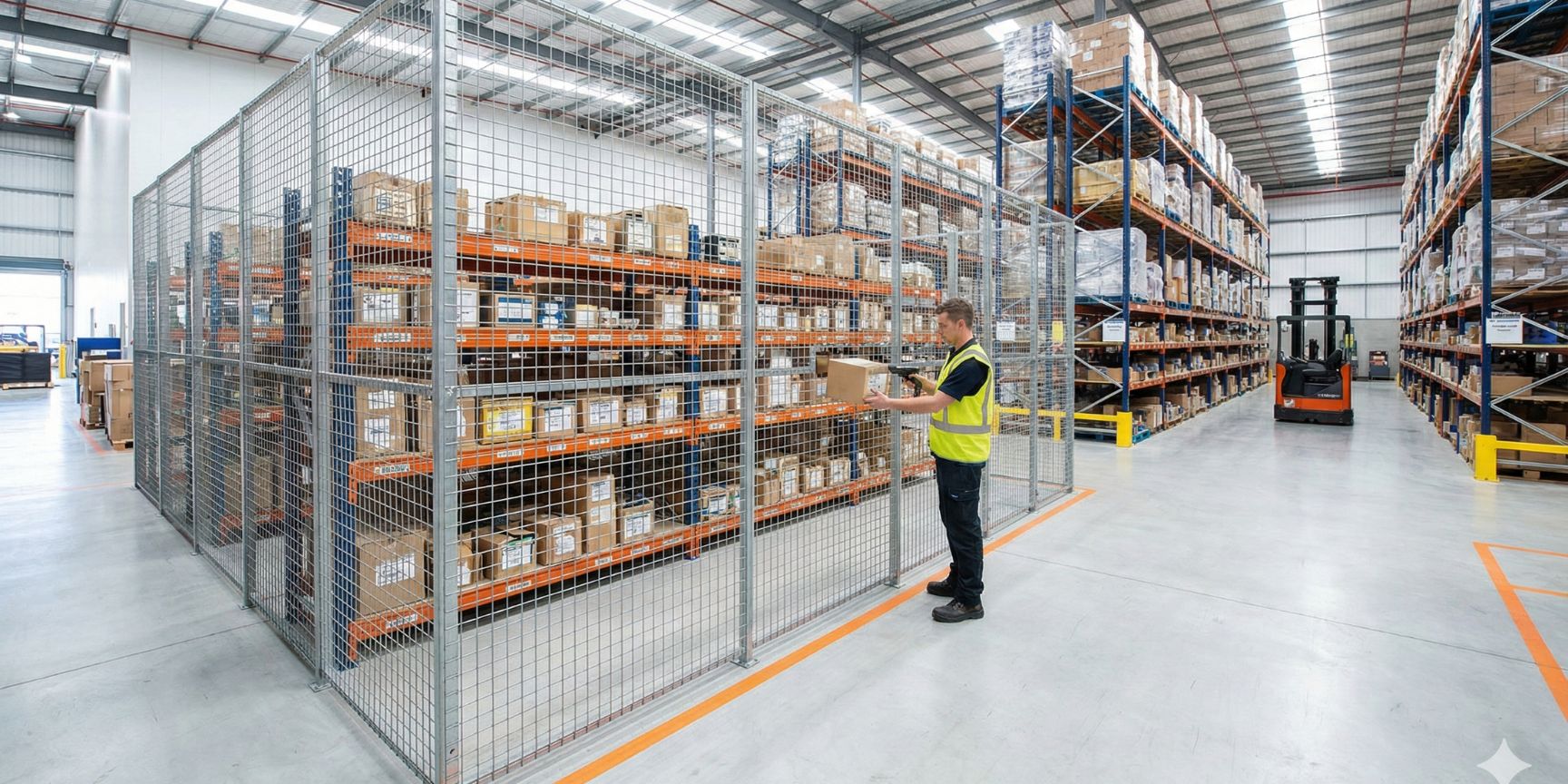
- Physical demarcation: This is the most common form. Part of the customer's production or warehouse is physically separated (e.g. by lattice fences, "cage").
- Access security: It must be clearly regulated (and often technically secured) who has access. The removal must be recorded (e.g. by scanning at the "exit" of the cage).
- Infrastructure: Electricity, data connection (WLAN for MDE scanners) and lighting are required. The requirements (temperature, cleanliness) depend on the product.
External consignment warehouse (close to the customer):
- These are often smaller halls (e.g. 1,000 – 5,000 m²) or multi-user properties operated by a 3PL.
- The focus is on handling efficiency (cross-docking capability) and excellent transport connections to the customer's plant (often "just-in-time" or "just-in-sequence" delivery).
- The service provider often bundles the consignment stocks of several suppliers for a large customer (e.g. an automotive plant).
Advantages and disadvantages at a glance
| Perspective | Advantages | Disadvantages / Risks |
| Customer (Consignee) | Enormous reduction in capital commitment (goods are only paid for when they are used). | Strong commitment to a supplier (vendor lock-in). |
| Maximum security of supply (goods are physically on site). | Space requirements for the storage area must be provided. | |
| Reduced administrative effort (no individual orders). | Possible liability risks (depending on the contract). | |
| Supplier (Consignor) | Strong customer loyalty & long-term sales security. | High capital commitment (finances the portfolio at the customer's site). |
| Better predictability through insight into real-time consumption data. | Full inventory risk (slow sellers, damage, shrinkage). | |
| Possibly lower transport costs (due to optimized loads/full loads). | High IT and process effort (WMS connection, monitoring). |

Legal and accounting pitfalls (in-depth)
The call-off contract is the foundation of the entire model. Verbal or incomplete agreements inevitably lead to conflicts. The following points require special depth:
- Insolvency of the customer: What happens if the customer (consignee) becomes insolvent? The goods are the property of the supplier and do not belong to the insolvency estate. The supplier has a right of segregation. In practice, however, this only works if the goods are clearly labelled as consignment goods (property of the supplier) and systemically recorded.
- Insolvency of the supplier: In this case, the claim (and the inventory) is transferred to the insolvency estate of the supplier. The customer must pay the goods to the insolvency administrator when they are removed.
- VAT (cross-border): In the case of cross-border consignment warehouses (e.g. supplier in Poland, warehouse in Germany), it becomes complex from a tax point of view. Since 2020, the EU has had simplification rules for this ("call-off stock" regulation according to Art. 17a VAT Directive). These allow the supplier not to have to pay tax on the shipment to the warehouse in the destination country immediately as an intra-Community delivery, but only when it is removed by the customer. However, this requires strict documentation and reporting (in the recapitulative statement).
Conclusion: Efficiency gains through partnership risk
The consignment stock is an advanced instrument of supply chain optimization. It shifts the inventory risk and capital commitment almost completely from the customer to the supplier.
It only works on the basis of a deep basis of trust based on partnership and – from a logistical point of view – excellent , error-free IT integration (WMS/ERP). Without automated, clean recording of withdrawals and stocks, the model is an incalculable financial risk for the supplier and an administrative nightmare for the customer. However, if it is operated by a competent contract logistics provider or clean in-house processes, it maximizes security of supply with minimal capital commitment.