




Loading gates in warehouse logistics
Table of contents
- Definition and system components of a loading dock
- Sizing and Standard Dimensions: Facts and Figures
- The perspective of the logistics property: third-party usability
- Technical Subtleties: Dock Levellers and Feed
- Energy efficiency and special solutions (ISO & DOBO)
- Frequently asked questions from practice (Q&A)
- Maintenance and repair (facility management)
- Conclusion: The goal as the eye of the needle
Definition and system components of a loading dock
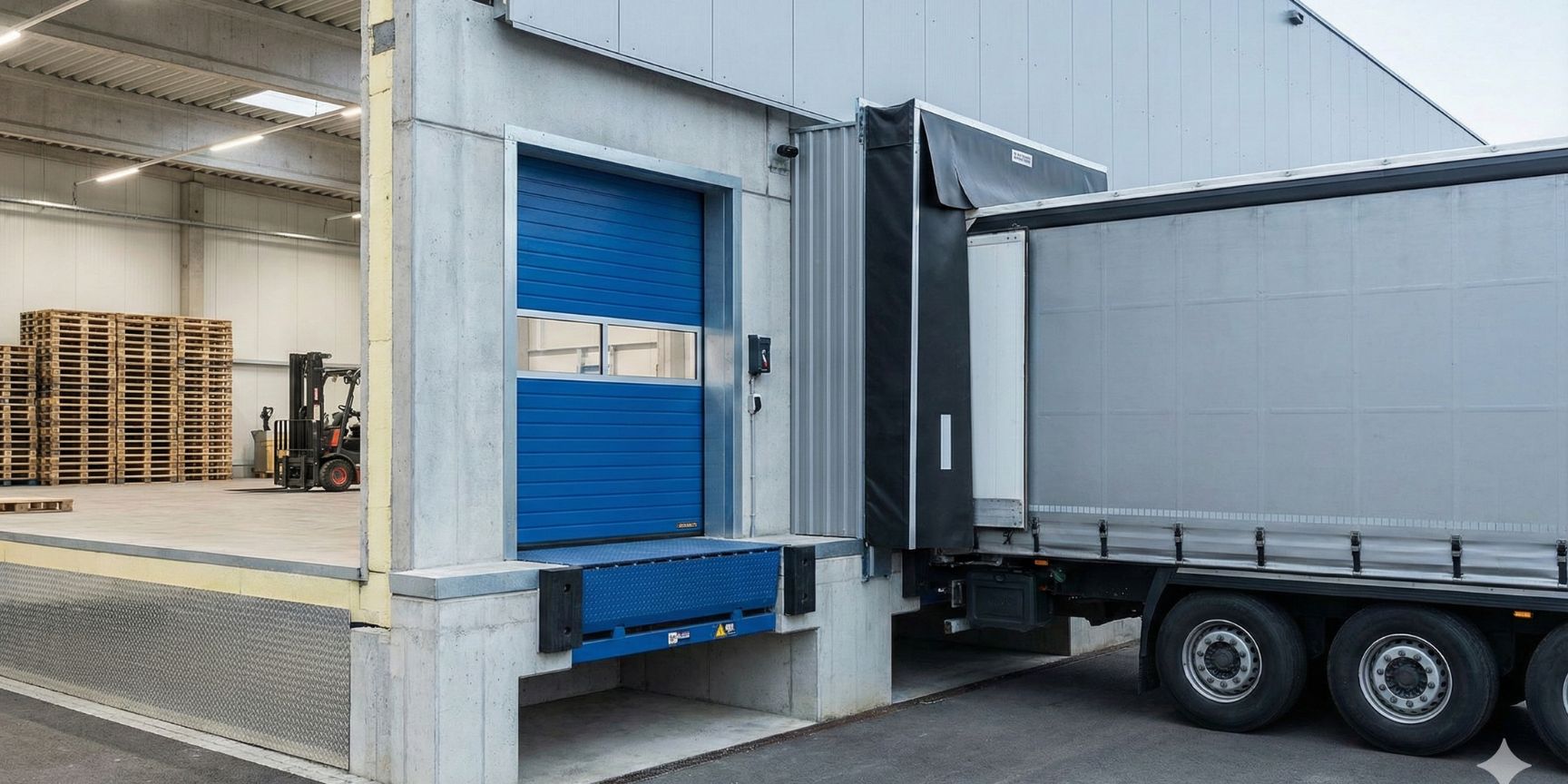
In technical parlance, the "loading gate" is rarely considered in isolation. It is part of a complete loading bay. For investors, contract logistics providers and planners, understanding the interaction of the three main components is essential:
- The industrial door (sectional door): Usually designed as a sectional ceiling door, it opens vertically upwards. This saves space in front of and behind the goal. Modern doors in cold stores have panel thicknesses of up to 80 mm for high insulation (U-value).
- Dock Leveller: It bridges the difference in height and the gap between the hall floor (ramp height) and the truck loading area.
- The dock shelter: It encloses the rear of the docking truck, protects against the weather and minimizes energy losses.
Only when these three components are synchronized is it called a high-performance loading dock.
Sizing and Standard Dimensions: Facts and Figures
The design of loading gates does not tolerate errors, as subsequent changes to the reinforced concrete structure of a hall are extremely costly. The following standards have become established in European logistics:
- Door width: The standard dimension is 3,000 mm. This offers enough room for a truck (approx. 2,550 mm wide), even if it does not dock perfectly in the middle.
- Door height: 3,000 mm to 3,200 mm are common. This covers the standard Euro trailer. For jumbo vehicles or double-decker traffic, higher doors (up to 4,500 mm) are often required.
- Ramp height: The standard height of the ramp (hall floor above the outer courtyard) is usually 1,200 mm.
- Important: A slope in the outdoor area ("docking yard") towards the ramp should not exceed 4% in order to avoid the truck touching down or problems with loading and unloading with industrial trucks.
The perspective of the logistics property: third-party usability
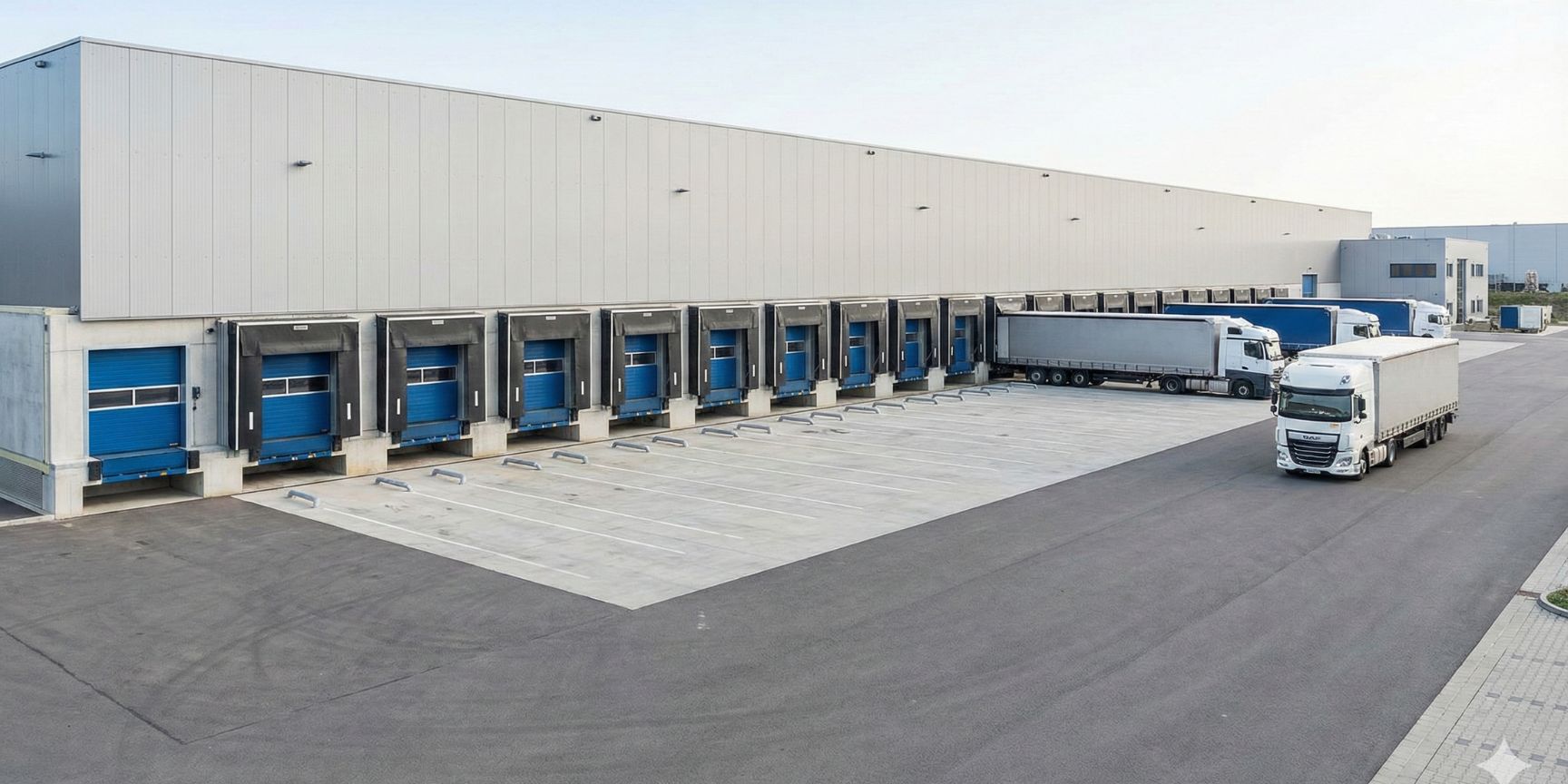
For developers and investors of logistics real estate, the number of gates is a decisive value factor. A building is considered "fungible" if it can be used for various logistics concepts.
The rule of thumb applies here:
1 loading door per 850 to 1,000 m² of hall space.
A 10,000 m² standard logistics hall should therefore have about 10 to 12 doors.
- Cross-docking systems: Here, the rate is significantly higher, often 1 door per 300 to 500 m², as goods are passed directly from goods receipt to goods issue without long storage.
- Mezzanine levels: If mezzanines are installed, it must be checked whether the number of gates is still sufficient for the increased storage volume in order to avoid bottlenecks in the outgoing goods department.
Technical Subtleties: Dock Levellers and Feed
The choice of dock leveller determines which vehicles can be handled. There are two main technologies:
- Swing Lip: The standard. A lip folds out and lies down on the truck. Cost-effective and robust.
- Telescopic Lip: Here, the lip extends continuously.
- Advantage: More precise positioning. Absolutely necessary when trucks are fully loaded up to the loading sill, otherwise the folding wedge would damage the goods. They also offer a longer range for large differences in altitude.
The dynamic load capacity of a standard bridge is usually 60 kN (6 tonnes), which is sufficient for most forklift trucks.
Energy efficiency and special solutions (ISO & DOBO)
In times of ESG criteria (environmental, social, governance) and rising energy costs, the tightness of doors is coming into focus.
- ISO loading points: In this case, the dock leveller is not installed in the hall, but in front of the hall in an attachment house. The hall door thus closes on the insulated hall floor. There are no thermal bridges due to the steel structure of the bridge.
- DOBO system (Docking Before Opening): Particularly important for temperature-controlled logistics (cold chains) and customs goods. The truck docks to the ramp with the truck doors closed. Only when the seal is completely established are the hall doors opened and only then the truck doors (often through special recesses in the ramp).
Frequently asked questions from practice (Q&A)
Here we answer questions that often arise in the day-to-day operations of contract logistics and facility management.
Question: What is the difference between a niche and a tarpaulin dock seal?
Answer: Curtains are the standard and can be flexibly adapted to different truck sizes. The latter are more expensive, but offer an almost airtight connection – ideal for deep-freeze warehouses to prevent icing and energy loss.
Question: Which safety systems are mandatory or "best practice" at loading gates today?
Answer: In addition to the legal regulations (e.g. emergency stop), immobilizers and traffic light systems are increasingly becoming established. Automatic wheel chocks, which are coupled with the gate control, prevent a truck from leaving the ramp while loading is still in progress (protection against rolling away accidents).
Question: How much space does a truck need in front of the gate (courtyard depth)?
Answer: The guideline in real estate development is 32 to 35 meters deep for the loading yard. This enables a standard truck (16.5m or 18.75m as a Giga-Liner) to dock and undock quickly without multiple manoeuvring.
Maintenance and repair (facility management)
Loading gates are moving components with high mechanical loads.
- UVV inspection: In Germany, an annual safety inspection in accordance with ASR A1.7 is mandatory.
- Wear parts: Especially the side sealing rubbers, the hydraulic hoses of the bridges and the sectional rollers of the doors are subject to high wear.
- Collision protection: Massive buffers (rubber buffers or movable steel buffers) on the outer façade are essential to absorb the kinetic energy of the docking truck (approx. 40 tonnes) and to prevent damage to the building.
Conclusion: The goal as the eye of the needle
For logistics real estate, the loading gate is the bottleneck of the value chain. Too little throughput due to defective technology, incorrect dimensioning (e.g. no moving bridges for fully loaded trucks) or a lack of numbers leads to downtime and inefficiency in contract logistics.
When planning or renting a hall, the focus should therefore not only be on the number of square meters, but also on the specification of the "loading bays". Modern ISO concepts and digital controls (linked to the warehouse management system) raise the standard today far beyond the simple "roller shutter".