




Lean Warehousing or lean storage called
Table of contents
What does lean warehousing mean in concrete terms?
Lean warehousing transfers the lean management principles originating from automotive production to warehouse logistics. The primary goal is to eliminate the "Seven Types of Waste" (Muda), which are reinterpreted in the warehouse context:
- Overproduction: Storage of goods that are not immediately needed and tie up capital.
- Waiting times: Downtime of employees or industrial trucks, e.g. when receiving or issuing goods.
- Unnecessary transports: Inefficient routing and unnecessary movement of goods within the warehouse.
- Wrong process steps: Processes that are too complex or cumbersome and do not add value.
- Overstocking: Inventory that exceeds actual demand unnecessarily ties up capital and storage capacity and increases the risk of depreciation due to obsolescence or shrinkage.
- Inefficient movement sequences: A lack of ergonomics at the workplace as well as a non-process-oriented arrangement of storage zones force employees to walk and reach superfluously.
- Errors and rework: Incorrectly picked orders or damage that require expensive corrective action.
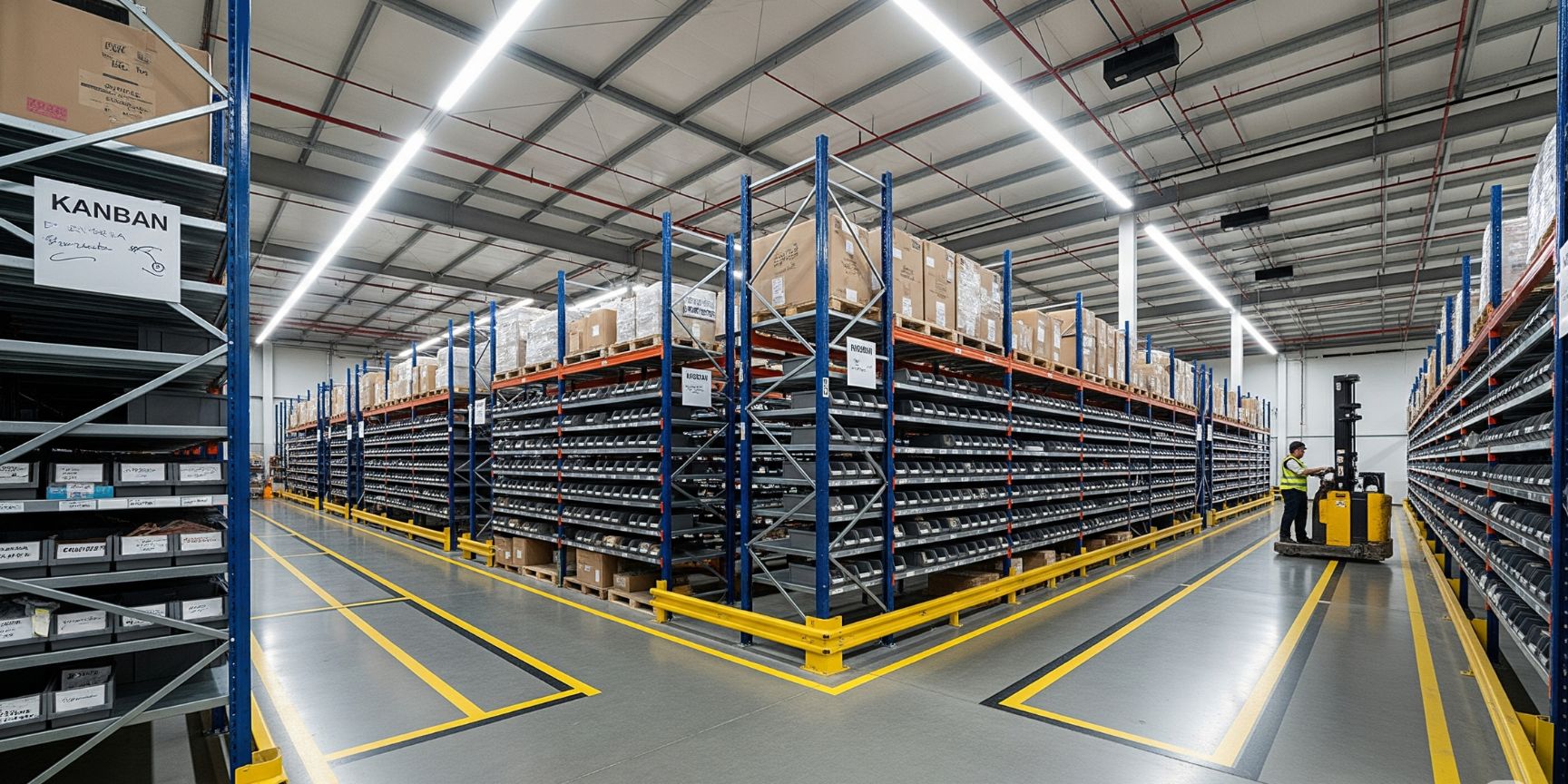
Through the consistent application of lean methods such as the 5S methodology (sorting, systematizing, cleaning, standardizing, self-discipline), Kanban to control the flow of materials or Kaizen (continuous improvement process), the warehouse becomes a synchronized and highly efficient organism.
The role of logistics real estate in the lean context
A logistics property is not just a shell, but a decisive factor for the success of lean warehousing. The layout, equipment and infrastructure of the hall must actively support the lean principles.
- Layout and material flow: A lean-optimized warehouse layout is characterized by short distances, clear structures and a flow-oriented arrangement. Areas for incoming goods, quality control, picking, packaging and outgoing goods are arranged in such a way as to avoid unnecessary transport and cross-traffic. A U-shaped arrangement (U-layout) is often ideal because it positions the entrance and exit close to each other and allows for flexible use of resources.
- Flexibility and scalability: The property must be able to adapt to changing requirements. Modular designs, flexible partition walls and a sufficient ceiling height for the use of modern shelving systems (e.g. mobile racking or automated small parts warehouses) are crucial here.
- Technical building equipment (TGA): Intelligent building services, such as needs-based LED lighting or efficient heating and ventilation technology, not only reduces operating costs, but also contributes to process reliability and employee satisfaction – an often underestimated aspect of the lean concept.
Visual management as the key to transparency
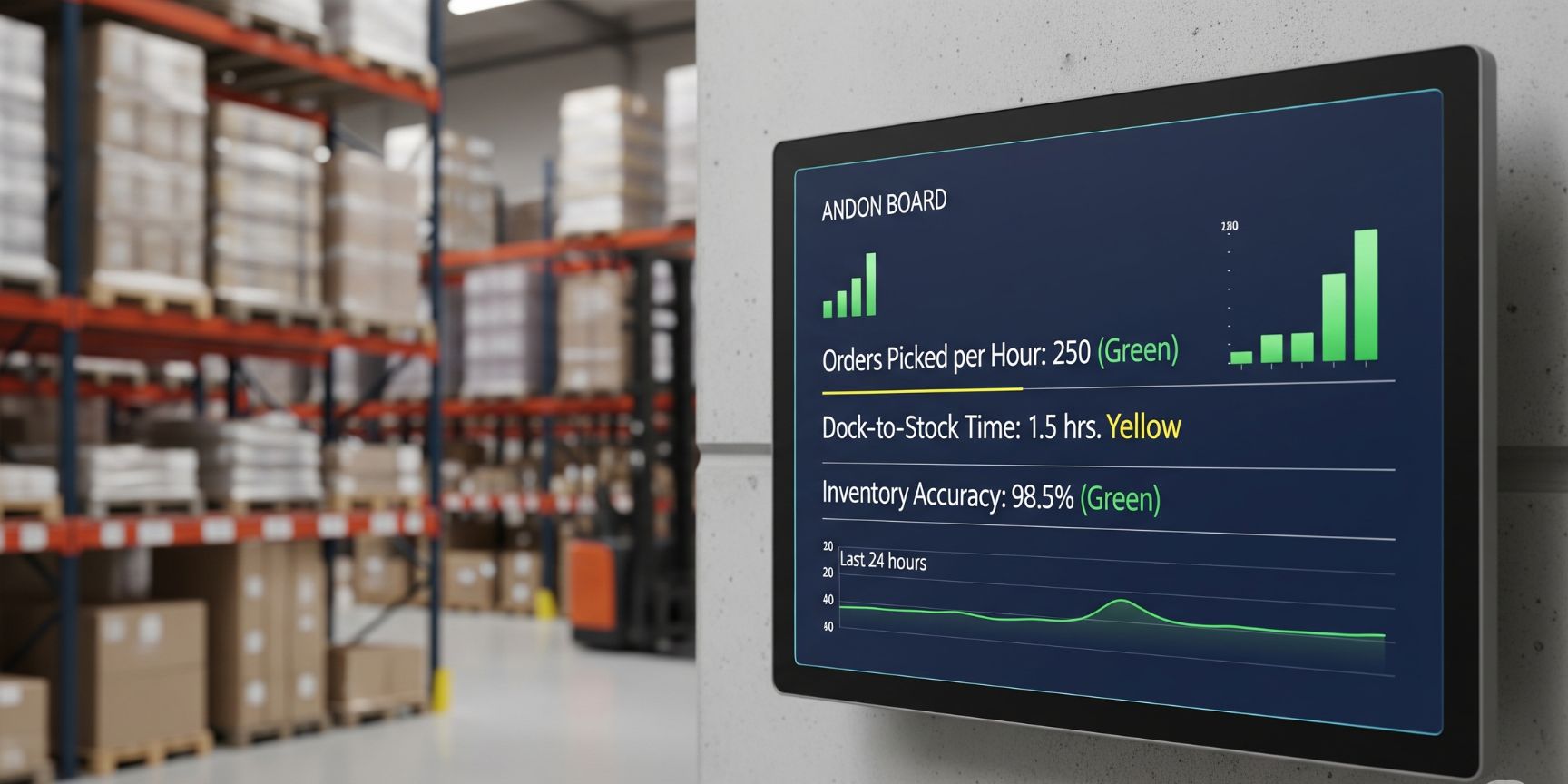
A central element of lean warehousing is visual management. In order to ensure transparency throughout the warehouse, process-relevant data, inventory information and important key figures must be accessible and easily understandable for the entire workforce at all times. This creates transparency, promotes personal responsibility and enables a quick reaction to deviations.
- Floor markings: Colour markings for driveways, storage zones, staging areas and hazardous areas ensure order and safety.
- Andon boards: At central points in the warehouse, these boards visualize the current status of orders or signal faults in real time.
- Key figure dashboards: Clear displays of key performance indicators (KPIs) such as pick performance, throughput times or error rates help to track the achievement of goals.
- Shadow boards: Dedicated and visualized locations for each tool eliminate search times and keep the workspace systematically organized.
People at the heart of the lean process
Lean warehousing is not a purely technical or procedural change; it is a cultural change. The employees are the decisive factor for success. Their involvement, training and motivation are essential.
The Kaizen idea, continuous improvement in small steps, thrives on the commitment of the employees on site. They are the experts in their processes and recognize waste the fastest. Through regular team meetings (shop floor management), an established suggestion system and the transfer of responsibility, employees become active shapers of the improvement process. The creation of ergonomic working conditions and the targeted reduction of physical strain not only promotes the well-being and satisfaction of employees, but also increases productivity while at the same time reducing absences due to illness.
Technology use in the lean warehouse
The use of modern technologies does not contradict the principles of lean warehousing; rather, both approaches create ideal synergies in combination. Digitalization supports lean principles by providing transparency and automating processes.
- Warehouse Management System (WMS): A modern WMS is the brain of the Lean Warehouse. It optimises storage strategies (e.g. chaotic warehousing), controls the picking processes in a route-optimised manner and enables paperless processing.
- Automation: Partially or fully automated solutions such as automated guided vehicles (AGVs), picking robots or automatic palletizers reduce manual activities, minimize errors and ensure a smooth, plannable material flow – in line with the "just-in-time" principle.
- Pick-by technologies: By using systems such as pick-by-voice, pick-by-light or pick-by-vision, warehouse employees are precisely guided through the picking process, resulting in a significant reduction in the error rate and an increase in overall efficiency
Implementation: A strategic process
The implementation of lean warehousing should not be understood as a one-off project, but as an ongoing process of continuous improvement. It requires a clear strategy, management support, and a willingness to change across the organization. The process typically begins with value stream mapping, where all current processes are recorded and analyzed in detail to identify potential waste. Based on this analysis, pilot projects will be launched in defined areas. The experience and successes gained there serve as the basis for the company-wide roll-out. It is important to make successes visible and to establish a culture in which mistakes are seen as an opportunity for improvement.