




Liquid Storage
Table of contents
- Definition and demarcation: What does "liquid storage" mean in logistics?
- The logistics property: structural requirements and WHG
- Warehouse logistics and handling: IBCs, drums and tanks
- Contract Logistics: Outsourcing Complexity
- Legal guardrails: TRGS 510 and AwSV
- Questions and answers (Q&A) for practice
- Key figures and data for orientation
- Conclusion: The niche as a growth driver
Definition and Demarcation: What does "Liquid Storage" mean in Logistics?
Liquid storage includes the storage of substances that are present at room temperature in a liquid aggregate state. In logistics, we basically differentiate between bulk storage (in large tanks or silos) and container-based storage (in drums, canisters or intermediate bulk containers – IBC).
While bulk logistics is often directly attached to production sites, container-based storage usually takes place in specialized logistics centers. Here, the requirements of classic warehouse logistics overlap with chemicals law and environmental protection. Especially in the field of contract logistics, expertise in dealing with viscosity, density and chemical reactivity is a decisive unique selling point.
The Logistics Property: Structural Requirements and WHG
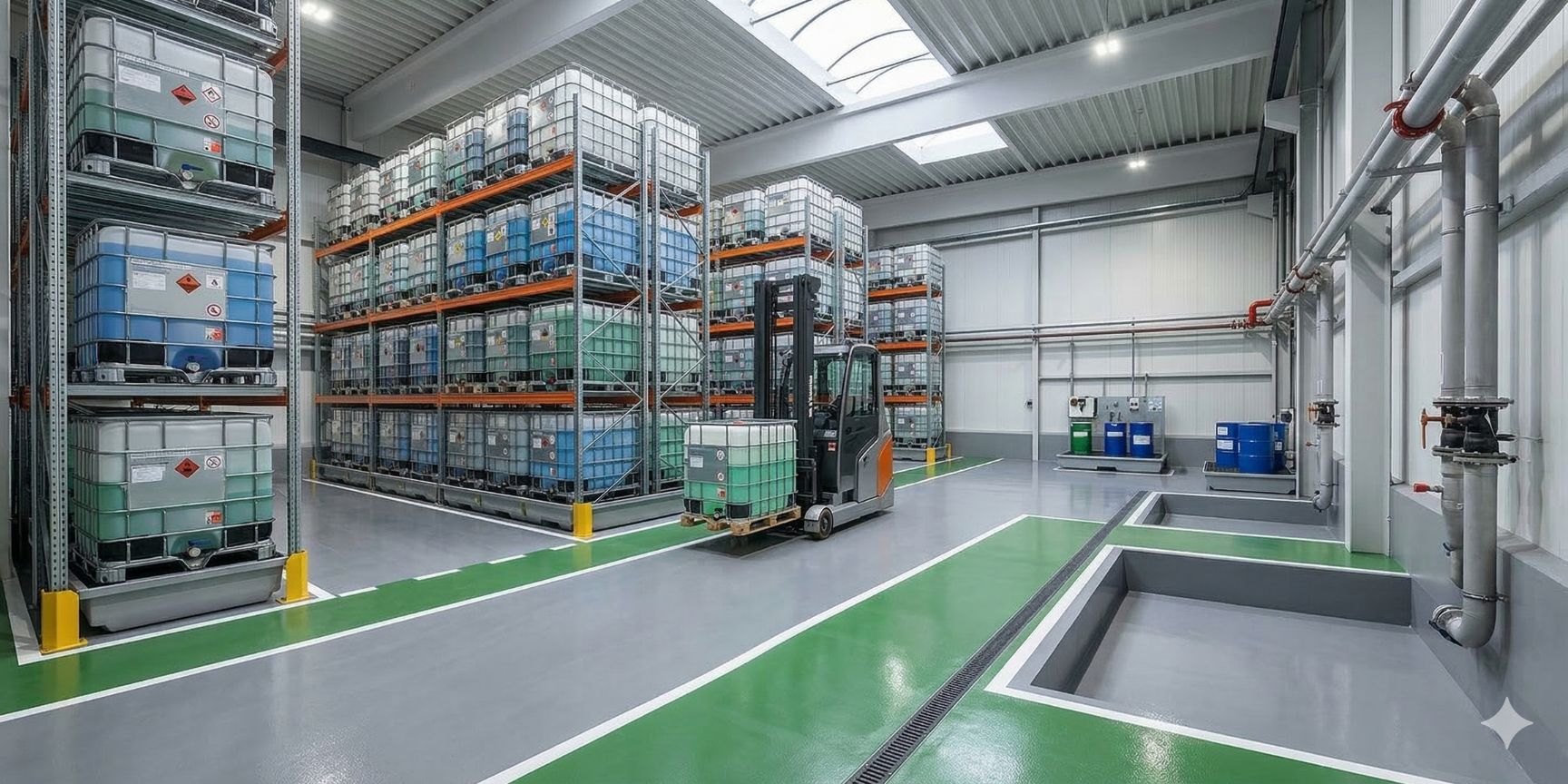
A hall for liquid goods is much more than a standard steel construction. The central set of rules in Germany is the Water Resources Act (WHG).
- Tightness and coating: The floor must act as a "drip pan". This is achieved through specialized WHG coatings (epoxy resin systems) that prevent leaking liquids from entering the groundwater.
- Fire detection and extinguishing technology: Liquids are often flammable. Conventional sprinkler systems are often not sufficient here. Instead, foam extinguishing systems or CO2 extinguishing systems are used.
- Storage sections: In order to minimise the risk of fire, halls are divided into fire compartments, which are separated by fire protection gates and fire walls.
Warehouse Logistics and Handling: IBCs, Drums and Tanks
In daily practice, the IBC (1,000 litres) dominates. Its advantages lie in its stackability and easy handling by industrial trucks.
- Shelving systems: Wide aisle or flow racks are often used. In the case of hazardous liquids, the shelves often have to be equipped with gratings and drip trays underneath.
- Temperature control: Many liquids (e.g. adhesives, food oils or pharmaceutical raw materials) require a constant storage temperature. Heated or cooled storage zones are used here to prevent viscosity changes.
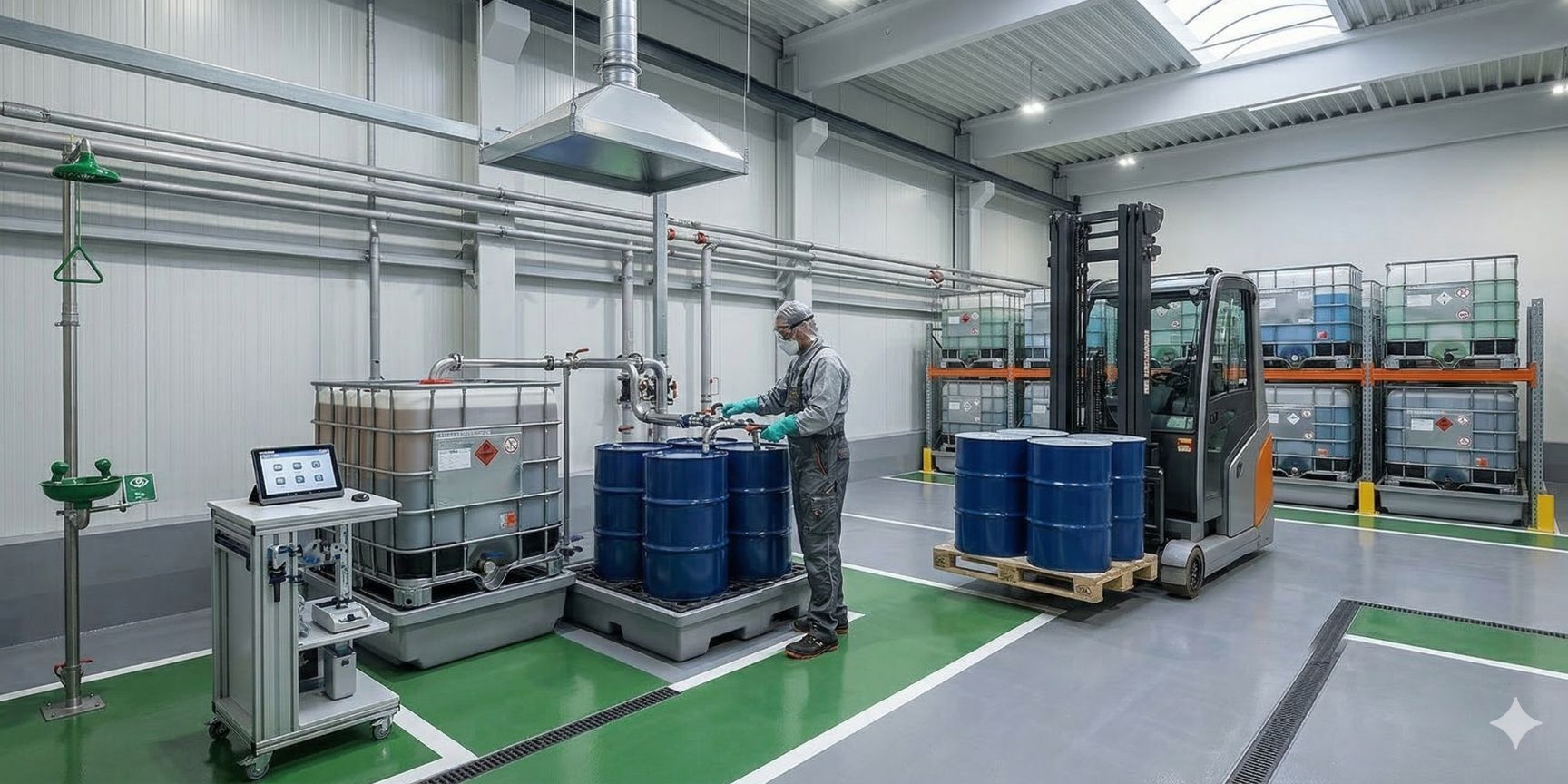
- Filling and decanting: Value Added Services (VAS) are a significant part of liquid logistics. The transfer of tankers into IBCs or filling them into small containers requires special explosion protection zones.
Contract Logistics: Outsourcing Complexity
Many manufacturing companies outsource liquid storage to contract logistics companies. The reason: The approval procedures according to BImSchG (Federal Immission Control Act) are lengthy and expensive. A specialized logistics service provider not only takes care of physical storage, but also:
- Dangerous Goods Management: Ensuring correct shipping.
- Batch tracking: Complete documentation, especially important in the food and chemical industries.
- Liability management: assumption of risk within the framework of the legal regulations.
Legal Guardrails: TRGS 510 and AwSV
Anyone who stores liquids moves in a dense network of regulations. TRGS 510 (Technical Rules for Hazardous Substances) regulates the storage of hazardous substances in transportable containers. The AwSV (Ordinance on Installations for the Handling of Water-Polluting Substances) defines how plants must be designed to guarantee the protection of waters.
Important fact: From a storage quantity of more than 225 litres of water-polluting liquid, specific requirements for retention (collection volume) already apply.
Questions and Answers (Q&A) for Practice
Question: How do you calculate the required collection volume in a hall?
Answer: As a rule of thumb, the drip pan must be able to hold the contents of the largest container (at least 100%) and at least 10% of the total storage capacity. In water protection areas, stricter rules often apply (100% of the total amount).
Question: Can different liquids be stored together?
Answer: Only in compliance with the prohibitions on joint storage in accordance with TRGS 510. Acids and alkalis, for example, must never be stored together in the same drip pan, as there is a risk of dangerous chemical reactions in the event of a leak.
Question: What role does viscosity play in warehouse logistics?
Answer: A decisive one. Highly viscous materials (viscous) often require heated bearings or "drum heaters" in winter to remain flowable. Low-viscosity materials, on the other hand, tend to spread quickly in the event of leaks, which places higher demands on the barriers (insulation systems).
Key Figures and Data for Orientation
| Parameters | Guideline / Info |
| Standard IBC Volume | 1,000 litres (corresponds to approx. 1.2 t depending on density) |
| Soil load | Often > 7.5 t/m² due to the high point loads of stacked liquids |
| WHG specialist company obligation | Obligation for installation and maintenance from hazard level B/C |
| Investment costs | A WHG-compliant indoor space is approx. 25–40% more expensive than a standard logistics space |
Conclusion: The Niche as a Growth Driver
Liquid storage is not a "commodity business". The combination of specialized real estate hardware (drip trays, extinguishing technology) and procedural know-how (dangerous goods law, viscosity management) makes it a highly attractive field for contract logistics. Companies that invest here secure barriers to market entry against the competition, as regulatory requirements and construction costs make it difficult for newcomers to scale quickly.