



LEED in Logistics
Table of Contents
- LEED in Logistics: The Global Benchmark for Green Supply Chain Real Estate
- What is LEED? Basics and scoring system
- The six central evaluation categories in logistics practice
- Special features of logistics real estate and hall construction
- LEED from the perspective of contract logistics and users
- Costs vs. benefits: Is it worth the effort?
- LEED compared to DGNB and BREEAM
- The challenge of "brownfield" and revitalization
- Conclusion and outlook
LEED in Logistics: The Global Benchmark for Green Supply Chain Real Estate
Sustainability in logistics has long since ceased to be a mere image cultivation, but a decisive competitive factor for investors, project developers and contract logistics companies. The LEED classification system, developed by the U.S. Green Building Council (USGBC), is one of the world's most transparent and sophisticated rating systems. But what does certification mean in concrete terms for a 40,000 m² warehouse or distribution center? This article sheds light on the depth of the system with a focus on the asset class logistics.
What is LEED? Basics and scoring system
LEED stands for "Leadership in Energy and Environmental Design". It is a voluntary certification system that defines standards for environmentally friendly, resource-saving and sustainable construction. In contrast to pure energy certificates, LEED considers the entire life cycle and performance of a property.
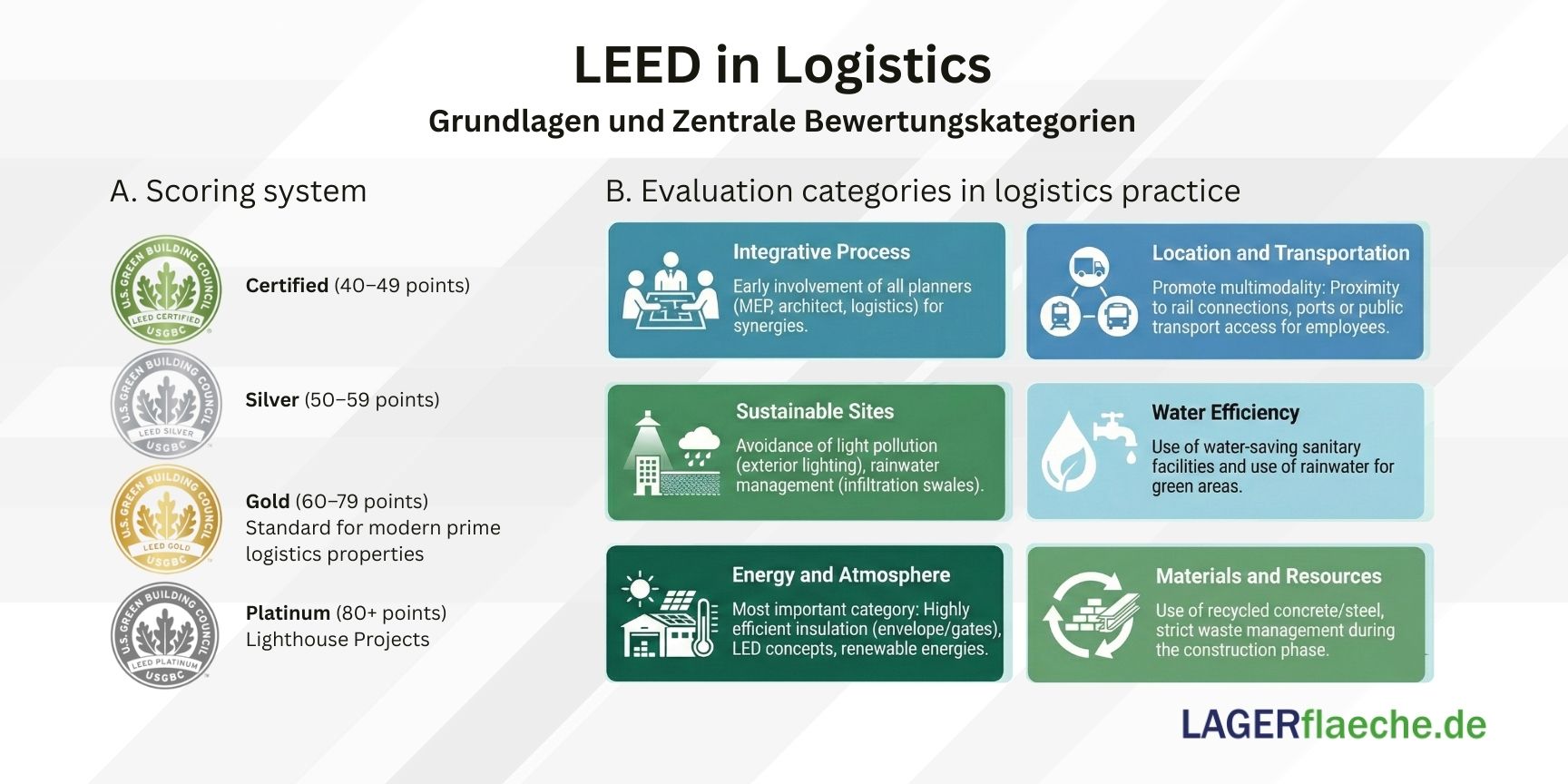
The evaluation is based on a point system (credits). Depending on the number of points achieved (maximum 110 points possible), one of four statuses is awarded:
- Certified: 40–49 points
- Silver: 50–59 points
- Gold (Gold): 60–79 points (The standard for modern prime logistics properties)
- Platinum (Platinum): 80+ points (lighthouse projects)
Question & Answer:
Is LEED only relevant for new buildings? No. Although the LEED BD+C (Building Design and Construction) system is best known for new buildings, LEED O+M (Operations and Maintenance) is just as important for logistics. It certifies the ongoing operation and maintenance of existing halls – a decisive factor for asset managers.
The six central evaluation categories in logistics practice
To understand the depth of certification, one must apply the criteria to the specific construction method of logistics real estate (large roof areas, high sealing, traffic volume):
- Integrative process: Early involvement of all planners (building services, architect, logistics planner).
- Location and transportation: Here, the logistics property scores with its multimodality. Proximity to railway sidings, inland ports or public transport connections for warehouse employees earns points.
- Sustainable sites: Prevention of light pollution through outdoor lighting at the loading yard and rainwater management (infiltration troughs instead of sewer system).
- Water Efficiency: Use of water-saving sanitary facilities for drivers and warehouse staff as well as the use of rainwater for green spaces.
- Energy and Atmosphere: The most important category. This involves the insulation values of the shell, LED lighting concepts and the use of renewable energies.
- Materials and Resources: Use of recycled concrete or steel and strict waste management during the construction phase.
Special features of logistics real estate and hall construction
In contrast to office towers, logistics centers have specific physical properties that influence LEED both positively and negatively.
The roof area as a power plant
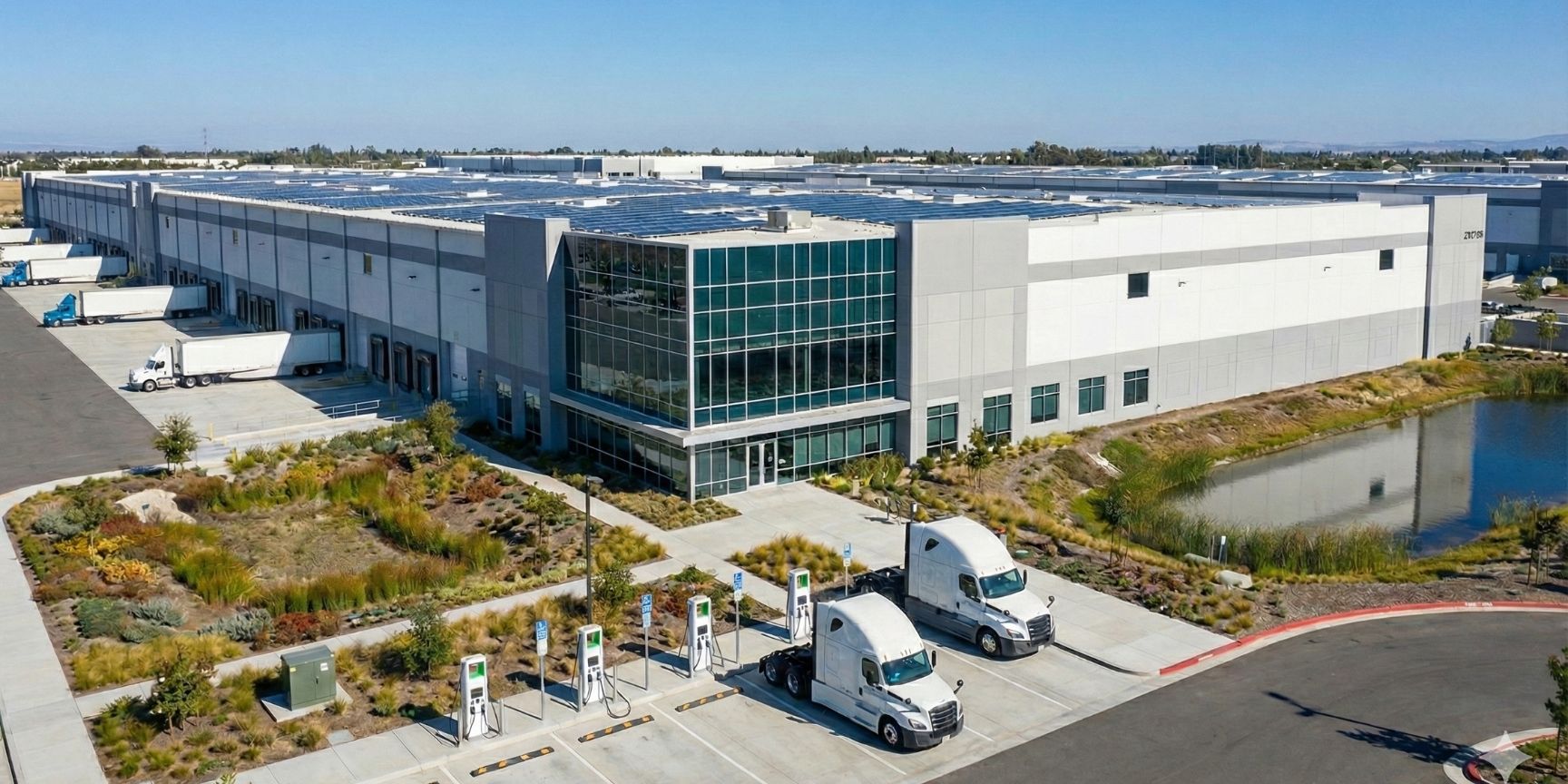
A logistics property often offers tens of thousands of square meters of roof space. For LEED credits in the field of "renewable energies", the installation of photovoltaic (PV) systems is almost mandatory. A full occupancy of the roof can provide significant points for gold or platinum status and at the same time reduce operating costs (OpEx) for the tenant (e.g. the contract logistics provider).
Thermal envelope and gates
Industrial doors (loading ramps) are classic thermal bridges. LEED requires highly efficient seals and high-speed doors to minimize energy losses. The radiant heaters or heat pump systems in the hall are also rigorously evaluated.
LEED from the perspective of contract logistics and users
For the tenant (the logistics service provider), the certificate may initially seem like a pure owner's trophy. But operationally, it has massive effects:
- Ancillary costs: A LEED Platinum hall consumes significantly less energy for lighting and heating. In times of volatile energy prices, this is a direct competitive advantage in the calculation of inventory rates.
- Indoor Environmental Quality: LEED assesses air quality (low-emitting materials for floor coatings and paints) and thermal well-being. In an industry with a shortage of skilled workers, a healthy working environment in the warehouse is an argument in recruiting.
- Corporate Social Responsibility (CSR): Large shippers (customers of logistics companies) are increasingly demanding CO2-neutral supply chains. A LEED-certified distribution center contributes directly to the customer's carbon footprint.
Costs vs. benefits: Is it worth the effort?
Critics often complain about the high certification costs (documentation, auditors, fees to the USGBC).
Facts & Figures: Studies show that the construction costs for a Green Building certified property are about 1% to 5% higher than for conventional buildings. On the other hand, however, there are:
- Higher rental income: "Green Premium" for rentals.
- Value stability: Avoidance of the "brown discount" (loss of value of unrenovated buildings).
- Exit strategy: Institutional investors and funds are often obliged by the EU taxonomy to invest only in sustainable assets. A logistics property without a certificate will be more difficult to sell in the future.
Question & Answer:
How long does the process take? The process runs parallel to the planning and construction phase. The final certification takes place after completion and review of the submitted documents by the GBCI (Green Business Certification Inc.). This can take several months after building acceptance.
LEED compared to DGNB and BREEAM
Why should you choose the US LEED system when there is the DGNB (German Sustainable Building Council) in Germany?
- LEED (USA): Most widespread worldwide. Ideal for international portfolios (e.g. Pan-European Logistics Funds), as globally comparable. Strong focus on energy efficiency.
- DGNB (Germany): Takes an even closer look at economic quality (life cycle costs) and socio-cultural aspects. Considered technically very demanding ("thoroughness"), but is less known internationally than LEED.
- BREEAM (UK): The oldest system, very widespread in Europe.
For international logistics REITs (Real Estate Investment Trusts), LEED is often the first choice to ensure the comparability of assets in the USA, Asia and Europe.
The challenge of "brownfield" and revitalization
A particularly exciting field for LEED is logistics on brownfields. Since land sealing is a critical issue in Germany, LEED massively rewards the use of already sealed areas. When an old industrial site is renovated and converted into a modern logistics park, there are high scores in the "Sustainable Sites" category. This promotes the circular economy in land management and reduces the consumption of arable land ("greenfield").
Conclusion and outlook
LEED is no longer a "nice-to-have" in the logistics real estate industry, but is becoming the market standard ("license to operate"). While silver used to suffice, gold is now the standard for core real estate.
The future lies in LEED Zero. This extension certifies net-zero targets (Carbon, Energy, Water, Waste). For logistics properties, this means that the hall of the future is not only energy-saving, but also energy-producing and completely CO2-neutral in operation. Anyone planning today should already anticipate these standards in order to avoid stranded assets.
Your Ideal Logistics Warehouse
Browse listings for warehouse space, logistics real estate, industrial land, and contract logistics solutions.
Browse Exposés
Maximize Exposure for Your Warehouse Space
Showcase your logistics properties and attract qualified inquiries.
Discover Products