



Labelling in the warehouse
Table of Contents
- Labelling: Definition and basic functions in logistics
- The Core Processes: Labeling in Warehouse Logistics
- Identification technologies: barcode, RFID and their areas of application
- Focus on Contract Logistics: Labeling as a Value-Added Service (VAS)
- The logistics property as an "enabler" for labeling processes
- Practical check: Important questions (Q&A) about labeling
- The Future of Labeling: From Static Code to Digital Product Passport
Labelling: Definition and basic functions in logistics
Labelling (or marking) is the application of information carriers (labels) to products, packaging or load units (such as pallets or cartons). These labels are used for clear identification, the transfer of information and the control of processes.
In logistics, a distinction must be made between two main functions of labelling:
- Product and legal compliance: These labels inform the end customer and meet legal requirements (e.g. ingredients for food, CE marking for electronics, dangerous goods labelling according to ADR/GHS).
- Logistical control: These labels are intended for the internal and external flow of goods. They contain machine-readable codes (such as barcodes or QR codes) and plain text information that is processed by warehouse management systems (WMS) and transport management systems (TMS).
For specialist portals in the field of logistics real estate and contract logistics, the second function – logistical control – is of crucial importance, as it directly influences the efficiency, accuracy and automation of processes.
The Core Processes: Labeling in Warehouse Logistics
A warehouse (whether in a distribution property or a production hall) cannot be operated efficiently without precise labeling. Marking is the key to "orchestration" by the warehouse management system (WMS).
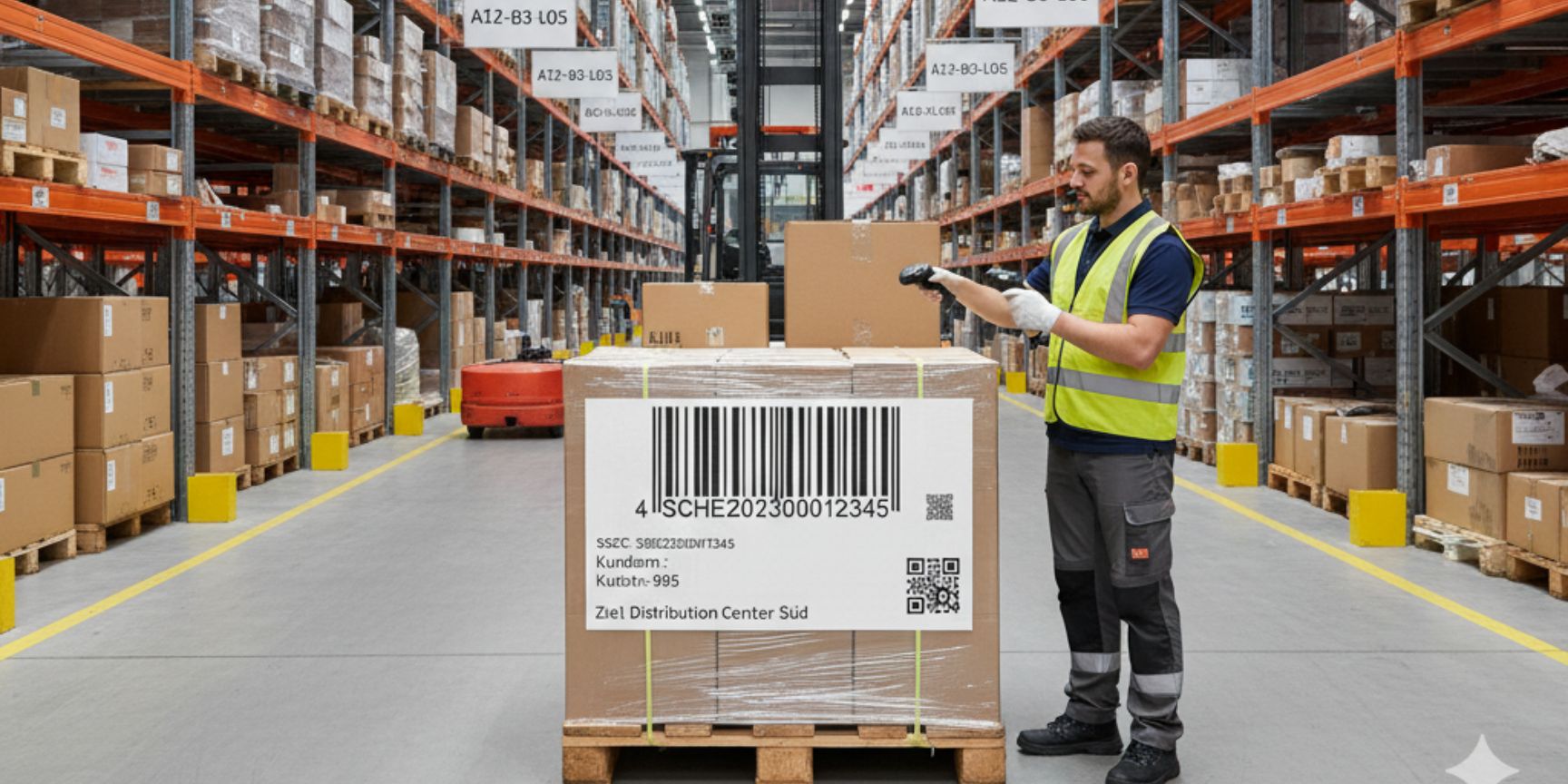
- Incoming goods: This is where the goods get their "logistical face". Incoming pallets or packages are scanned (if already labeled by the supplier, e.g. via NVE/SSCC) or receive an internal goods receipt label. This label links the physical unit to the data record in the WMS (quantity, article number, best-before date, batch).
- Storage: The WMS assigns a storage location to the goods. The employee scans the label of the goods and then the label of the storage location (shelf label). Only through this "logical marriage" does the system know where the article is. In chaotic (dynamic) storage systems, this is the absolute basic requirement.
- Picking: During an order (pick), the WMS guides the employee to the right place. The scan of the shelf and/or product label confirms the correct removal (pick confirmation). This drastically reduces the error rate, often to less than 0.1%.
- Outgoing goods: The picked goods are packed and receive the final shipping label (e.g. CEP service provider label) and, if necessary, a pallet label (NVE/SSCC) that summarizes all units on it.
Identification technologies: barcode, RFID and their areas of application
The technology on the label determines the speed, data density, and cost of the process.
1D barcodes (e.g. EAN/GTIN, Code 128) These are the classic barcodes. They are extremely cost-effective to print (simple direct thermal or thermal transfer printing) and very reliable. Their disadvantage: They require direct visual contact with the scanner (line-of-sight) and can store relatively little information (usually only an identification number).
2D codes (e.g. QR code, DataMatrix) These two-dimensional codes can store many times more data (up to several thousand characters) on the same surface. They are therefore used if more than just the article number is relevant, e.g. batch number, serial number or best-before date (BBD) directly in the code. They are more robust against damage and can be read from different angles.
RFID (Radio Frequency Identification) RFID tags do not require visual contact. They communicate by radio.
- Advantage (bulk detection): An RFID gate (e.g. at the goods receipt gate) can detect a complete pallet with hundreds of individual items in a matter of seconds without having to unpack them. This revolutionizes the incoming and outgoing goods process.
- Disadvantage: The cost per label (day) is significantly higher than for printed barcodes (several cents instead of fractions of a cent). In addition, liquids and metals can interfere with the radio waves (shielding).
Focus on Contract Logistics: Labeling as a Value-Added Service (VAS)
Contract logistics is not just about storage, but also about taking over entire process chains for the customer (client). Labelling is becoming a central, often highly complex service (value-added service).
- Customer-specific award: The logistics company not only stores the goods, he prepares them for sale. This includes price labelling (e.g. for retailers), the attachment of special promotion stickers or the packaging of sets (co-packing) that require a new, own set label.
- Compliance & Routing: Large trading companies (e.g. Amazon, REWE, Lidl) or the automotive industry (VDA label) have extremely strict specifications (routing guides) for the labelling of deliveries. Non-compliance (incorrect label format, missing NVE/SSCC) leads to high penalties (chargebacks) or refusal of acceptance. The contract logistics provider ensures this compliance for its client.
- Multilingualism and localization: For clients who operate internationally, the logistics provider often has to attach country-specific labels (e.g. with ingredients in the respective national language) to the warehouse "on demand" (postponement).
The logistics property as an "enabler" for labeling processes
A modern logistics hall is not only a weather protection, but an infrastructure that enables efficient labeling processes in the first place or hinders them.
- Network infrastructure: The best avalanche transceiver and the most modern handheld scanners (MDE devices) are useless without seamless, high-performance WLAN or 5G campus network coverage. "Dead spots" in high-bay warehouses or at incoming goods lead to process interruptions during scanning.
- Layout and zones: Modern halls are planning dedicated areas for VAS (see Contract Logistics). These areas require special equipment: sufficient power connections for printer fleets (label printers), good lighting and ergonomic packing and labeling stations.
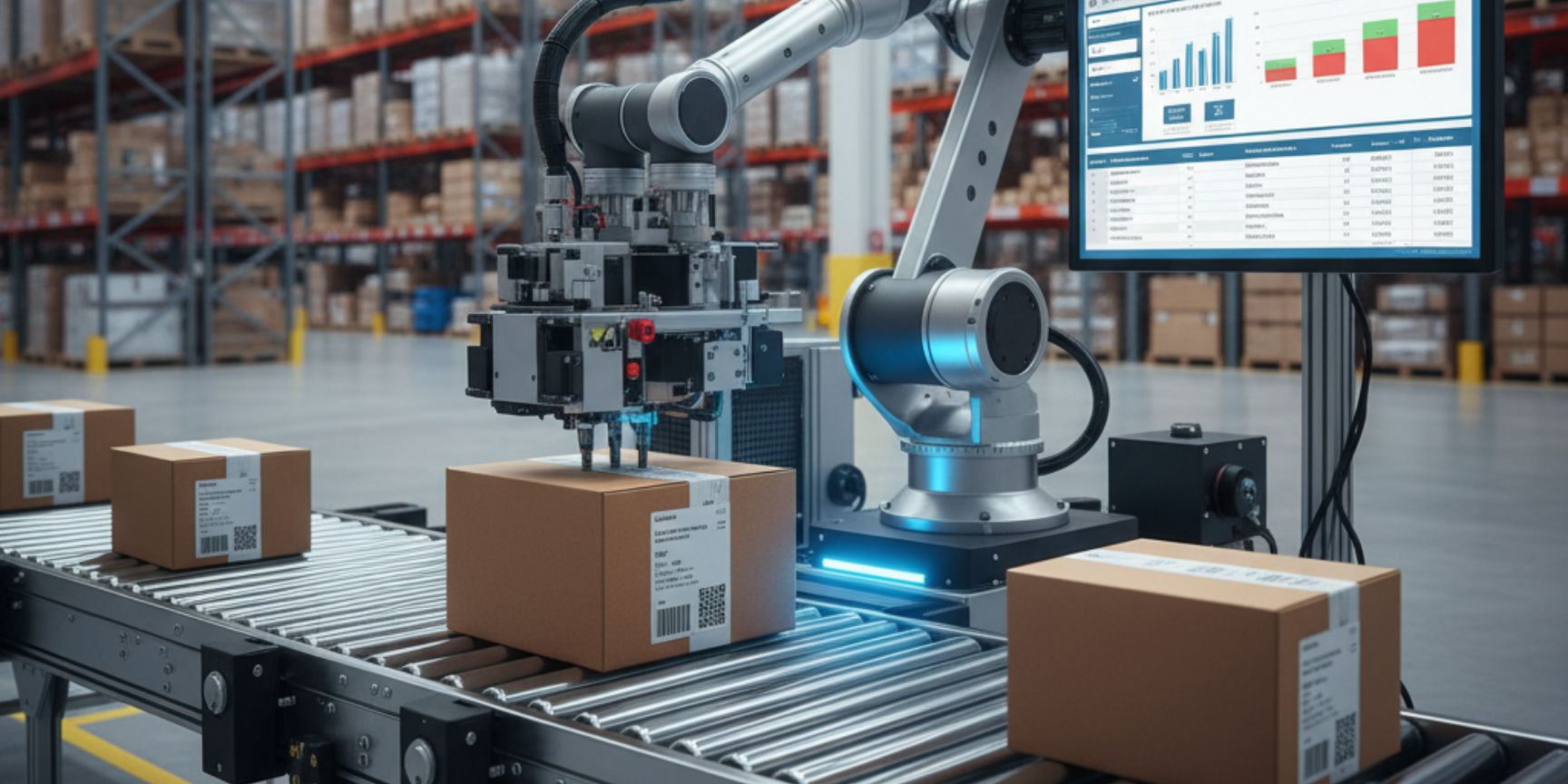
- Automation integration: If conveyor belts are used, the property must allow the integration of automatic labelers (print-and-apply systems). These apply shipping labels fully automatically in the flow (up to 2,000-3,000 parcels/hour) and require space, compressed air and power supply.
- Passive labelling (hall): Labelling also includes marking within the property. These include floor markings, parking space labels (often retroreflective for forklift scanners from a long distance) and essential safety markings (escape routes, shelf load signs).
Practical check: Important questions (Q&A) about labeling
Question: What is the difference between a GTIN (EAN) and an NVE/SSCC?
Answer: The GTIN (Global Trade Item Number, formerly EAN) identifies the product (e.g. "Bottle of water 0.5L"). It is the same on every identical product. The NVE (number of the shipping unit) or SSCC (Serial Shipping Container Code) is a unique serial number for a logistical unit (e.g. "Pallet No. 4711, which goes to customer Meier on 28.10."). The NVE/SSCC is the "license plate" of the pallet or carton and the key to tracking in transit (ASN - Advanced Shipping Notice).
Question: Why is the choice of material for labels so important?
Answer: The material must fit the application and environment. A simple thermal label (like a receipt) fades in sunlight and is not smudge-proof; it is only suitable for short-lived shipping labels. Robust film labels (e.g. polyester) are needed for permanent shelf identification. In deep-freeze logistics (-25°C), a special adhesive (suitable for deep-freezes) is required, as standard adhesives become brittle and the label falls off.
Question: Who defines the standards for labeling?
Answer: The global standardizer is GS1. GS1 manages the system of GTINs, NVE/SSCC and the standards for barcodes (e.g. GS1-128). Industries such as the automotive industry (VDA) or the chemical industry (GHS) have their own specific standards, often based on GS1.
The Future of Labeling: From Static Code to Digital Product Passport
Labeling is evolving rapidly. Pure automation (print-and-apply) is already standard. The next steps are "smart" labels. RFID is being used more cheaply and more widely. Future labels (smart labels) could have integrated sensors for temperature (cold chain) or vibration.
However, the biggest change is imminent due to regulatory requirements such as the EU's Digital Product Passport (DPP). In the future, a label (probably a QR code) will have to serve as a gateway to a database that contains detailed information about a product's sustainability, origin, repairability and recyclability. For logistics, this means that it no longer scans just an ID, but becomes a data collector and manager for the entire life cycle of a product.