




Logistics Parks explained
Table of Contents
- What exactly is a logistics park?
- The central building blocks: warehouse logistics and contract logistics
- The logistics property: More than just four walls and a roof
- Location factors: The strategic formula for success
- Modern logistics parks: Focus on sustainability and technology
- Who are logistics parks suitable for and what advantages do they offer?
What exactly is a Logistics Park?
A logistics park is a purposefully developed, spatial concentration of companies and institutions that provide logistics and logistics-related services. In contrast to a non-specific industrial park, a logistics park is strategically geared to the needs of the logistics industry. Characteristic features are a very large total area, excellent connections to at least two modes of transport (e.g. motorway and rail or waterway), modern infrastructure and the presence of synergy effects due to the proximity of different players. These parks are often also referred to as freight transport centres (GVZ), especially if they have a strong intermodal focus (e.g. transshipment from truck to rail).
Question: Is every business park with a large warehouse automatically a logistics park?
Answer: No. The decisive difference lies in the overall strategic concept. A real logistics park offers more than just rentable space. It is designed as an ecosystem that integrates multimodal transport routes, central services (e.g. customs clearance, IT services) and an infrastructure optimised for logistical processes (e.g. 24/7 operating permits, wide access routes).
The Central Building Blocks: Warehouse Logistics and Contract Logistics
At the heart of every logistics park are companies whose core business is warehouse logistics and contract logistics.
- Warehouse logistics encompasses the classic core functions of the warehouse: the receipt of goods, their storage, the picking of orders and shipping (handling, storage, picking, delivery – ULKA). This is primarily about the efficient physical management of inventories.
- Contract logistics goes far beyond this and is the dominant business model in modern logistics parks. It is based on long-term contracts between a service provider (often a 3PL or 4PL provider) and a customer. The service provider not only takes care of the storage, but also integrates a variety of value-added services (VAS) into the process chain. These include, for example, assembly, set formation, quality controls, returns management, repair services or even parts of final assembly. The contract logistics company thus becomes a partner deeply integrated into the customer's supply chain.
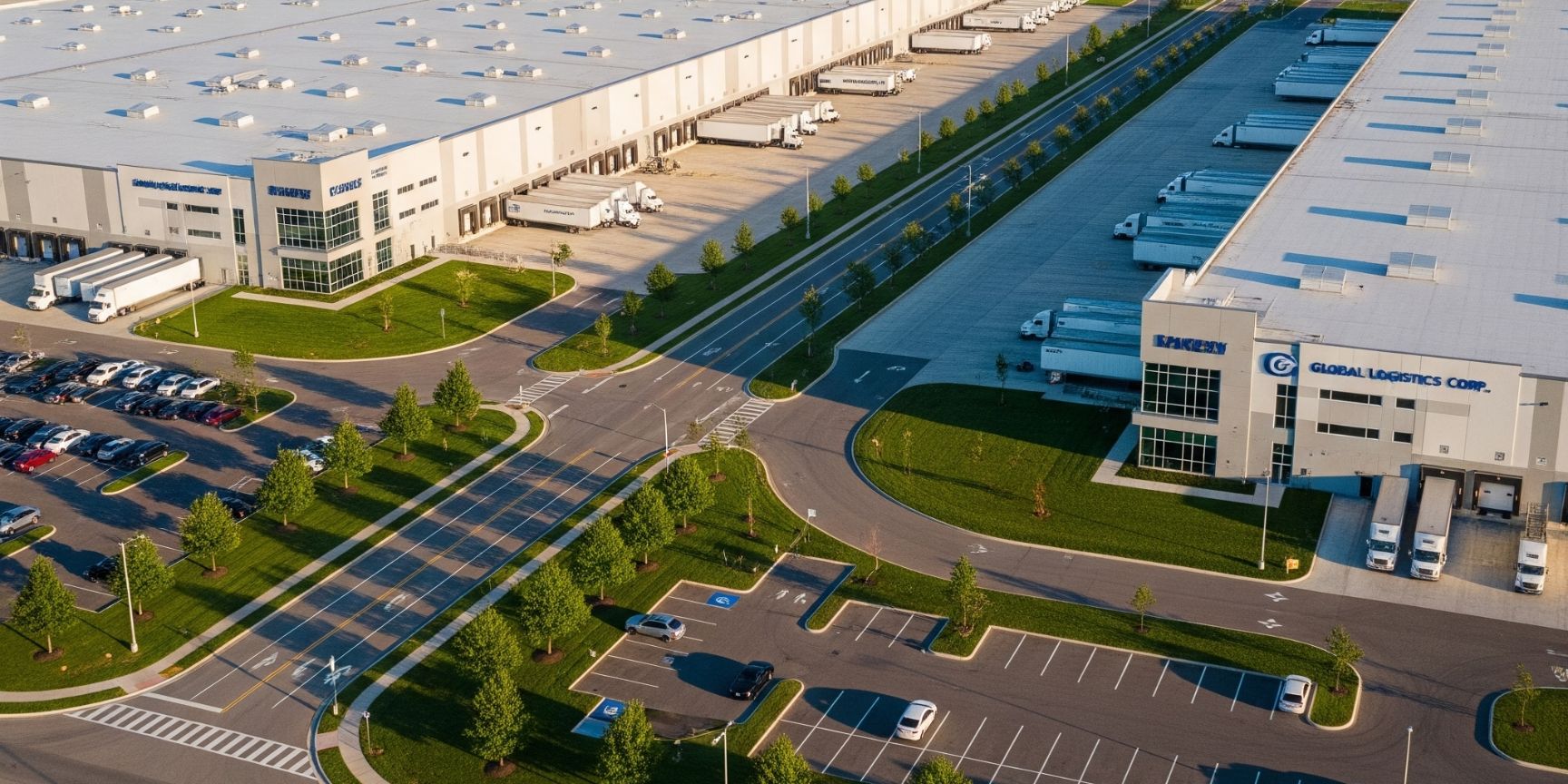
The Logistics Property: More than just Four Walls and a Roof
The physical shell for these processes is the logistics property or logistics hall. Modern buildings are highly specialized and standardized buildings that must enable maximum efficiency. Today's "Grade A" properties are characterized by the following key figures:
- Hall height: At least 10 metres, often 12 metres lower edge of trusses (UKB) in order to make optimum use of high-bay warehouses.
- Floor load: A load capacity of at least 5 t/m² to ensure the use of heavy industrial trucks.
- Gates: A high density of dock levelers, ideally one door per 800-1,000 m² of hall space.
- Flexibility: The properties can often be divided into flexible units of 5,000 to 10,000 m² (multi-tenant capability).
- Fire protection: Modern sprinkler systems (ESFR – Early Suppression Fast Response) are standard.
In addition to the pure hall space, office and social areas, sufficient truck parking spaces and buffer zones (staging areas) are part of a high-quality logistics property.
Location Factors: The Strategic Formula for Success
The choice of location is the most critical factor for the success of a logistics park. A distinction is made here between macro and micro locations.
- Macro location: The supra-regional connection is crucial. Proximity to densely populated conurbations, seaports and airports as well as central motorway junctions (e.g. A1, A2, A3, A7 in Germany) is fundamental. The so-called "banana" regions (e.g. the "blue banana") mark the main economic arteries of Europe.
- Micro-location: Here, the direct conditions on site count. A direct, intersection-free connection to a federal motorway, the availability of qualified and unqualified workers in the area and the permission for 24/7 operation are indispensable criteria.
Modern Logistics Parks: Focus on Sustainability and Technology
The trend is clearly moving towards "green" and "smart" logistics parks. Sustainability is no longer seen as just a cost factor, but as a strategic advantage. Certifications according to standards such as DGNB (German Sustainable Building Council) or BREEAM are almost mandatory. Concrete measures include:
- Large-scale photovoltaic systems on the roofs
- E-charging infrastructure for trucks and cars
- Intelligent building control to reduce energy consumption
- Use of rainwater and greening of areas
Technologically, automation is advancing. Automated guided vehicles (AGVs), robotics in the picking process and the use of digital twins for process optimization are on the rise and place new demands on the infrastructure of real estate.
Who are Logistics Parks Suitable for and What Advantages do they Offer?
Logistics parks are ideal for a wide range of users, including e-commerce companies, automotive suppliers, retail chains, and most importantly, logistics service providers (3PLs) that work for various customers. The main advantages are:
- Scalability: Companies can rent and expand space flexibly.
- Synergies: Sharing infrastructure and services reduces costs.
- Modern standards: Access to high-quality, efficient real estate without its own high investment costs (CAPEX).
- Labour pool: Attractive locations attract a larger pool of potential employees.
- Process reliability: Professional management and established framework conditions (e.g. operating permits) increase planning security.
Question: Is settling in a logistics park always more expensive than a solitary location?
Answer: Not necessarily. While pure rental prices per square metre can be higher in prime locations, these costs are often overcompensated by efficiency gains, lower transport costs due to better connectivity and shared infrastructure costs. The total cost of ownership can therefore be even lower.