




Industrial park – Significance for logistics
Table of Contents
- What is an industrial park? A definition
- GE vs. GI: The decisive difference for logistics
- The industrial park as a logistics hotspot
- The logistics property: More than just a hall
- Practical requirements for modern logistics areas
- Types of operations: Warehouse logistics vs. contract logistics
- Current challenges: shortage of space and ESG
What is an industrial park? A definition
A commercial area is a specifically designated area within a municipality that is primarily intended for the settlement of commercial enterprises. These areas are specified in the development plan of a city or municipality. The legal basis for this in Germany is the Building Use Ordinance (BauNVO).
The purpose of this designation is to bundle commercial activities in order to minimise conflicts of use with other uses (in particular residential). Industrial estates serve as locations for production, trade, services and – of central importance – for logistics. They provide the necessary infrastructure (road connections, supply and disposal) and define clear rules as to what type of operation is permitted and what emissions (noise, odour, etc.) may be generated.
GE vs. GI: The decisive difference for logistics
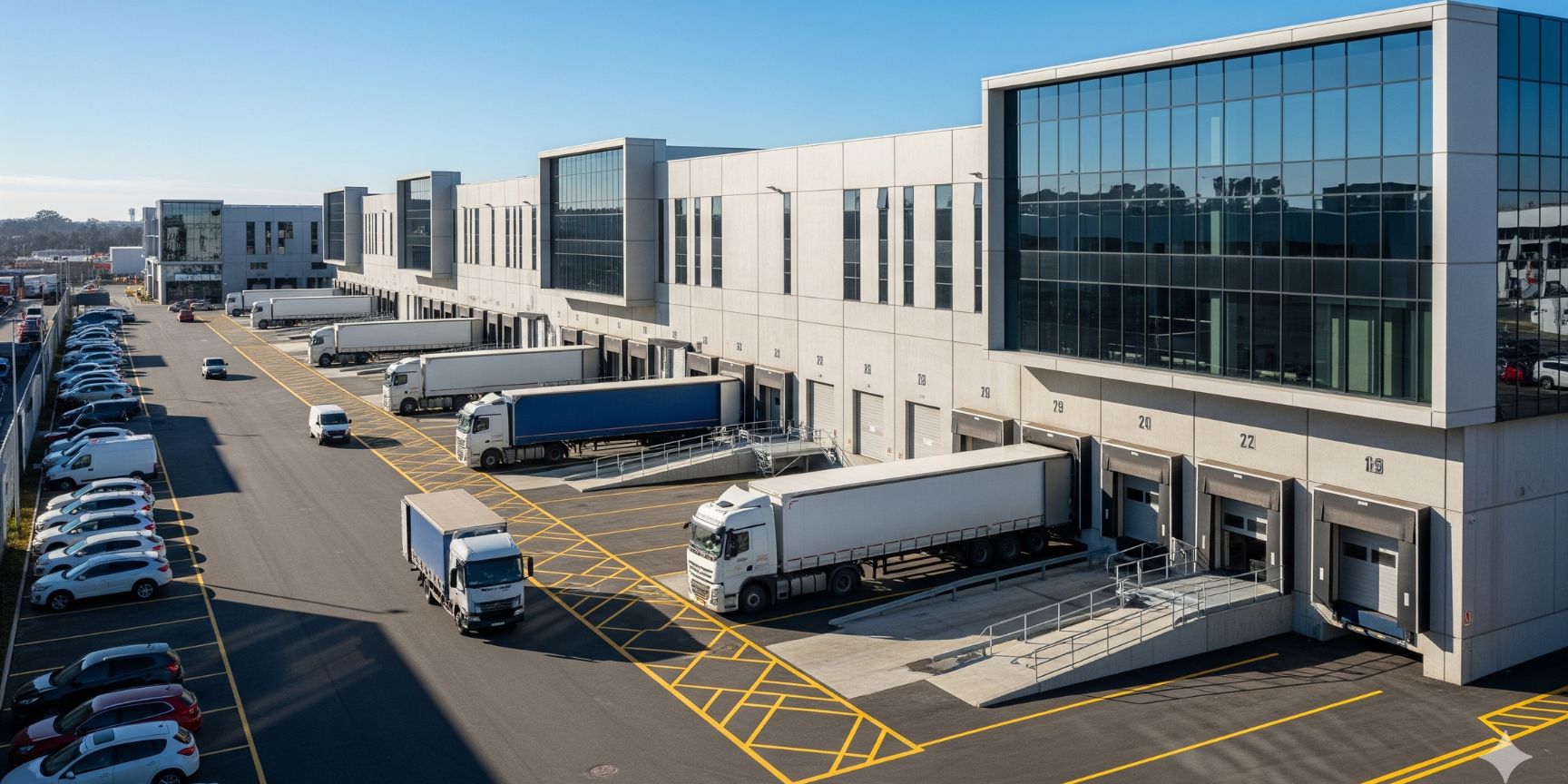
For logistics companies, the exact type of business park is the most important factor when choosing a location. The BauNVO mainly distinguishes between the commercial area (GE) and the industrial area (GI).
Question: What is the main difference between a GE and a GI area?
The answer lies in the permissible levels of interference and the operating hours:
- GE – Commercial area (§ 8 BauNVO): Serves to accommodate commercial enterprises that do not cause significant nuisance. This typically includes farms that do not cause massive noise or odor emissions. For logistics, this often means a restriction: 24/7 operation (three-shift system), as is common in transshipment warehouses or CEP service providers, is often not legally enforceable or only with difficulty, as the night-time noise guideline values must be complied with.
- GI – industrial area (§ 9 BauNVO): Serves exclusively to accommodate commercial enterprises that are not permitted in other building areas. Significantly harassing businesses are permitted here. This is the classic area for "heavy" industry and large-scale logistics. The decisive advantage: In a GI area, 24/7/365 operation is usually possible without restrictions.
For contract logistics and the e-commerce fulfilment sector, which depend on maximum efficiency and end-to-end processes, designation as a GI area is therefore often a knock-out criterion.
The industrial park as a logistics hotspot
Commercial areas (and especially industrial areas) have become the "hotspots" of logistics. Their significance goes far beyond pure storage. They are transshipment points, value centers and strategic buffers in global supply chains.
The rise of e-commerce has massively accelerated this trend. The requirements for fast delivery (same-day/next-day delivery) require decentralised but efficient logistics properties near metropolitan areas. These are almost exclusively found in designated commercial areas.
In addition, infrastructures are bundled here. Many successful logistics parks are being built at interfaces between modes of transport (road, rail, water) or in the immediate vicinity of freight transport centres (GVZ), which optimise combined transport.
The logistics property: More than just a hall
When talking about logistics in the industrial park, the focus is on the logistics property . This asset class has become extremely professionalized over the past two decades. A modern logistics hall is a highly specialized standard product that is trimmed for maximum efficiency.
A distinction is made between roughly different types:
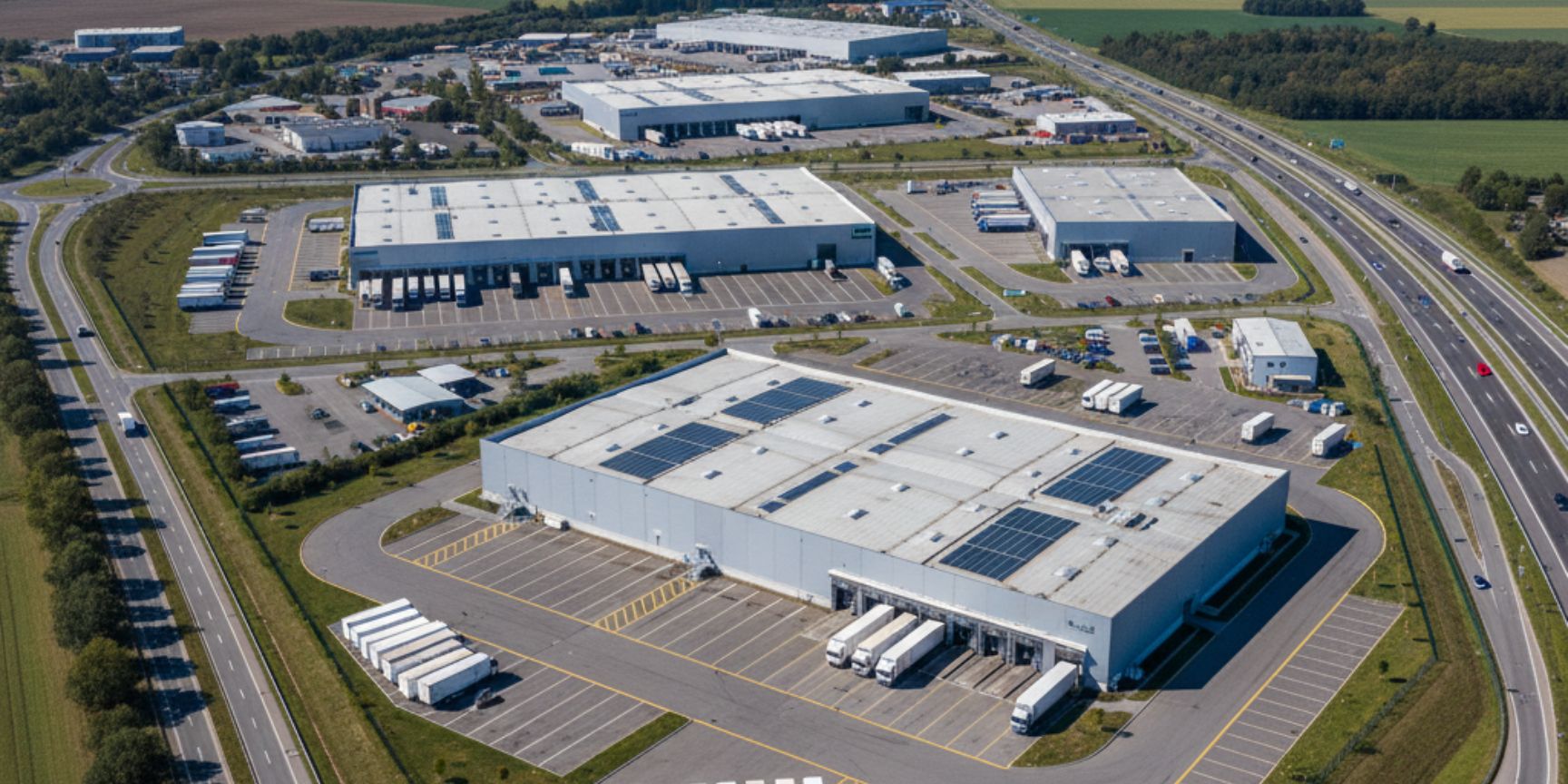
- Big box / large-area logistics: These are the large "boxes" (often 30,000 m² to over 100,000 m²) in GI areas on motorway axes (e.g. A1, A2, A7). They serve as central warehouses for retail chains, e-commerce players or as multi-user centers for contract logistics companies.
- Urban logistics / city logistics: Smaller properties (often < 10,000 m²) in inner-city commercial areas (GE). They serve the "last mile", e.g. as CEP hubs (courier, express, parcel services) or for the urban supply of goods.
- Special properties: Cold storage halls (temperature-controlled logistics), hazardous goods warehouses (with special WHG requirements) or production logistics halls (often directly at the plant).
Third-party usability is a key factor: A property is considered to retain its value if it can be used by another logistics company without major renovations after the first tenant has moved out.
Practical requirements for modern logistics areas
Question: Which key figures (KPIs) define a "good" logistics hall in the industrial park?
A logistics specialist checks a hall for specific, hard criteria that determine whether the operating processes thrive or spoil:
- Hall height: The height is measured as the UKB (lower edge of the truss). The minimum standard for new developments today is 10 metres, and often 12.20 metres for high-bay warehouses in order to ensure maximum storage capacity (cubature).
- Floor load capacity: The hall floor (a steel fibre concrete slab) must withstand the weight of the shelves and the constant traffic of industrial trucks. A minimum of 5 tonnes (t) per m² (surface load) is standard. Equally important is the evenness of the floor (according to DIN 18202).
- Gate frequency: Crucial for the turnover of goods (the "flow"). As a rule of thumb, at least one docking station per 800 to 1,000 m² of hall space applies. In addition, ground-level sectional doors (often 4x4.5m) are required for lateral loading and unloading or for Sprinter.
- Mezzanine: These are recessed mezzanines above the loading zones. They are worth their weight in gold for contract logistics, as value-added services (VAS) take place here (e.g. packaging, returns processing, quality control) or offices are housed here.
- Outdoor areas: Sufficient manoeuvring areas (at least 35m in front of the gates for trucks), truck parking spaces and separate car parking spaces are essential.
Types of operations: Warehouse logistics vs. contract logistics
The hall in the industrial park is only the shell; the process in it is decisive.
Warehousing refers to the core functions: goods receiving, storage (e.g. block storage, rack storage), picking (compilation of shipments) and outgoing goods. It's a more transactional business.
Contract logistics goes far beyond that. It is a strategic partnership, usually based on long-term contracts (3-5+ years). The logistics service provider not only takes care of the storage, but also entire process chains for the customer (outsourcing).
Question: What role do value-added services (VAS) play in contract logistics?
VAS are the core of contract logistics and the reason why special space (such as mezzanine) is so important in logistics properties. They transform a warehouse into an "extended workbench". Examples of VAS are:
- Production-related services: pre-assembly of assemblies, set formation, software installation.
- Trade-related services: labelling (price labelling), packaging (e.g. construction of sales displays), packaging.
- After-sales services: returns management (inspection, reprocessing, repackaging), repair services.
These processes often require more personnel and different space qualities (brighter, cleaner, ESD protection) than pure pallet storage.
Current challenges: shortage of space and ESG
The logistics sector, especially in Germany's top industrial parks (e.g. Hamburg, Berlin, Rhine-Main, Ruhr area), faces two major challenges:
- Shortage of space: The hunger for space in logistics is enormous (approx. 6-8 million m² of new construction per year in Germany), but the available plots of land designated as GI ("greenfields") are rare. Municipalities are often reluctant to redesignate because logistics is considered space-intensive, but (compared to production) low in jobs and traffic-intensive. This is leading to rising rents and a focus on brownfield development (revitalization of old brownfield sites).
- ESG (Environmental, Social, Governance): Sustainability is no longer a "nice-to-have". Investors, tenants and municipalities are demanding clearly defined standards. In logistics real estate, this means:
- Environment (E): DGNB or BREEAM certifications, PV systems on roofs (statics must allow this!), e-charging stations (for cars and increasingly for trucks), heat pumps instead of gas dark radiators, rainwater harvesting and biodiversity on outdoor surfaces.
- Social (S): High quality of social and office space, good public transport connections for employees, occupational safety.
- Governance (G): Transparent supply chains and facility management.
Today, the future viability of an industrial park as a logistics location depends to a large extent on how it masters the balance between economic efficiency (24/7 operation) and ecological responsibility (ESG).