




Industrial pallets in logistics
Table of Contents
- Definition and demarcation: What is an industrial pallet?
- Technical specifications: Facts, figures, data
- Influence on the logistics property and hall planning
- Industrial pallets in contract logistics: pooling and cost-effectiveness
- Materials compared: wood vs. plastic
- Practical tips for warehouse managers and planners
- Expert Q&A: Frequently asked questions from practice
- Conclusion: The strategic importance of the load carrier
Definition and demarcation: What is an industrial pallet?
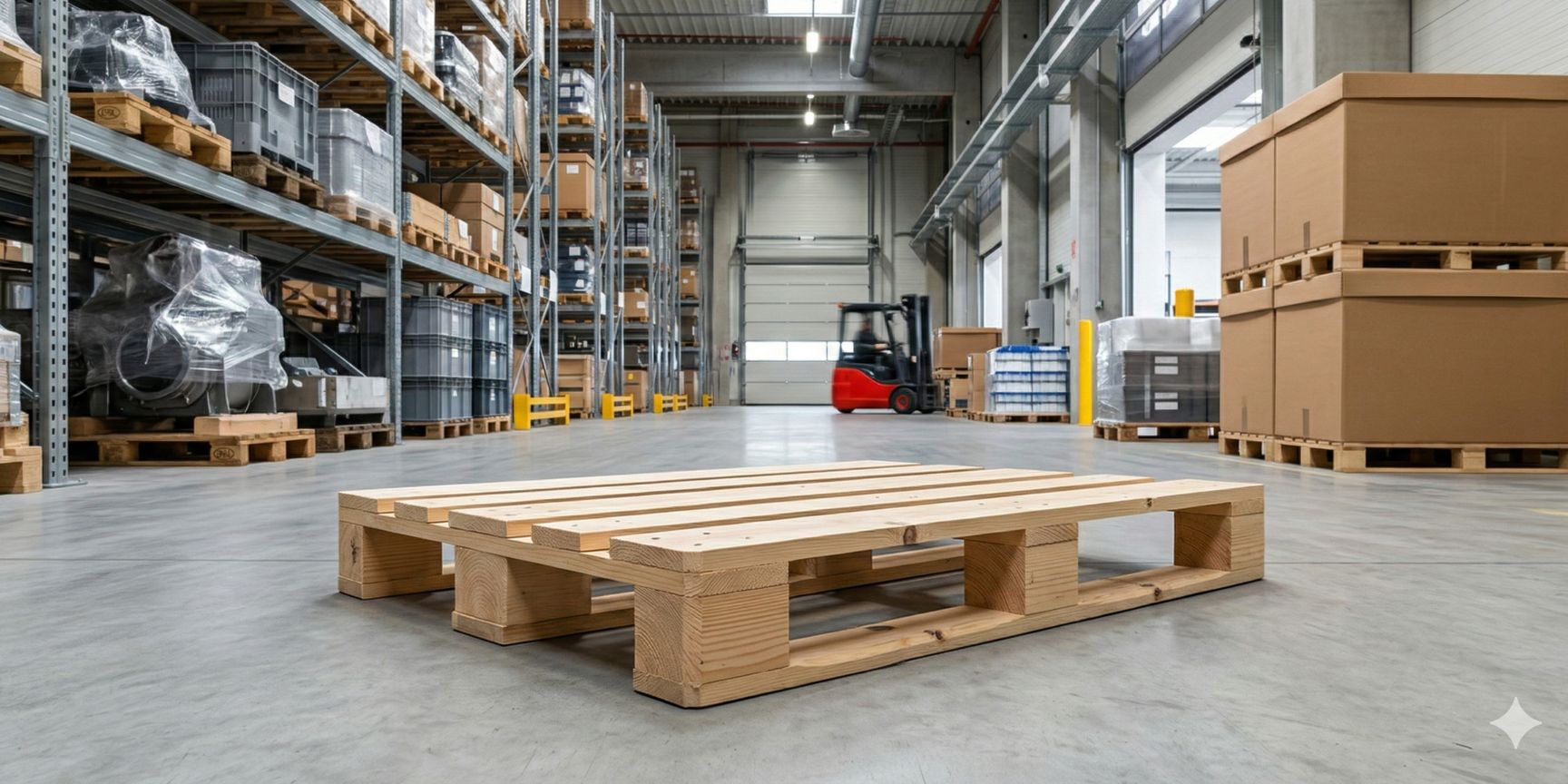
While the Euro pallet (1200 x 800 mm) is the undisputed standard in European small-scale retail, the industrial pallet (also known as ISO pallet or block pallet) with its dimensions of 1200 x 1000 mm is the powerhouse for volume-intensive industries. It offers around 25% more floor space than the standard Euro pallet.
In contract logistics, it is mainly used where large containers, heavy raw materials or chemical products are moved. It is standardised according to ISO 6780 and is available in different designs (wood, plastic, metal) and qualities (e.g. IPPC standard for export).
Technical specifications: Facts, figures, data
The technical key data of the industrial pallet are essential for the planning of a logistics property or a racking system:
- Basic dimensions: 1200 mm x 1000 mm.
- Net weight: Approx. 20–24 kg (wood), depending on moisture level and type of construction.
- Load capacity:
- Static: Up to 5,000 kg (storage on solid ground).
- Dynamic: 1,250 to 1,500 kg (when transported by industrial trucks).
- In high racks: Usually up to 1,000 kg (selective load on the runners).
- Entry undersize: Usually designed as a 4-way pallet, which allows driving under from all four sides.
Influence on the logistics property and hall planning
The choice of pallet size is a strategic decision that must be taken into account when building a logistics property. The industrial pallet dictates the grid dimension of the columns and the depth of the shelving systems.
In modern halls, the use of industrial pallets leads to the following adjustments:
- Shelf depth: Standard pallet racks are often designed to be 1100 mm deep to store Euro pallets lengthwise. For industrial pallets, the statics and depth support must be precisely matched to the 1000 mm or 1200 mm orientation.
- Space utilisation: As the industrial range is wider, the number of storage spaces per linear metre of racking will change. In block storage, its larger footprint provides a more stable basis for stacking at great heights.
- Floor loading: Due to the higher load capacities of the pallets themselves, the requirements for the point load resistance of the hall floor (WMS classes according to DIN 18202) are increasing.
Industrial pallets in contract logistics: Pooling and cost-effectiveness
In contract logistics, the management of load carriers is a critical cost factor. There are two main systems here:
- Open exchange pool: Pallets are exchanged for equivalent carriers directly at the recipient's premises. This requires strict quality management, as "industrial pallet" is not synonymous with "exchangeable quality" according to the EPAL standard (unless it is the certified EPAL 3).
- Closed-loop / rental systems (e.g. CHEP, LPR): In the chemical or automotive industry, rental models often dominate. Here, the logistician pays for the use; the maintenance and return is carried out by the pooling provider. This reduces the administrative effort and ensures consistent quality for automated conveyor systems.
Materials compared: Wood vs. plastic
| Feature | Wooden industrial pallet | Plastic industrial pallet |
| Acquisition costs | Low to Medium | High (factor 3-5) |
| Lifespan | Limited (risk of splintering) | Very high (up to 10 years) |
| Hygiene | Problematic (pores) | Excellent (HACCP compliant) |
| Sustainability | Renewable raw material, repairable | Recyclable, but energy-intensive to produce |
| Area of application | Construction, Heavy Industry, Export | Chemicals, pharmaceuticals, food |
Practical tips for warehouse managers and planners
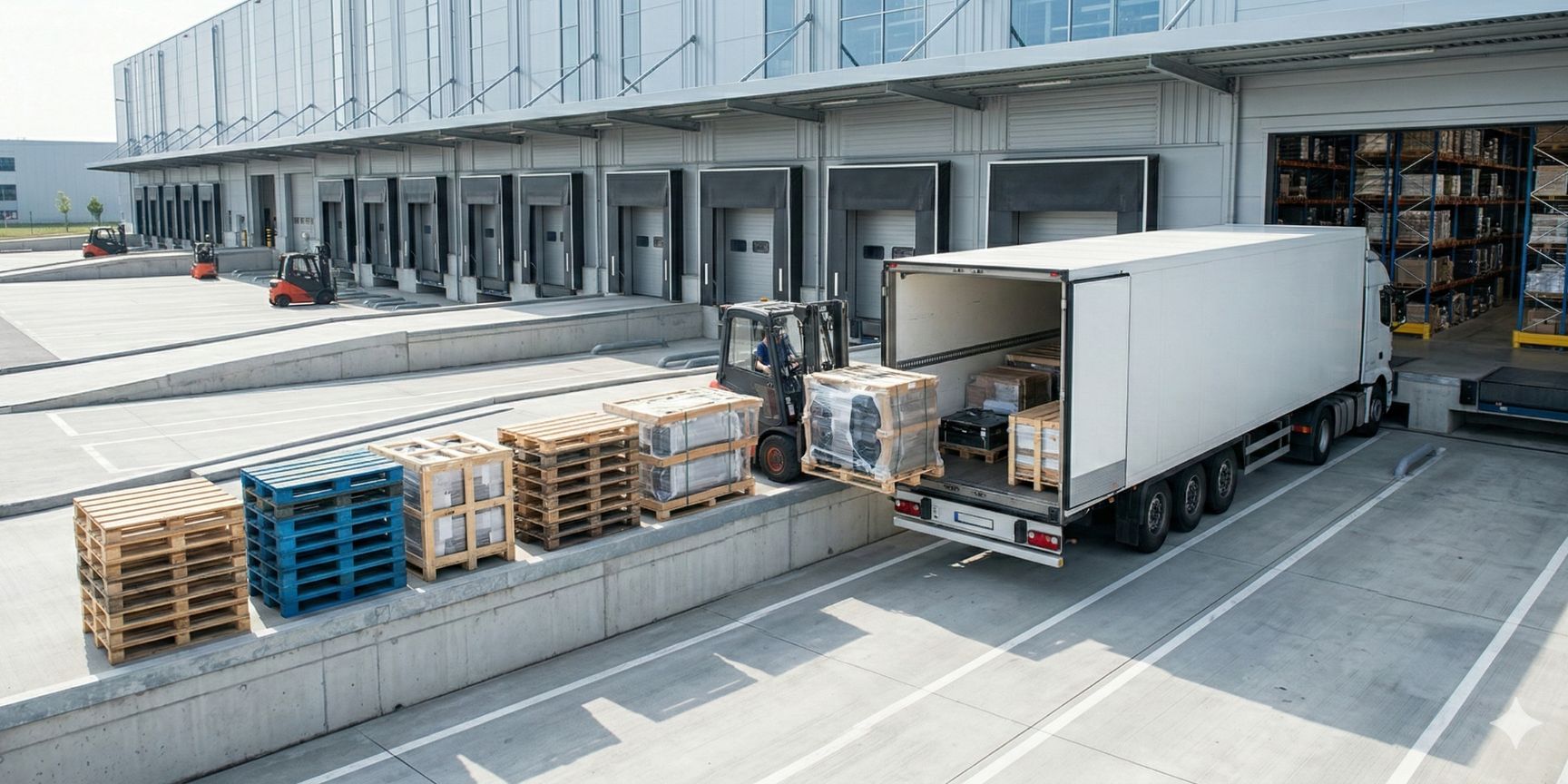
- Load securing: The 1000 mm width means that two industrial pallets next to each other take up exactly 2.00 m in the truck (standard width approx. 2.45 m). There is a gap of approx. 45 cm, which must be secured with dunnage pads or strapping to prevent slipping.
- Parking space calculation: A standard semi-trailer holds 26 industrial pallets (with a single-layer load), as opposed to 33 Euro pallets. This must be taken into account in the freight cost calculation.
Expert Q&A: Frequently asked questions from practice
Question: Can any industrial pallet be stored in a high rack?
Answer: No. Only pallets with an appropriate sled design (usually 3 or 5 runners) are safe for self-supporting storage on the rack. Pallets of nine blocks without connecting floor boards ("feet") may only be used on flat floors or on shelves with shelves/gratings.
Question: What does ISPM 15 mean in relation to industrial pallets?
Answer: This standard stipulates that wooden packaging for international trade must be heat-treated to prevent the spread of pests. For export, the "IPPC stamp" on the industrial pallet is mandatory.
Question: Why do automated warehouses often rely on plastic pallets?
Answer: Wood is a natural product and works. Millimeter deviations or chipped wooden parts can interfere with sensors in conveyor systems. Plastic pallets are dimensionally stable and "system-clean", which minimizes downtimes.
Conclusion: The strategic importance of the load carrier
The industrial pallet is much more than just a piece of wood or plastic. It is a business indicator. If you neglect the choice of pallet, you risk inefficiencies in truck utilization, damage in the high rack or problems with international customs clearance. In the modern logistics property, it is the pacesetter for the entire intralogistics.