




Euro pallet in logistics
Table of Contents
- Definition and technical specification: The measure of all things
- The Euro pallet in warehouse logistics: system relevance and automation
- Influence on logistics real estate and hall planning
- Contract Logistics: Management of the "Grey Gold"
- Quality classification: From new to rejects
- Fire protection and insurance in the logistics hall
- Future and Sustainability: ISPM 15 and Alternatives
Definition and technical specification: The measure of all things
The Europool pallet, colloquially known as the Euro pallet, is a reusable transport pallet standardised in accordance with EN 13698-1. It is the undisputed standard in European road haulage and intralogistics. Their design follows strict specifications of the EPAL (European Pallet Association) and the UIC standard 435-2.
Facts, figures, data:
- Basic dimensions: 1200x800
- Net weight: approx. 20 to 24 kg (depending on the moisture content of the wood)
- Load capacity (dynamic):
- Load-bearing capacity (static): up to with full-surface support
- Construction: 11 boards, 9 blocks, 78 special nails
This standardization is crucial. Any deviation would lead to malfunctions in highly automated warehouses. An interesting detail for professionals: the chamfers on the floor boards are mandatory to facilitate entry with industrial trucks (pallet trucks, forklifts).
The Euro pallet in warehouse logistics: system relevance and automation
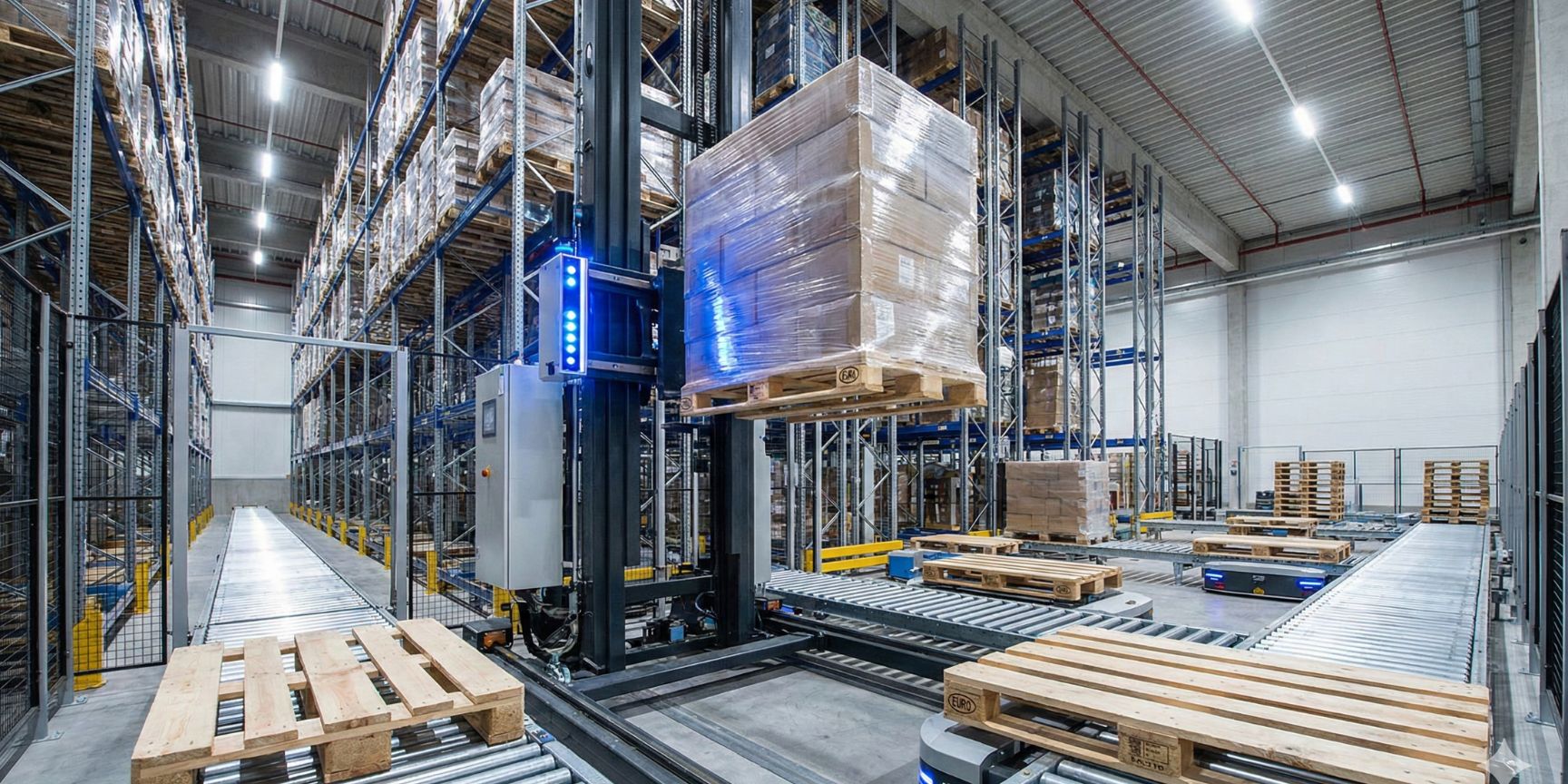
In operational warehouse logistics, the Euro pallet dictates the process landscape. It is compatible with almost all common shelving systems and industrial trucks.
What role does the pallet play in automated systems?
In automated small parts warehouses (AS/RS) or high-bay warehouses (HRL), the dimensional accuracy of the pallet is the critical factor. While slight deformation is tolerable in manual block storage, in the high-bay warehouse even protruding nails or missing chips on the blocks lead to system downtimes. Conveyor systems (roller conveyors, chain conveyors) are designed exactly for the runner width and the skid spacing of the Euro pallet.
Particular attention is paid to the ability to drive underneath: Since the pallet can be driven under on four sides, it allows a high degree of flexibility in storage and retrieval, whereby the pick-up via the narrow side is the standard in truck loading ("longitudinal"), while the broad side of the rack is often used for storage ("transverse").
Influence on logistics real estate and hall planning
For developers of logistics properties and planners, the Euro pallet is the atomic element of architecture. An efficient hall is built "around the pallet".
The column grid: The grid dimensions of modern logistics halls (often meters or meters) are derived directly from the dimensions of the Euro pallet. The aim is to achieve an optimal number of pallet spaces in the rack aisles between the supports without creating "dead space".
How does the pallet affect the truck loading docks and gates? A standard semitrailer (tarpaulin truck) offers space for 33 to 34 Euro pallets.
- Three Euro pallets lengthwise or two crosswise fit exactly next to each other.
The logistics property must offer sufficient staging space (outgoing goods zone) in front of the gates to pre-stow these complete truckloads. The depth of this zone is often calculated as a multiple of the pallet length plus manoeuvring area for forklifts.
Contract Logistics: Management of the "Grey Gold"
In contract logistics, the pallet is not only a load carrier, but a currency. Pallet management is a significant cost and risk factor in service contracts.
The exchange system: The Euro pallet pool is the largest open exchange system in the world.
- Step-by-step exchange: The truck delivers 33 full pallets and takes 33 empty ones directly back with it.
- Pallet account: If a direct exchange is not possible, pallet debts are posted to accounts and settled later.
Challenges for service providers:
- Loss of quality: A contract logistics company that ships high-quality goods on new pallets, but receives back from the recipient inferior pallets that are just barely exchangeable, makes an economic loss.
- Administrative effort: The management of pallet accounts requires a high level of accuracy. Missing pallet notes are hard cash. In tenders, therefore, it is often precisely defined whether pallets are "included" or are billed separately as a fee (pallet handling charge).
Quality classification: From new to rejects
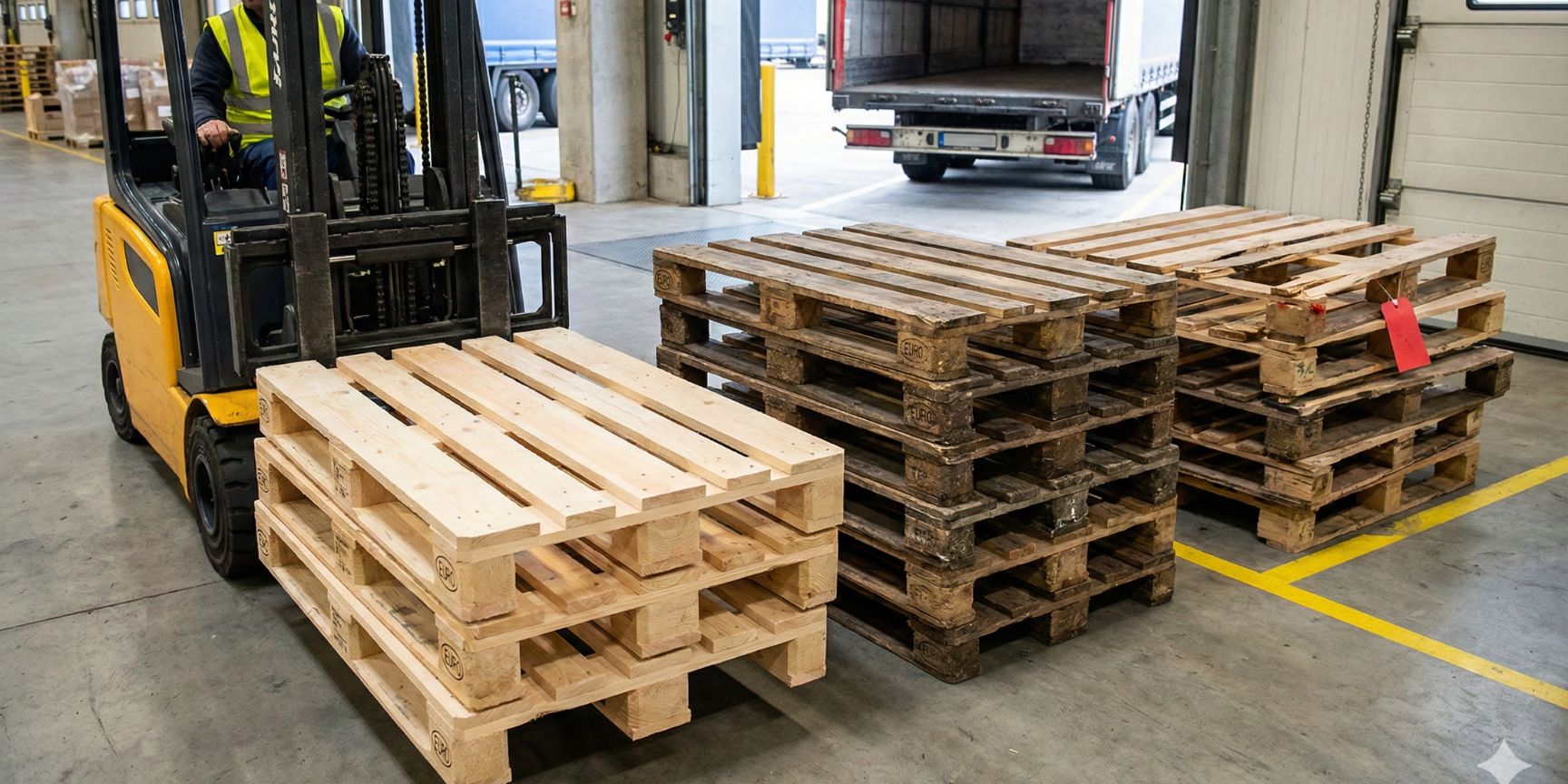
Not every Euro pallet is suitable for every purpose. For specialist portals, the distinction between the quality classes is essential:
- NEW: Brand new, directly from the manufacturer. Mandatory for food and pharmaceutical logistics (hygiene).
- Class A (first choice): Light-coloured wood, no soiling, fully usable for automatic bearings.
- Class B (second choice): Wood darkened, slight soiling, but technically fully intact. Standard for transport logistics.
- Class C (Third Choice): Heavily darkened, technically still safe, but visually deficient.
- Not exchangeable: Damaged components (e.g. board broken, block missing). These need to be repaired.
Important: Repairs may only be carried out by licensed companies. A repaired pallet receives a special test nail that certifies it again as a full-fledged Euro pallet.
Fire protection and insurance in the logistics hall
An often underestimated aspect is the fire load. Wooden pallets represent an enormous fire load in large quantities.
What does this mean for the sprinkler system?
In rack warehouses, sprinkler systems must be designed in such a way that they can handle the fire potential stored in the pallets and the goods. Empty pallets are often more dangerous than full ones, as the chimney effects between the stacked, dry wooden pallets drive the fire up extremely quickly. Insurers therefore often stipulate that empty pallets must not be stored indoors, but in separate outdoor warehouses or in specially sprinkled areas (often at a distance of at least 10 meters from the building).
Future and Sustainability: ISPM 15 and Alternatives
The Euro pallet is sustainable per se, as it is made of renewable raw materials and can be repaired. However, for international export (outside the EU), the ISPM 15 Standard (IPPC) is mandatory.
This means that the pallets must be heat treated (HT) to kill pests. This is recognizable by the "ear stamp" on the center block.
Trend analysis: Despite the advent of plastic pallets (H1 sanitary pallets, lighter export pallets), the wooden Euro pallet remains the market leader due to its unbeatable price-performance ratio and extreme robustness. In "Green Logistics", it scores with its CO2 balance (wood stores CO2) and multiple use, but is under cost pressure due to rising wood prices.