



ISO 14001 in Logistics
Table of Contents
- ISO 14001:2015 – The backbone of corporate environmental protection
- Relevance for contract logistics: "License to Operate"
- Focus on warehouse logistics: operational levers and KPIs
- The logistics property: interface between construction and operation
- Life Path Assessment and Risk-Based Approach
- Practical questions: effort, duration and benefits
- Differences: ISO 14001 vs. EMAS
- Conclusion and outlook
ISO 14001:2015 – The backbone of corporate environmental protection
DIN EN ISO 14001:2015 is the globally accepted standard for environmental management systems (EMS). Unlike pure product standards, it does not define absolute environmental limits, but requires a continuous improvement process (CIP) of an organization's environmental performance.
For skilled workers, the decisive factor is that the 2015 revision introduced the High Level Structure (HLS). This facilitates integration into existing quality management systems (such as ISO 9001), as the structure and terminology have been harmonized. The core is the PDCA cycle (Plan-Do-Check-Act), which ensures that environmental goals are not only defined once, but are also operationally implemented, measured and readjusted. In logistics, this means the transition from sporadic "green measures" to strategically anchored corporate governance.
Relevance for contract logistics: "License to Operate"
In contract logistics, ISO 14001 has evolved from a "nice-to-have" to a de facto "license to operate". In tenders of large industrial and commercial customers, the presence of a certified EMS is often a knock-out criterion.
Why is that? Shippers are increasingly obliged to report (see CSR Directive or Supply Chain Act). They must prove the emissions of their Scope 3 chain. A logistics service provider (3PL) that works in accordance with ISO 14001 offers the client data security and process validity.
Question: Does the certification apply to the service provider or the location?
Answer: ISO 14001 can be used as a matrix certification for an entire group of companies or for individual locations (site certification). In contract logistics, customers often demand location-specific evidence to ensure that exactly "their" hall is operated in an environmentally compliant manner.
Focus on warehouse logistics: operational levers and KPIs
In pure warehouse logistics, the standard has a deep impact on operational processes. It's not just about waste separation in the office, but about significant energy and resource flows.
Important fields of action (environmental aspects) in the warehouse:
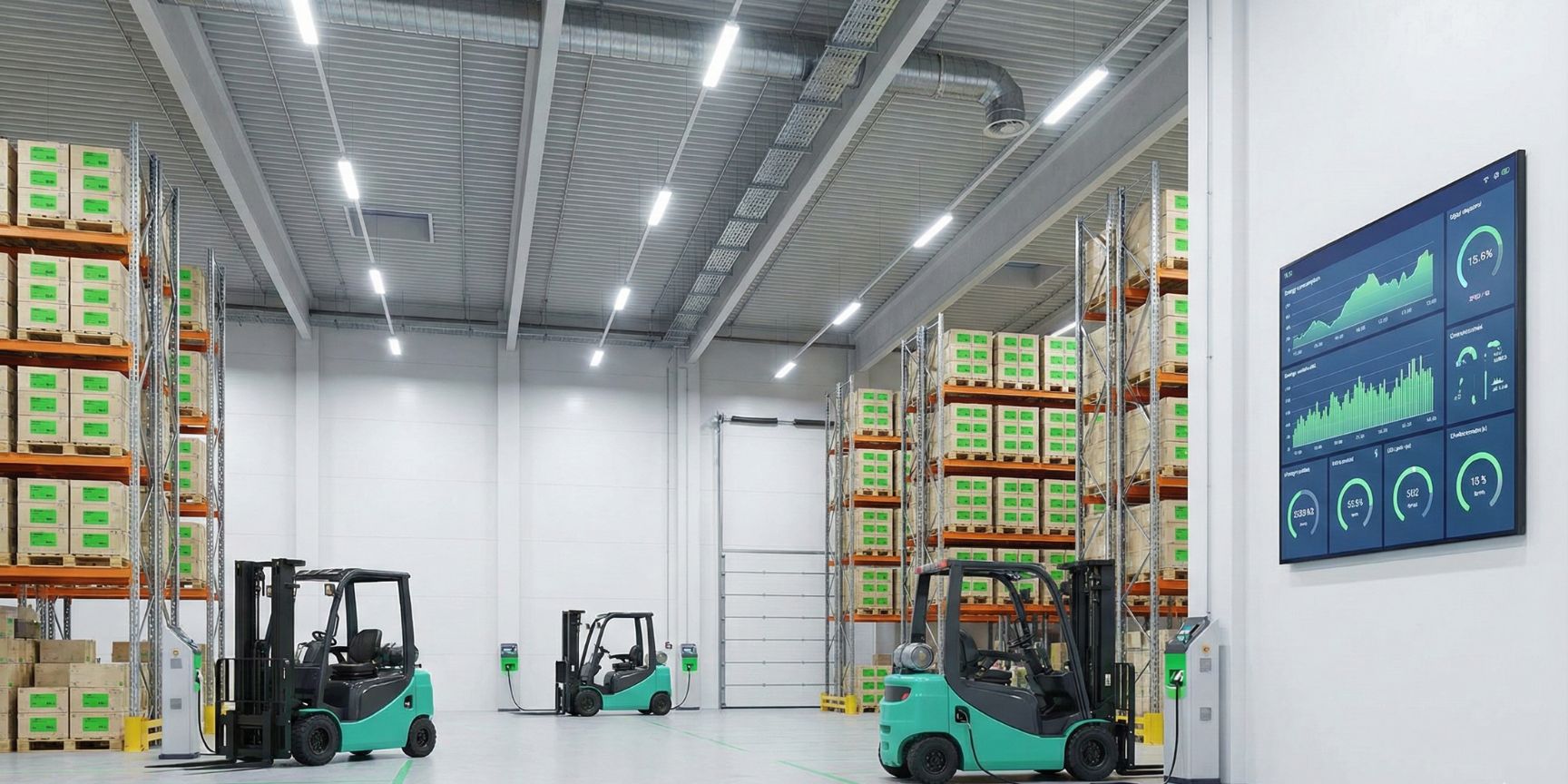
- Energy efficiency in industrial trucks (FFZ): Switching from lead-acid to lithium-ion batteries not only reduces energy consumption through higher efficiencies, but also eliminates the risk of acid accidents and reduces water consumption during maintenance. ISO 14001 requires an assessment of the life cycle costs here.
- Lighting management: In halls with a height of 10 to 12 meters, lighting is a massive cost factor. An ISO-compliant goal would be to convert to LED with presence-dependent control (motion sensors in the aisles). Savings potentials of 50 to 70% are realistic and measurable here.
- Packaging management: The reduction of stretch film by using thinner but more powerful high-performance films or the introduction of returnable load carriers are typical goals within the framework of the EMS.
Important KPIs (Key Performance Indicators) for EMS in the warehouse:
- Energy consumption per pallet moved (kWh/pallet).
- Waste rate per pick position.
- Proportion of recycled packaging materials.
The logistics property: interface between construction and operation
An often misunderstood point is the distinction between real estate certification (e.g. DGNB, BREEAM) and company certification (ISO 14001).
- The property (hardware): DGNB or BREEAM assess the structural substance (insulation, PV pre-installation, building materials).
- The operation (software): ISO 14001 evaluates how the user (logistician) acts in this shell.
Nevertheless, there are strong interactions. A modern logistics property (gold/platinum status) makes ISO 14001 certification much easier for the user.
Example: A smart metering system installed on site enables the logistics company to carry out the required energy monitoring. Conversely, ISO 14001 requires the operator to meticulously comply with and document requirements from the building permit procedure (e.g. seepage of surface water on the property) as part of the "binding obligations".
Life Path Assessment and Risk-Based Approach
Since its revision in 2015, the standard has required a life cycle perspective. For logistics specialists, this means that the view must not end at the factory gate.
- Upstream: Where do the packaging materials come from? Are suppliers also certified?
- Downstream: How is the transport packaging disposed of by the end customer? Can the logistics company offer return systems here?
In addition, the risk-based approach is key. Logisticians must assess environmental risks (e.g. accident of a tanker truck on the company premises, leakage of hazardous substances in the hazardous goods warehouse) and prove preventive measures (emergency plans, binders, training). This is very much in line with the requirements for a hazardous materials warehouse according to TRGS 510.
Practical questions: effort, duration and benefits
To increase the usefulness of this article, we answer frequently asked questions from practice:
Question: How long does it take to get certified?
Answer: For a medium-sized logistics location, you should expect 6 to 12 months. This depends heavily on the maturity of the existing processes. Those who already live ISO 9001 are faster, as about 30-40% of the documentation (management review, internal audits, document control) is structured identically.
Question: How much does certification cost?
Answer: The external costs for the auditor (certification company) depend on the number of employees and the size. For a logistics site with about 100 employees, the pure audit costs are often between 3,000 and 6,000 euros per year (including surveillance audits). However, the internal costs (personnel retention of the environmental management officer) are usually higher.
Question: Do I need an external consultant?
Answer: Not necessarily, but often more economical in the start-up phase. A specialized consultant provides ready-made legal registers (important for compliance!) and process templates, which saves internal resources.

Differences: ISO 14001 vs. EMAS
The term EMAS (Eco-Management and Audit Scheme) is often used. EMAS is the "premium version" of environmental management and a European regulation.
- ISO 14001: Worldwide standard, focus on the management system, certificate by auditor.
- EMAS: Includes ISO 14001 in its entirety, but also requires a published environmental statement that is validated and sets stricter standards for legal compliance and employee involvement.
- Recommendation: ISO 14001 is usually the standard of choice for internationally active logistics companies. EMAS is suitable for companies that strive for particularly proactive communication of their environmental performance.
Conclusion and outlook
In the logistics industry, ISO 14001 is much more than a bureaucratic effort. It is the most effective tool to manage the complexity of environmental regulations, customer requirements and cost efficiency. In the future, the standard's integration with digital tools (IoT for real-time consumption data) and its link to ISO 50001 (energy management) will continue to increase. For logistics real estate operators and contract logistics companies, the following applies: If you do not have a valid EMS today, you will have difficulty winning demanding mandates or obtaining financing for new buildings tomorrow (keyword EU taxonomy).