




In-house warehouses in logistics
Table of Contents
- Definition: What is a self-contained warehousing?
- The strategic decision: in-house storage vs. third-party storage (make-or-buy)
- Focus on logistics real estate: buying, building or renting?
- Requirements for the "hall": Modern in-house warehouse specifications
- Cost and performance analysis in the in-house warehouse (KPIs)
- FAQ: Frequently asked questions about in-house storage
- Conclusion: The in-house warehouse as a strategic success factor
Definition: What is a self-contained warehousing?
An in-house warehouse (also known as an in-house warehouse or internal warehouse) is a storage facility that is owned, managed, and operated by the company that owns the stored goods. Unlike the external warehouse (outsourcing, e.g. to a 3PL service provider), the company retains full control over all aspects: the property (or its lease), the staff, the technology (e.g. the warehouse management system) and the operational processes.
This type of operation is a classic case of an insourcing decision. The company deliberately chooses to carry out warehouse logistics itself as a core or support function, rather than outsourcing it to external specialists (such as freight forwarders or contract logistics specialists).
The strategic decision: In-house storage vs. third-party storage (make-or-buy)
The decision for or against an in-house warehouse is one of the most fundamental strategic decisions in logistics. It is the classic "make-or-buy" decision, applied to warehousing.
Perspective Contract Logistics: Contract logistics is the direct alternative to the in-house warehouse. A contract logistics service provider (3PL) not only handles pure warehousing (as in the case of pure warehouse rental), but also the entire operational process, often enriched with value-added services such as packaging, returns management or quality control.
Per own warehouse:
- Maximum control: Direct control of processes, quality and personnel.
- High flexibility (process): Short-term adaptation of processes, prioritization of orders.
- Know-how protection: Sensitive product data or processes do not leave the company.
- Specialization: Ideal for highly specific requirements (e.g. hazardous goods, pharmaceuticals, complex assembly logistics) that service providers find difficult to map.
- Cost (potential): For very high, stable volumes, economies of scale can push costs below those of a service provider.
Per external warehouse (contract logistics):
- Variable costs: Costs are "variabilized" and "externalized". Fixed costs (personnel, rent) become variable costs (e.g. costs per pallet/pick).
- Focus on core business: Management capacities are freed up.
- Scalability: Easier to manage seasonality and growth without your own investment.
- Expertise: Service providers bundle know-how and technology (e.g. IT systems, automation).
- Investment risk (CAPEX): No own capital has to be invested in buildings, technology or staff retention.
Focus on logistics real estate: buying, building or renting?
Once the "make" decision has been made in favor of an in-house warehouse, the real estate question immediately arises. The company becomes a user of a logistics property.
Purchase (stock): Purchase of an existing property (brownfield).
- Advantage: Faster availability.
- Disadvantage: Often compromises in layout, height or efficiency (old building). High CAPEX (investment costs).
New construction (own use): The company acquires a plot of land (greenfield) and builds it itself.
- Advantage: 100% tailor-made for our own processes. Long-term asset.
- Disadvantage: Longest implementation time (planning, approval, construction). Highest risk and capital commitment.
Rent (long-term): Renting a logistics hall (often newly built by a developer).
- Advantage: Low capital commitment (OPEX instead of CAPEX), high flexibility at the end of the contract, modern standards.
- Disadvantage: Long-term leases (often 5-10 years), dependence on the landlord for changes.
The location decision (macro location: transport connections, proximity to ports/production; Micro-location: labour availability, plot layout) is just as crucial to the success of the own warehouse as the property itself.
Requirements for the "hall": Modern in-house warehouse specifications
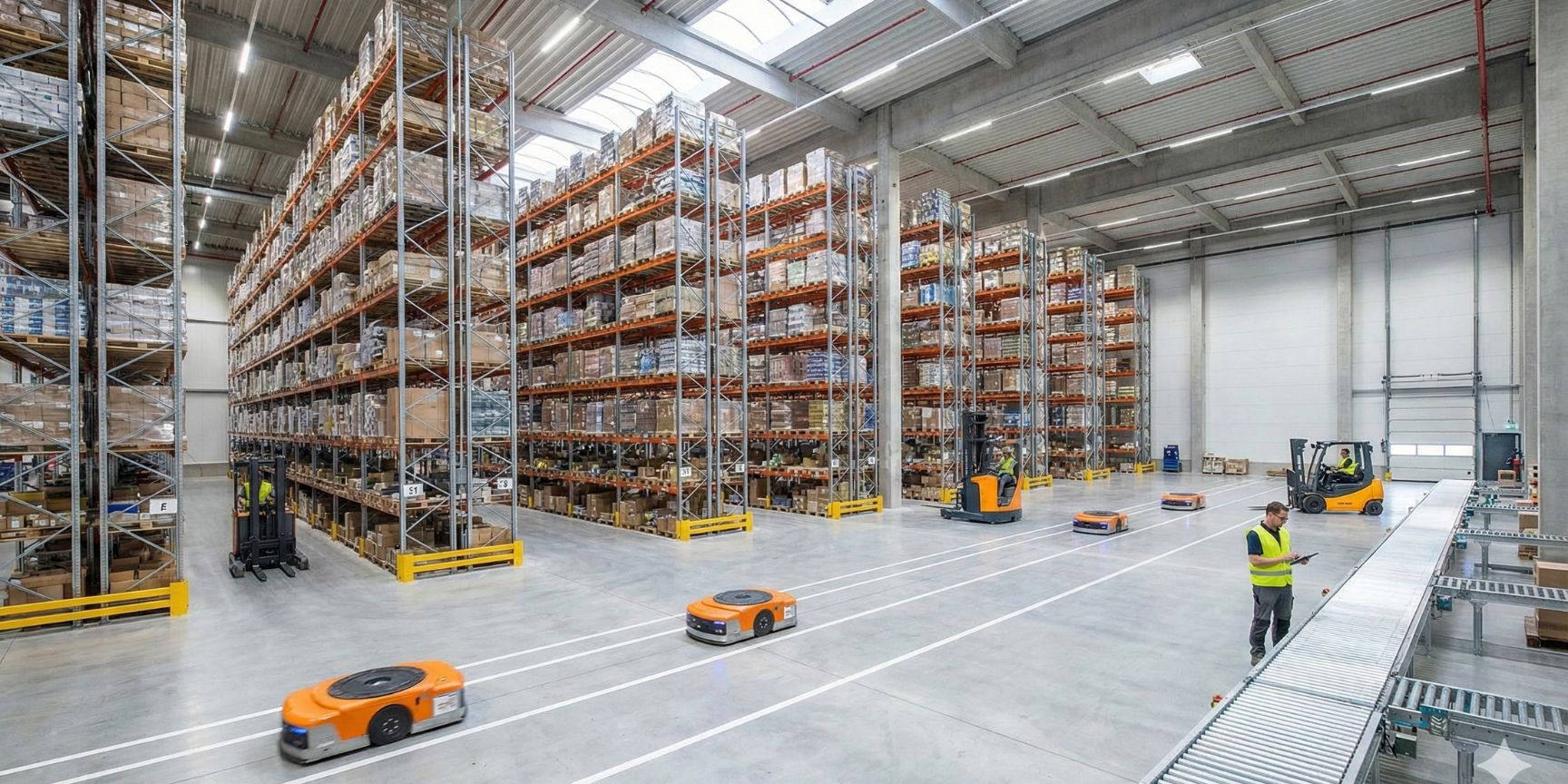
The physical hall (the "warehouse") defines the efficiency of intralogistics. An in-house warehouse that is planned today must be sustainable in order to secure the value of the investment. Outdated properties (e.g. hall heights of less than 8 metres) are often no longer economically viable.
Facts and figures (ZDF) for a modern logistics hall (Grade-A):
Hall height (UKB): At least 10 metres, ideally 12-12.5 metres (lower edge of truss) for high-bay storage and maximum volume utilisation.
Floor load capacity: At least 5 t/m² (better 6 t/m²) for heavy shelves or block storage. Evenness according to DIN 18202 or 15185 (important for narrow-aisle forklifts).
Gates: Sufficient number of ramp gates (for truck docking) and ground-level gates (for internal traffic). The standard is often 1 door per 800-1,000 m² of hall space.
Fire protection: Essential. Often requested: ESFR (Early Suppression Fast Response) sprinkler systems that enable shelf-free storage (without in-rack sprinklers).
Column grid: Wide grids (e.g. 12 x 24 metres) for maximum flexibility in shelf positioning.
Mezzanine: Intermediate levels above the loading zones (incoming and outgoing goods) for value-added services or light storage.
A deficiency in these specifications inevitably leads to operational compromises and higher process costs in the in-house warehouse.
Operational excellence: challenges of internal warehouse logistics
Owning your own warehouse is easy, but operating it efficiently is the challenge of warehouse logistics. This is where the wheat is separated from the chaff.
Personnel: Finding, qualifying and retaining skilled and auxiliary staff (warehouse clerks, forklift drivers, order pickers) is often the biggest hurdle. In its own warehouse, the company bears the full personnel risk (illness, fluctuation, non-wage labour costs).
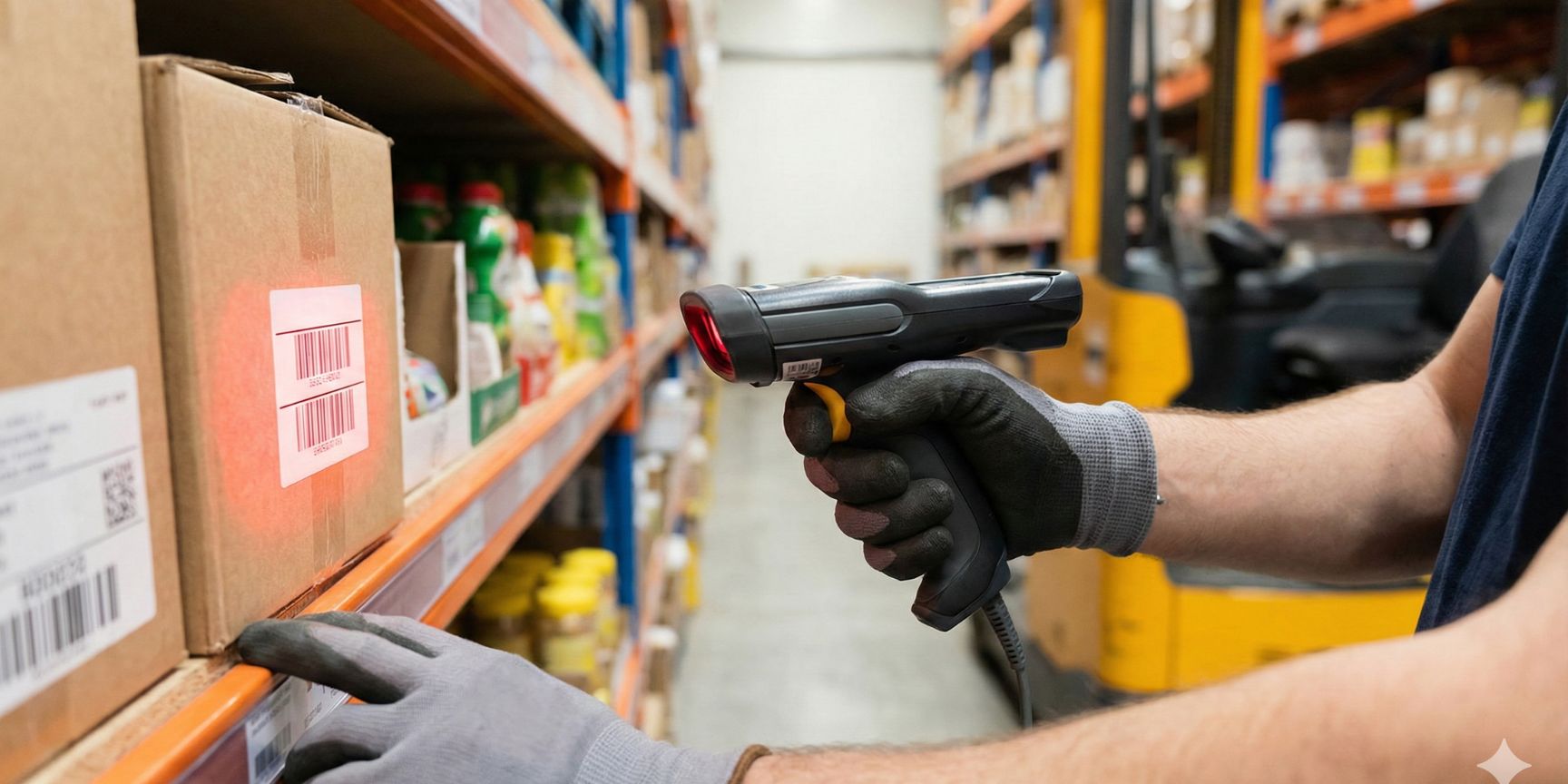
Technology (WMS): A modern in-house warehouse cannot be controlled without a powerful warehouse management system (WMS ). The WMS is the brain of the warehouse. It controls incoming goods, storage (chaotic vs. fixed location), picking strategies (e.g. pick-by-scan, pick-by-voice, multi-order picking) and outgoing goods.
Process optimisation (CIP): An in-house warehouse carries the risk of "operational blindness". There is no external benchmark that a contract logistics provider automatically brings to the table by looking after several customers. A continuous improvement process (CIP) is absolutely necessary.
Automation: The in-house warehouse must decide on the use of automation. Is MDE scanning (mobile data capture) enough? Or is it worth investing in conveyor technology, sorters, AutoStore or automated guided vehicles (AGVs)?
Cost and performance analysis in the in-house warehouse (KPIs)
In order to measure the success of an in-house warehouse, the costs must be made transparent. These are divided (greatly simplified) into:
Capital-bound costs (fixed):
- Depreciation (depreciation) on buildings and technology (in the case of purchase/construction).
- Rental or leasing costs (in the case of rent).
- Interest on tied capital.
Operating costs (variable/fixed):
- Personnel costs (incl. non-wage costs, training).
- IT costs (WMS licenses, support, hardware).
- Energy costs (heating, light, electricity for industrial trucks).
- Maintenance and repairs.
- Insurance and administration.
Important key figures (KPIs) for the management of the company's own warehouse:
Storage Cost Rate: Total Storage Cost / Average Inventory (or per m² / per pallet).
Turnover frequency: How many times per year is the inventory completely "rotated"? (High turnover frequency = low capital commitment).
Pick performance: Number of picks per hour / per employee.
Error rate: Incorrect deliveries or inventory reconciliation.
Degree of land utilization: Used storage space / Available storage space.
FAQ: Frequently asked questions about in-house storage
Question: From what size of company or what turnover is an in-house warehouse worthwhile?
Answer: There is no fixed turnover limit. The decision depends more on the stability of the volume and the strategic importance of logistics. A company with a very high but extremely fluctuating volume (e.g. start-up in hype) often fares better with a service provider (contract logistics). A medium-sized company with stable, predictable throughput and specific requirements is more likely to benefit from its own warehouse.
Question: What are the biggest mistakes when planning an in-house warehouse?
Answer:
1. Too low a height: The most common and expensive bad investment.
2. Inflexible processes: The warehouse is built around an "as-is" state and cannot reflect future growth or changed order structures (e.g. more e-commerce).
3. Underestimation of IT: The WMS is seen as a pure "storage space manager" instead of a process control tool.
Question: Is an in-house warehouse more sustainable than outsourcing?
Answer: It at least provides more control over sustainability. The owner/operator can invest in photovoltaics on the roof (often 100% self-consumption possible), e-charging infrastructure for trucks or efficient insulation and heating (e.g. heat pumps). With a service provider, you are dependent on its sustainability strategy.
Conclusion: The in-house warehouse as a strategic success factor
The company's own warehouse is much more than just a hall for storing goods. It is a deliberate entrepreneurial decision for maximum control and a deep investment in capital, personnel and technology.
While contract logistics offers flexibility and variabilization of costs, the in-house warehouse allows for the creation of tailor-made, highly integrated logistics processes that can serve as a real competitive advantage. However, success stands and falls with the right strategic planning – from the "make-or-buy" analysis to the selection of the logistics property to operational excellence in daily warehouse logistics.