




Multi-Order Picking in Warehouse Logistics
Table of Contents
- Multi-order picking: the efficiency engine of modern intralogistics
- Process Architecture: Batch Picking vs. Cluster Picking
- The time factor: Why multi-order picking is indispensable
- Requirements for the logistics property and hall layout
- Perspective Contract Logistics: Flexibility as a Currency
- Technological support: IT is indispensable
- Questions and Answers (Q&A) on Practice
- Conclusion and outlook
Multi-order picking: the efficiency engine of modern intralogistics
Multi-order picking (MOP) is a method of order fulfillment in which an order picker processes several customer orders simultaneously in a single pass. In contrast to single-order picking, in which each order is processed separately, MOP bundles the withdrawals. This is a decisive economic factor, especially in e-commerce and spare parts logistics, where small-scale orders dominate.
In practice, this means that the warehouse employee heads for a storage location and picks goods for two, four or even twelve different orders at the same time. This not only changes the process, but also places specific demands on the storage technology and the property itself.
Process Architecture: Batch Picking vs. Cluster Picking
To understand MOP in depth, one must distinguish between two main strategies, which are often used interchangeably, but work differently logistically:
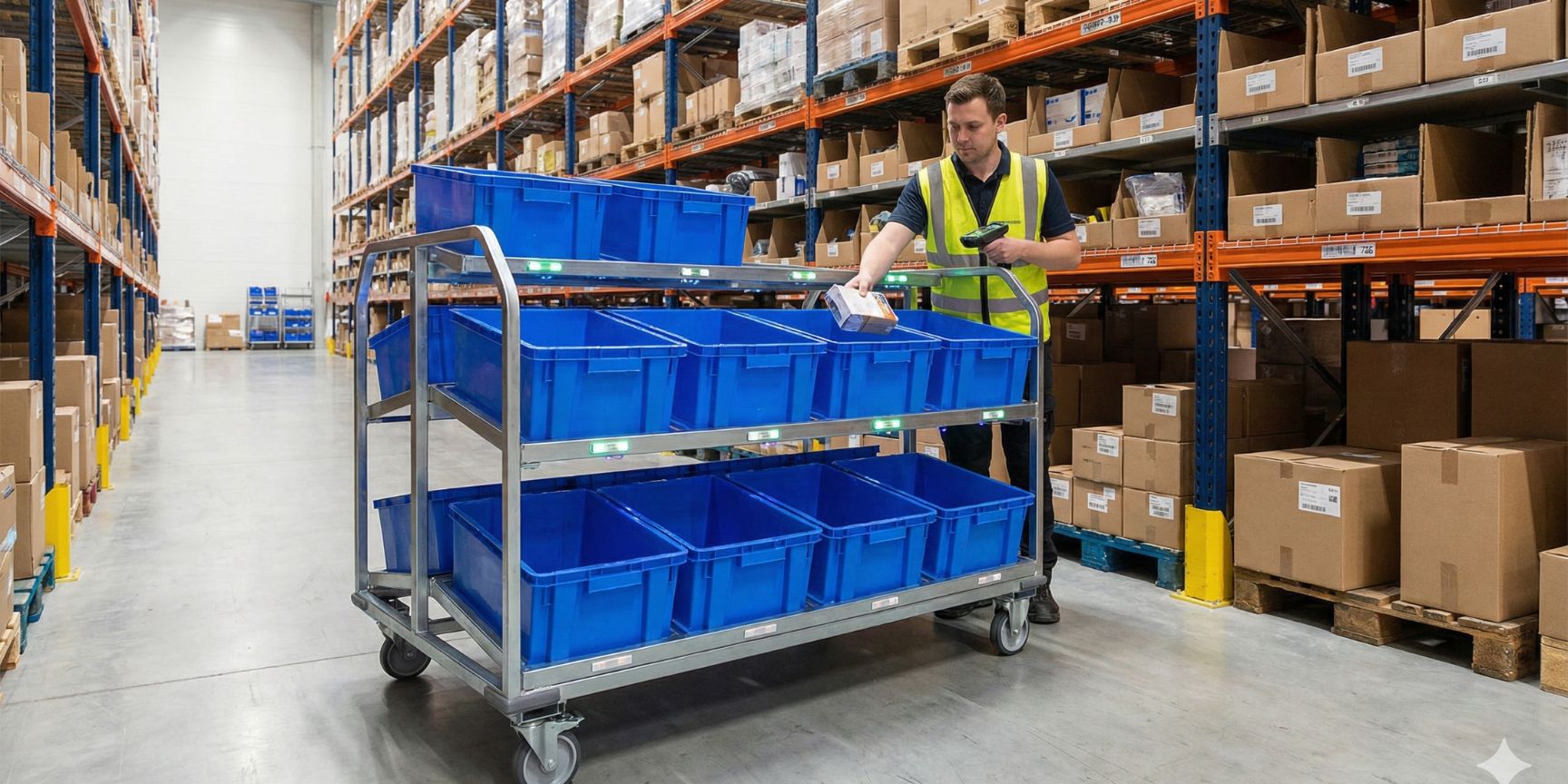
- Cluster picking (sort-while-pick): Here, the employee carries a picking trolley with him that has separate compartments (e.g. cartons or boxes). Each order is assigned to a compartment. When picking the item, the employee sorts the item directly into the correct order compartment. The advantage: After the tour, the orders are ready to be shipped; a downstream sorting process is no longer necessary.
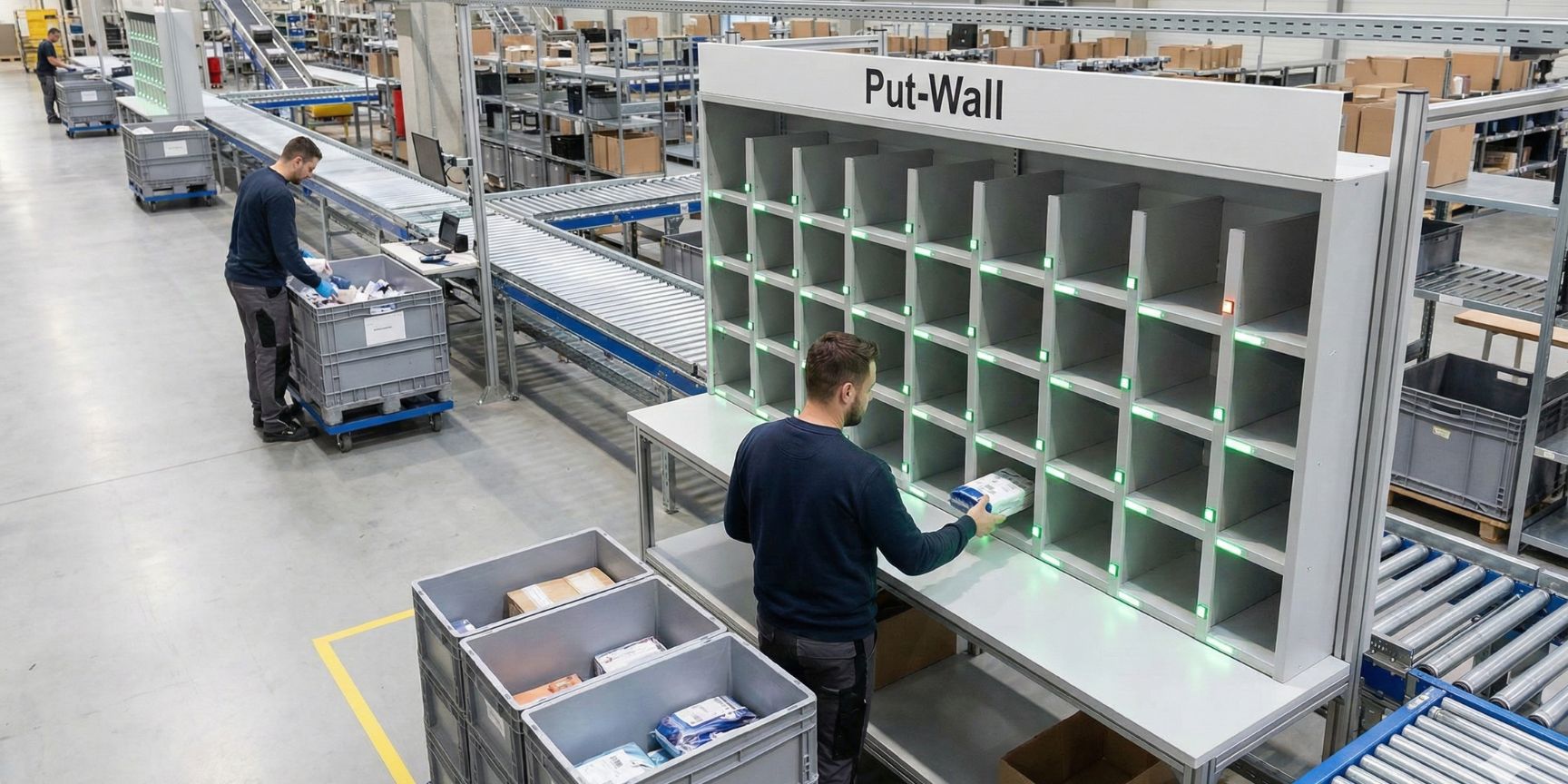
- Batch picking (pick-and-sort): Here, the items for all orders are collected and removed in a container (the so-called batch). Only after the tour has been completed is the collected quantity distributed to the individual customer orders in a downstream area (sorter, put wall). This allows for even higher pick rates, but requires more space for consolidation.
The time factor: Why multi-order picking is indispensable
In classic warehouse logistics, 50% to 60% of the total picking time is often attributable to the pure travel time (the time that the employee runs from one storage location to the next). The actual extraction (gripping time) and information processing (dead time) make up the smaller part.
MOP massively attacks this critical "travel time block".
- Example calculation: If an employee has to travel 500 meters for a single order, he or she will travel 2000 meters for 4 individual orders. If these 4 orders are combined in a multi-order pick, the distance often drops to 600-700 meters for all four orders combined. The "pick density" (number of picks per meter of distance) increases significantly.
Requirements for the logistics property and hall layout
From the point of view of project developers and investors for logistics properties, the choice of picking method has a direct influence on the hall design. MOP is not a pure software process; it needs physical space.
- Aisle widths: While narrow aisles are often sufficient for single-order picking, cluster picking requires wider aisles. The picking trolleys must be larger in size to accommodate 8 to 12 containers. A standard corridor of 1.20 m can become a bottleneck here; Widths of 2.50 m or more are often necessary to enable oncoming traffic.
- Lighting and floor conditions: Since MOP often requires a high level of concentration (avoiding errors during sorting), an illuminance of at least 200 to 300 lux in the aisles is essential. In addition, industrial floors must be extremely flat (DIN 18202, line 4), otherwise the heavily loaded multi-order trolleys are difficult to manoeuvre.
- Consolidation areas: Batch picking (pick-and-sort) in particular requires less space in the aisles, but significantly more space in the outbound goods area. Here, areas for put walls or sorter systems must be planned. This shifts the area ratio from the storage zone to the action area.
Perspective Contract Logistics: Flexibility as a Currency
For contract logistics companies, MOP is often the key to profitability. Contract logistics contracts are often based on cost-per-unit or cost-per-order models.
- Scalability: During peak times (e.g. Black Friday), MOP allows you to increase volume without having to hire more staff in a linear fashion. An experienced picker can increase his performance from e.g. 60 picks/hour to 120-150 picks/hour in the MOP process, depending on the item structure.
- Multi-client capability: In multi-user centers, MOP systems must be able to cleanly separate orders from different clients or mix them intelligently, provided that the shipping destinations are identical (cross-docking scenarios).
Technological support: IT is indispensable
Manual MOP is prone to errors. If an employee has to distribute 10 items across 4 compartments, the risk of a misthrow rate increases. Therefore, MOP is almost always tied to assistive technologies:
- Pick-by-Light / Put-to-Light: Illuminated displays at the storage location or on the picking trolley show exactly how many parts need to be placed in which compartment.
- MDE / Handhelds: Mobile data acquisition devices guide the employee through the warehouse in a route-optimized manner.
- Pick-by-Voice: Voice commands keep hands and eyes free, which is particularly important when handling bulky goods in the MOP process.
Questions and Answers (Q&A) on Practice
Question: From which order structure is multi-order picking worthwhile?
Answer: MOP shows its strengths when the ratio of "lines per order" is low (typically 1 to 3 items) and the range of items is large. For large orders (e.g. 50 items per order), single-picking is usually more efficient, as the trolley is quickly full anyway.
Question: How long is the training period for employees?
Answer: It is higher than with single picking. The cognitive load (mental load) is greater because the employee has to constantly switch between "Which product?" and "Which subject?". However, intuitive systems such as Pick-by-Light can reduce the training time to a few hours.
Question: What role does the weight of the articles play?
Answer: A limiting role. MOP is ideal for small parts (cardboard, textile, electronics). For heavy goods (white goods, furniture), MOP is hardly feasible for ergonomic reasons (weight of the trolley) and safety aspects.
Conclusion and outlook
Multi-order picking is much more than an organizational measure; it is a strategic decision that determines the architecture of the logistics property and the selection of the conveyor technology. For contract logistics companies and operators of fulfillment centers, it is the most effective method to counter the growing cost pressure and the shortage of personnel by using the available resource "time" as efficiently as possible.