



Micro-hubs in urban logistics
Table of Contents
- The Micro-Hub: Rethinking Urban Logistics – A Turning Point for Warehousing, Services and Real Estate
- What is a Micro-hub?
- The Role from the Perspective of Warehouse Logistics
- Perspective of Contract Logistics: New Business Models
- The "Micro-Hub" Logistics Property: Requirements and Potentials
- Facts, Figures, Data: The Market at a Glance
- Challenges and Outlook
The Micro-Hub: Rethinking Urban Logistics – A Turning Point for Warehousing, Services and Real Estate
In the dynamic world of city logistics, driven by booming e-commerce and the call for more sustainability, the micro-hub is establishing itself as a central building block for the fine distribution of goods in urban areas.
What is a Micro-hub?
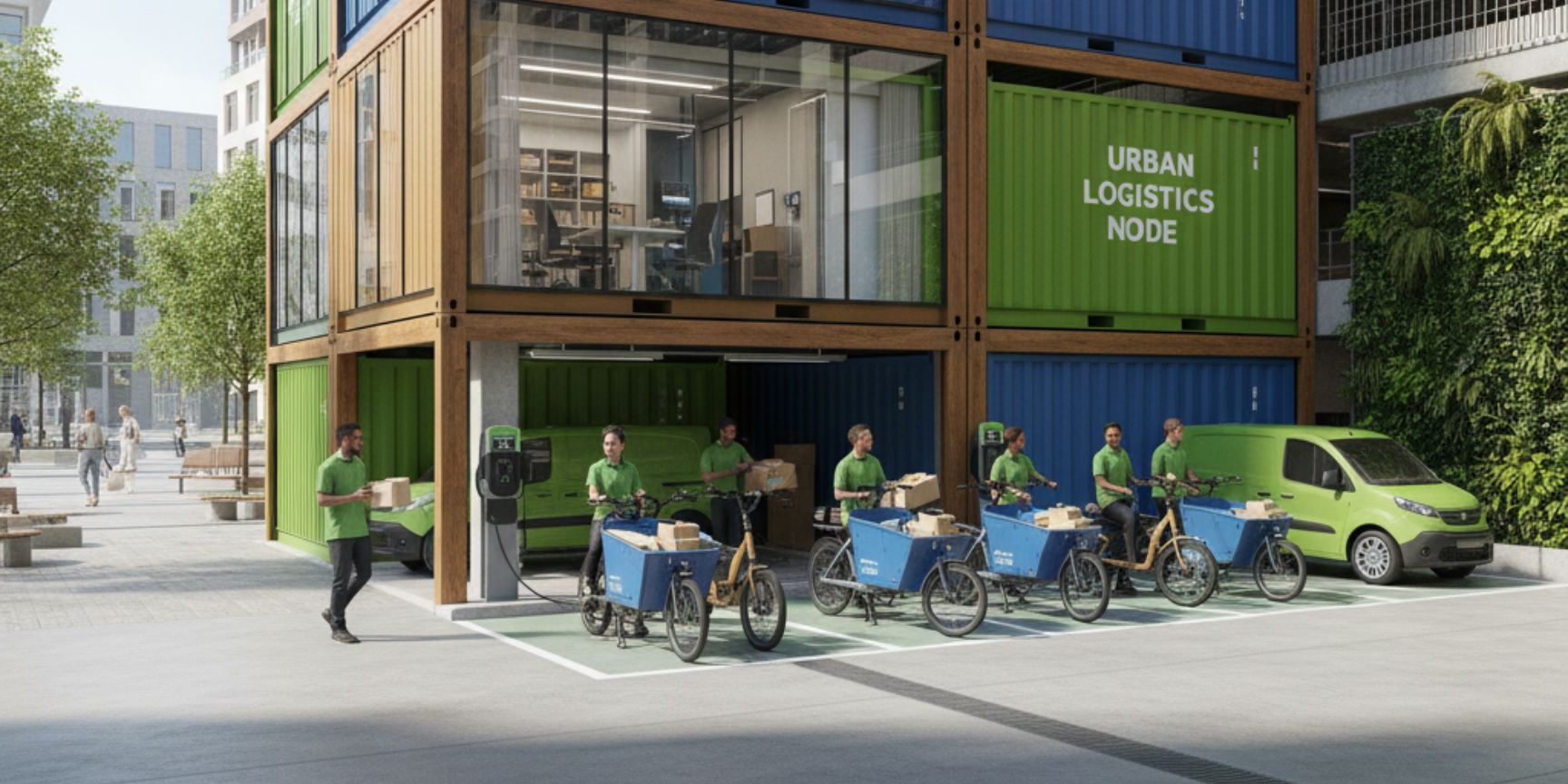
A micro-hub is a small, decentralized logistics facility strategically placed in urban or peri-urban areas. It acts as a transshipment point and temporary buffer for shipments on the "last mile" to the end customer. In contrast to large logistics centers on the outskirts of cities, which are designed for truck traffic, the micro-hub serves as the basis for low-emission fine distribution, usually by cargo bike, electric van or even on foot. The areas typically vary between 15 m² and 300 m² and can range from mobile containers to fixed installations in converted shops or parking garages.
The Role from the Perspective of Warehouse Logistics
From the perspective of pure warehouse logistics, a micro-hub represents a significant departure from traditional processes. The operational processes are designed for maximum throughput and minimum dwell time of the goods.
What Warehouse Logistics Processes take place in a Micro-hub?
The core function is cross-docking. In the morning, the hubs are supplied with pre-sorted shipments for the respective delivery area by larger, often electrically driven, vans or small trucks. Within the hub, only a quick fine sorting according to routes for the couriers takes place. Classic warehouse processes such as storage, complex picking or inventory play a subordinate role. The focus is on speed and efficiency to deliver shipments on the same day. Modern hubs use simple digital tools for shipment tracking and route planning that are specifically tailored to the needs of fine distribution.
Perspective of Contract Logistics: New Business Models
For contract logistics service providers (3PLs), micro-hubs are more than just transshipment points; they are enablers for innovative, customer-oriented services and new business models.
What Value-added Services can be offered through Micro-hubs?
Beyond pure parcel delivery, micro-hubs enable a range of value-added services. These include:
- Same-day and instant delivery: The proximity to the customer enables deliveries within a few hours or even minutes, a decisive competitive advantage in quick commerce.
- Returns management: Customers can easily hand in returns at the hub, which speeds up the process for consumers and retailers.
- Flexible pick-up points (Click & Collect): The hub serves as a pick-up station for goods ordered online.
- Mini-fulfillment: For local retailers without their own storage capacities, the micro-hub can take care of the storage, picking and shipping of smaller quantities of products.
- Technician and service logistics: Tradesmen or technicians can temporarily store spare parts or tools here and call them up as needed, which increases the efficiency of their assignments.
These services transform the micro-hub from a pure cost factor into a profitable service center and an integral part of the urban supply and value chain.
The "Micro-Hub" Logistics Property: Requirements and Potentials
The rise of micro-hubs is creating a new, highly interesting niche segment in the logistics real estate market. The requirements for these objects are fundamentally different from classic "big box" halls.
What Distinguishes a Suitable Property for a Micro-hub?
The location is the all-important factor. A high population and demand density in the immediate vicinity is essential for economic efficiency. Other criteria are:
- Accessibility: Good connections for delivering vans (up to 7.5t) and at the same time safe, direct routes for cargo bikes.
- Condition: Ground-level access is ideal. Sufficient manoeuvring and loading space in front of the object is a must. Inside, in addition to the pure handling area, secure parking and charging facilities for the e-cargo bikes, battery charging facilities and small social rooms for the drivers are also needed.
- Flexibility: Often, it is not long-term leases that are sought, but flexible models. This opens up opportunities for the conversion of vacant retail space, workshops, underground car parks or even parts of multi-storey car parks.
For property owners in urban locations, renting to logistics service providers offers an attractive opportunity to make space that would otherwise be difficult to let profitable.
Facts, Figures, Data: The Market at a Glance
The CEP market (courier, express, parcel) in Germany is growing inexorably. Forecasts by the German Parcel and Express Logistics Association (BIEK) predict an increase in shipment volume to around 5.7 billion shipments by 2026. This growth is primarily taking place in the cities and is creating enormous pressure. Studies such as those conducted by Fraunhofer IML show that the use of micro-hubs and cargo bikes can reduce CO2 emissions on the last mile by over 30% and significantly relieve inner-city traffic. A single delivery truck can be replaced by 3-5 cargo bikes operating from the hub.
Challenges and Outlook
Despite the obvious benefits, implementing micro-hubs is not a foregone conclusion. High rents in city centres, complex approval procedures and the need for a high consignment density to ensure profitability are the biggest hurdles. In addition, operation requires intelligent control and coordination.
Are Multi-user Hubs the Future?
Yes, there are many indications that it will. Multi-user or provider-neutral hubs, in which several CEP services, retailers or logistics companies share the infrastructure, are considered to be particularly future-proof. They bundle shipment volumes, which increases profitability for all parties involved and further reduces the space required in the city. The future lies in connected, technologically advanced and cooperatively used urban logistics spaces that enable an efficient, sustainable and liveable city.