




Middle warehouse in logistics
Table of Contents
- Definition: What is meant by a middle bearing?
- Strategic functions and goals in the supply chain
- Differentiation: middle warehouse vs. central warehouse, buffer warehouse and regional warehouse
- Requirements for the logistics property (hall)
- The role of the middle warehouse in contract logistics
- Processes, technology and KPIs in practice
- FAQ: Important questions and answers about the Mittellager
Definition: What is meant by a middle warehouse?
In logistics science, the term medium-sized warehouse is not a rigid, structurally defined category (such as a "high-bay warehouse"), but a functional and process-related classification of a warehouse within a multi-level supply chain.
A medium-sized warehouse is a warehouse location that is located between two or more stages of the value chain . It is neither the pure procurement warehouse (which receives raw materials directly from the supplier) nor the final delivery or distribution warehouse (which serves the "last mile" to the end customer).
Its primary task is to decouple the upstream stages (e.g. production, overseas procurement) from the downstream stages (e.g. regional distribution, store delivery, e-commerce fulfillment). It acts as a central buffer and consolidation point to increase the efficiency of overall logistics, optimize inventory, and increase responsiveness to market fluctuations.
Strategic functions and goals in the supply chain
The establishment of a medium-sized warehouse is a strategic decision aimed at balancing the trade-offs of logistics (cost, time, quality, flexibility).
The core functions are:
- Decoupling and buffering function: This is the most important function. A central warehouse decouples the rhythm of production from the rhythm of sales.
- Example production: Production can run in optimized, large batch sizes (e.g. 10,000 pieces of an article) in order to minimize set-up costs. The central warehouse accommodates these production batches.
- Example sales: However, sales or trade requests volatile, small quantities (e.g. 50 pieces) on a daily basis. The middle warehouse meets this demand without the production having to change its rhythm. It thus protects the chain from the so-called "bullwhip effect".
- Consolidation function: Goods from different suppliers or production sites (national or international) are bundled in the middle warehouse. Instead of many small, expensive partial deliveries (LTL – Less Than Truckload) to the regional locations, bundled, cost-effective full truckloads (FTL) are shipped from the middle warehouse.
- Assortment formation and storage function: The middle warehouse often stocks the entire or a broad core assortment of a company. Regional warehouses or fulfillment centers then often only hold a reduced, fast-moving assortment (A-items), while slow-moving B- and C-items remain centrally in the middle warehouse and are shipped from there as needed (centralized inventory).
- Security function: In times of volatile supply chains (e.g. due to geopolitical crises or shortages of raw materials), the middle warehouse serves as a strategic buffer (safety stock) to ensure the ability to deliver (service level) to the customer, even if the inbound flow is disrupted.
Differentiation: middle warehouse vs. central warehouse, buffer warehouse and regional warehouse
The terms are often used synonymously, but a clear distinction is important for experts.
- Central warehouse: This term primarily describes organizational or geographical centrality. A middle warehouse can be a central warehouse (if it is the only main warehouse). However, the term "middle" emphasizes the procedural position (in the middle of the river) more than the geography.
- Buffer storage: A buffer storage facility is used exclusively for decoupling. A central warehouse almost always fulfils a buffer function, but often goes beyond this (e.g. through consolidation or assortment formation). A "buffer stock" can also be a small buffer directly on a production line; a "medium-sized warehouse", on the other hand, usually refers to an independent location or a large, separate zone.
- Regional warehouse: The regional warehouse is downstream of the middle warehouse. The middle warehouse supplies the regional warehouses, which then take over the fine distribution in a specific region.
- Cross-docking point: A cross-dock (CD) is designed for maximum handling with minimum storage time (< 24 hours). A central warehouse, on the other hand, is explicitly designed for a longer dwell time (buffering) and has a classic storage function (storage, retrieval).
Requirements for the logistics property (hall)
The focus on "medium-sized warehouses" has a direct impact on the requirements for the logistics property. Since stocks are held here and not just handled, the focus is on volume and efficiency.
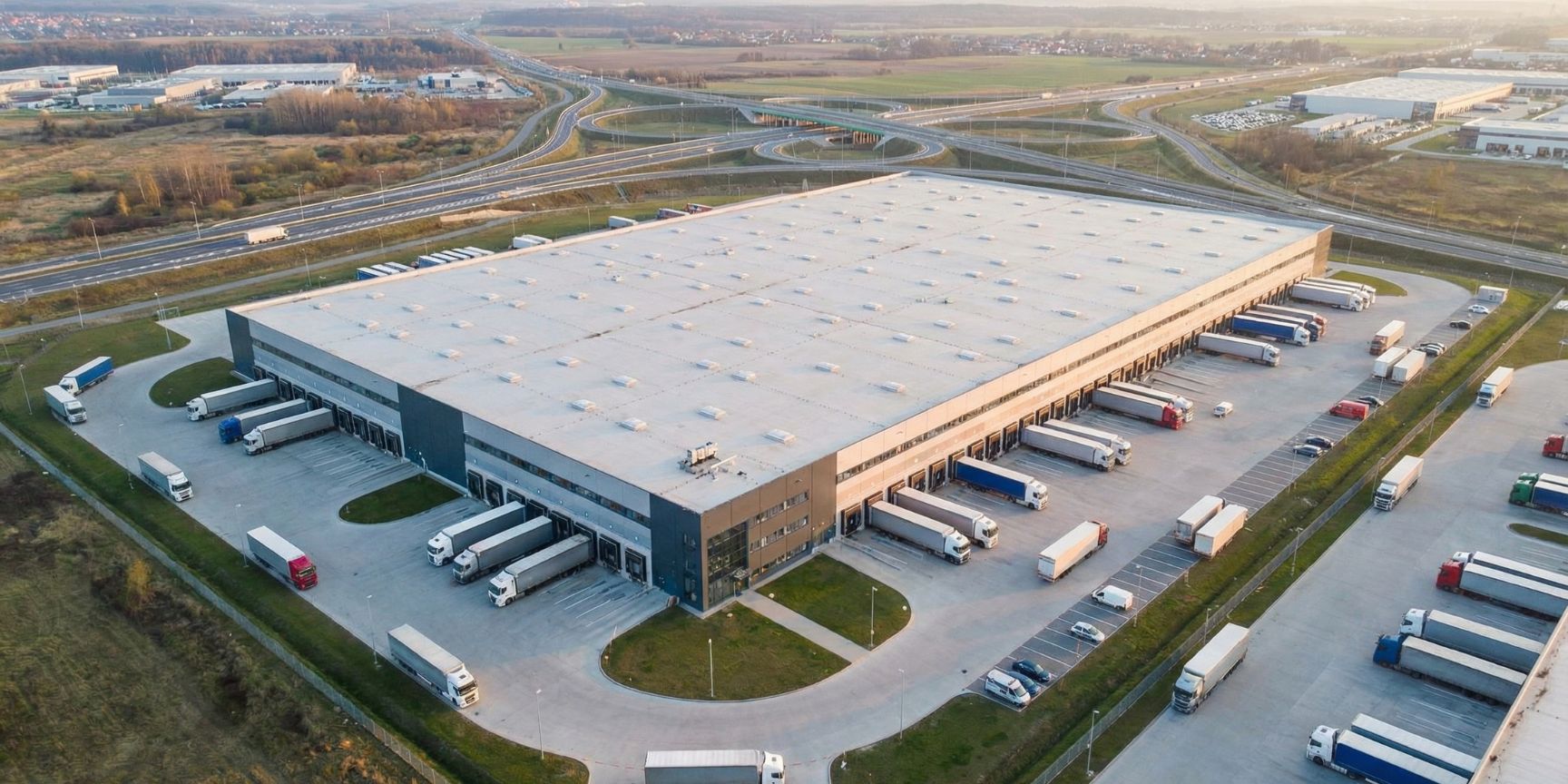
- Location (macro location): In contrast to city logistics hubs, it is not the proximity to the end customer that is decisive, but the proximity to supra-regional transport hubs (motorway junctions, container terminals, freight villages). The location must be optimally accessible for both inbound (from production/port) and outbound (to regional warehouses).
- Area and height (property): Mid-sized warehouses are often "big box" properties (typically > 20,000 m², often 50,000 m² and more). The hall height (UKB – lower edge of truss) is decisive for the storage volume; today, 10 m to 12.5 m are standard for efficiently operating high-bay warehouses or narrow-aisle warehouses.
- Floor load: For heavy shelves, a high floor pressure/load capacity (often > 5 t/m²) is required.
- Goals: A high number of gates (ramps) is important. In the case of pure central warehouses, a clear relationship between incoming and outgoing goods gates is often defined in order to cleanly separate the internal flows (e.g. I-Flow or U-Flow).
The role of the middle warehouse in contract logistics
For contract logistics service providers (3PL), medium-sized warehouses are a central business area. Companies often outsource this function to have variable costs instead of fixed costs and to focus on their core business.
In contract logistics, the middle warehouse often becomes a place for value-added services (VAS). Since the commodity "rests" here before being decentralized, this is the ideal time for services such as:
- Quality
- Outer packaging (co-packing)
- Set formation (kitting)
- Labelling or price labelling
- Packaging for specific promotions or countries
In this case, the 3PL service provider not only provides the hall (property), but also manages the entire process – from the WMS (Warehouse Management System) to the personnel.
Processes, technology and KPIs in practice
In the middle warehouse, different processes often dominate than in e-commerce fulfillment.
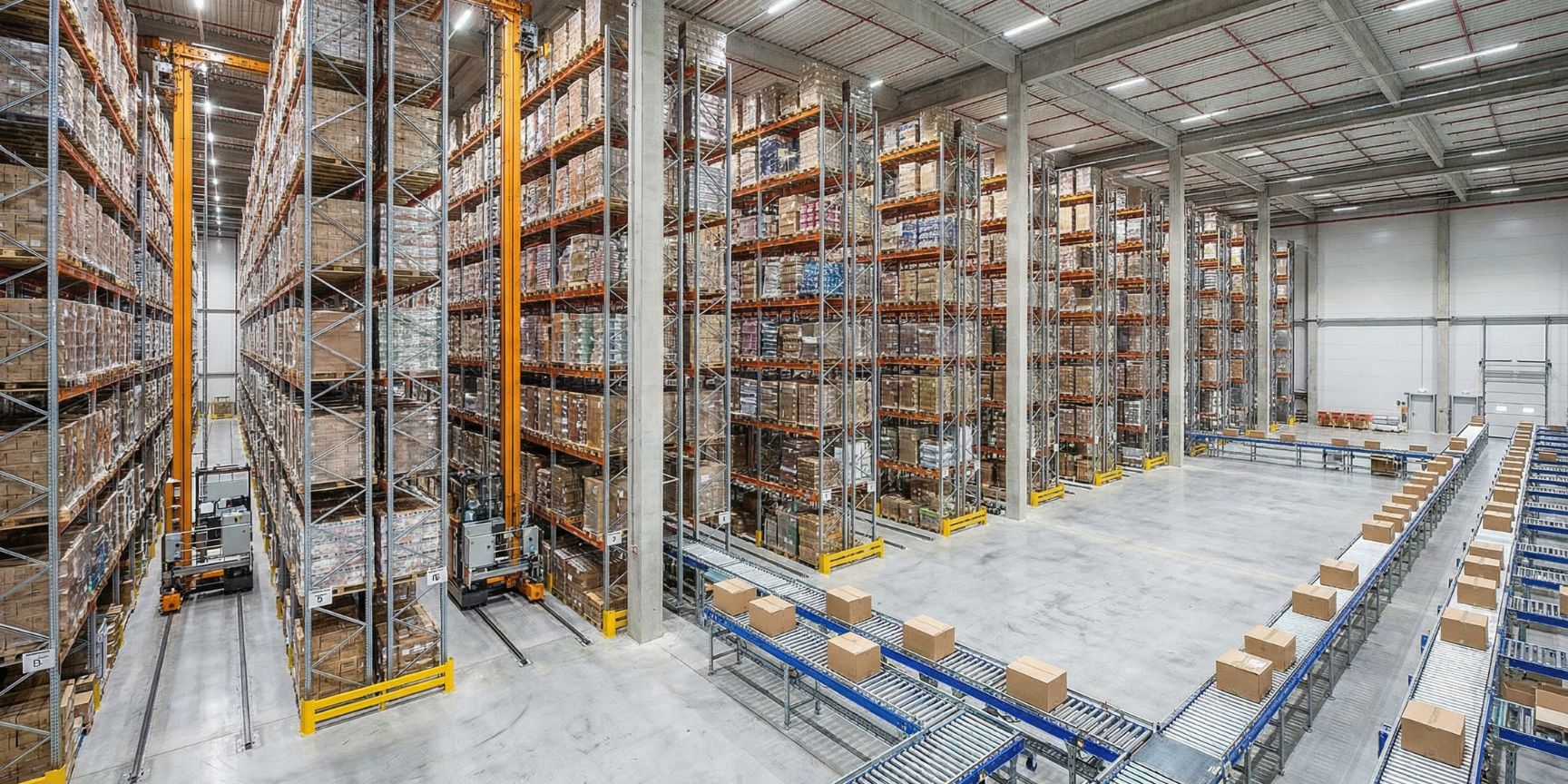
- Storage: Often done pallet-clean. The goods come from production in single-type full pallets (or containers) and are stored (e.g. by reach truck or narrow-aisle forklift).
- Retrieval/picking: Retrieval to regional warehouses is also often carried out on pallets or in larger containers (case pick). Fine-grained piece picking tends to take place in the downstream stages, but can occur in the VAS area.
- Technology: Due to the often high volumes and standardized processes (pallet handling), the degree of automation in Mittellägern tends to be high. Typical are:
- Automatic pallet storage ( e.g. stacker cranes - SRMs)
- WMS (Warehouse Management System) as the brain for controlling all inventories and processes.
- Conveyor technology for connecting incoming goods, buffer zone and outgoing goods.
- KPIs (key figures): Important key figures for managing a medium-sized warehouse are:
- Storage range: How long will the inventory in the middle warehouse last to meet the demand of the regional warehouses?
- Turnover frequency: How often is the stock renewed per year? (Often lower in mid-range warehouses than in distribution warehouses).
- Storage cost rate: Cost per cubic meter stored or per pallet.
FAQ: Important questions and answers about the middle warehouse
Question: Doesn't a mid-range warehouse slow down the speed of the supply chain?
Answer: It adds a physical step, but increases the overall efficiency and resilience of the chain. It enables optimized (and therefore faster) full loads instead of slow partial deliveries. It decouples production from the volatile market, which makes production more efficient. A central warehouse is a "speed regulator", not a brakeman.
Question: Is a mid-center warehouse always a separate building?
Answer: Most of the time, yes. From a process engineering point of view, it is a separate location. In very large logistics centers (e.g. 100,000 m²), however, a "medium-sized warehouse" can also be a structurally or systemically separated zone (e.g. Hall A is the buffer for production, Hall B is e-commerce fulfillment).
Question: For which industries is a central warehouse typical?
Answer: Wherever production (or global procurement) and sales (regional trade/customers) differ greatly in time or quantity. Classic examples are:
- Automotive industry: As a buffer for parts from suppliers before they are delivered to the assembly line just-in-sequence.
- Retail (FMCG): As a central warehouse that supplies the regional distribution centers of the supermarket chains.
- Pharmaceutical: As a central, often air-conditioned warehouse (GDP-compliant) to supply wholesalers.
Q: Is the importance of Mittellägern increasing or decreasing? A: It's rising. The supply chain crises of recent years have shown that "lean management" (minimal inventory) comes at the expense of resilience. Companies are once again building up strategic buffers in a targeted manner (de-risking). These buffers are often formed in central warehouses in order to prevent inventory costs from exploding (risk pooling).