




Narrow-aisle warehouses in logistics
Table of Contents
- Definition: Narrow-aisle warehouse (NAW) – The supreme discipline of space efficiency
- Core features and technical requirements (warehouse logistics)
- FAQ: Important questions and answers about NAW
- Focus on logistics real estate: Soil as the foundation of success
- Relevance in Contract Logistics (3PL)
- Cost-effectiveness: High investment (CAPEX) vs. low operating costs (OPEX)
- Summary: Advantages and disadvantages in practice
Definition: Narrow-aisle warehouse (NAW) – The supreme discipline of space efficiency
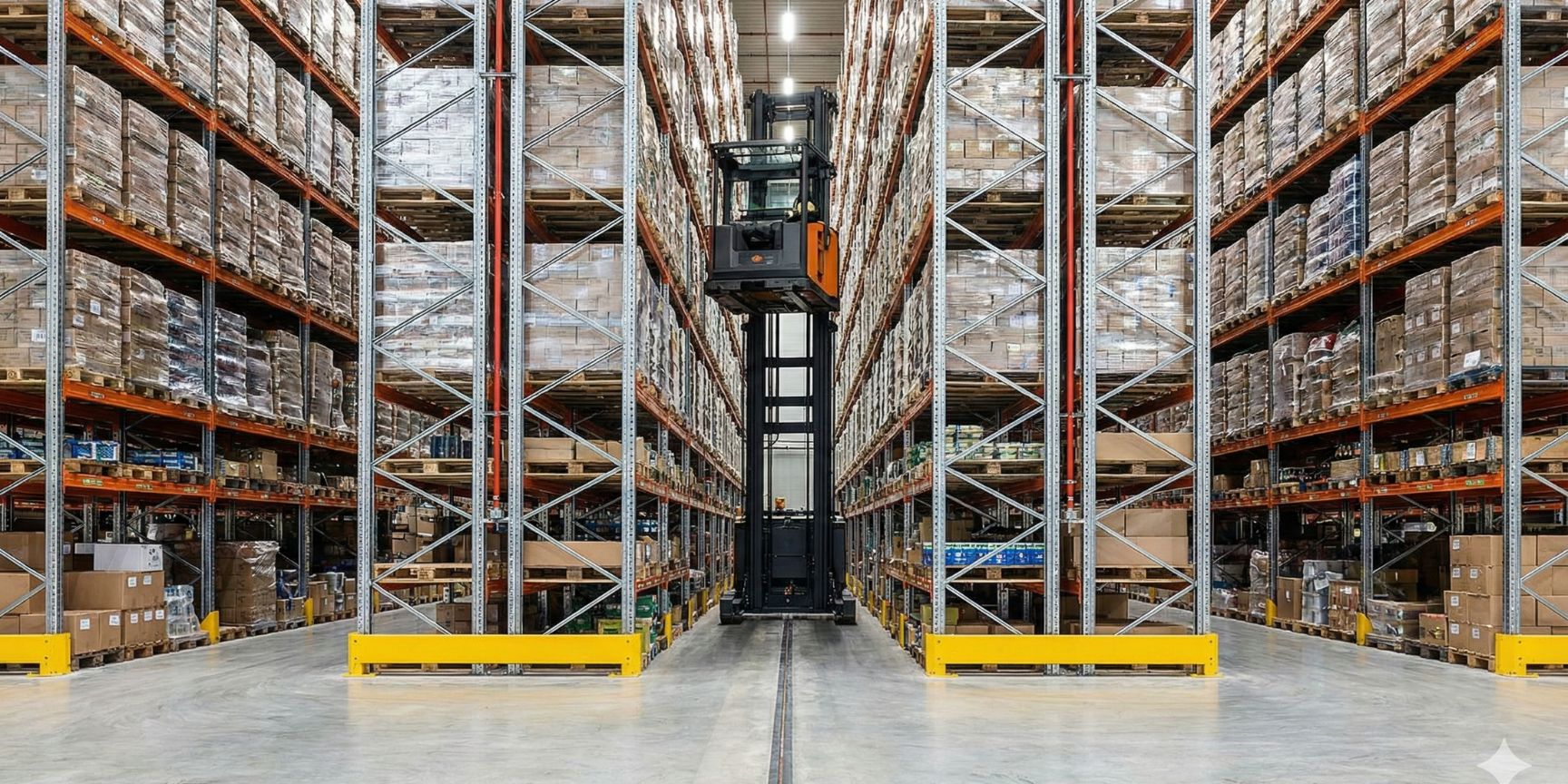
A narrow-aisle warehouse (NAW) is a specific design of the pallet high-bay warehouse that is characterized by extremely narrow work aisles. While conventional wide-aisle warehouses have aisles of 2.50 meters to over 3.50 meters (primarily for forklifts), NAW operates with aisle widths of typically only 1.50 meters to 1.90 meters.
This drastic reduction in traffic space is the core of the concept: it serves to maximise the degree of space utilisation (ratio of storage space to total area) and, in combination with large shelf heights (often 12 to over 17 meters), the degree of space utilisation. An NAW is inherently designed for high storage density and capacity and is often found in industries with high storage requirements where there is limited (or expensive) floor space.
Core features and technical requirements (warehouse logistics)
The operation of an NAW is inextricably linked to special industrial trucks and structural requirements.
Industrial trucks
Standard forklifts cannot operate in these aisles. Only narrow-aisle forklifts (including VNA forklifts) are used. A distinction is made between two main types:
- Man-down machines (storage and retrieval machines): The driver remains on the ground while the load handling device (e.g. swivel push fork or telescopic fork) stores and retrieves the pallet. They are ideal for pure pallet handling (Full Pallet In / Full Pallet Out).
- Man-up devices (order picking forklifts): The driver drives up to the removal height together with the cab. This is essential if NAW also picks directly (pick-by-case or pick-by-piece).
Forced leadership in the corridor
Due to the minimal tolerances, these trucks cannot be manoeuvred freely in the aisle. They require forced guidance to prevent damage to shelves and equipment and to enable high travel speeds.
- Mechanical guide: Two guide rails (forced rails) attached to the side of the floor in which lateral rollers run on the forklift. This is a robust but inflexible solution.
- Inductive guidance (inductive steering): A guide wire embedded in the ground generates a magnetic field that the forklift detects and automatically follows. This is the most modern shape, allows a "jointless" floor, but requires precise installation.
FAQ: Important questions and answers about NAW
Question 1: Is a narrow-aisle warehouse the same as a high-bay warehouse?
Answer: Not necessarily, but mostly. "High-bay warehouse" is primarily defined by the height (usually from 12 meters). "Narrow-aisle warehouse" (NAW) is defined by the aisle width. In practice, an NAW is almost always also a high-bay warehouse, as the investment in the narrow aisles (space efficiency) only makes economic sense in combination with great height (space efficiency). However, a high-bay warehouse can also be designed as a wide-aisle warehouse.
Question 2: What is the handling capacity in a narrow-aisle warehouse?
Answer: The handling capacity per forklift is often very high because the travel and lifting times are optimized. However, the overall performance of the warehouse can be limited by a systemic bottleneck: due to the system, only a single industrial truck can move in a narrow aisle at a time. Overtaking or oncoming traffic is excluded. The total storage and retrieval performance of this aisle depends on this one device. Careful bottleneck analysis and simulation (e.g. number of double clearances per hour) is therefore essential before implementation.
Question 3: How flexible is an NAW when it comes to assortment changes?
Answer: An NAW is highly inflexible. The rack construction and especially the forced guide (mechanical or inductive) are static. A later reclassification of NAW gears into wide aisles or a change in the gear routing is extremely costly and time-consuming (especially in the case of induction wire in the floor). NAW is therefore primarily suitable for relatively stable assortments with plannable turnover.
Focus on logistics real estate: Soil as the foundation of success
From the point of view of logistics real estate, NAW places the highest demands on the hall of all warehouse types.
The "Super-Flat-Floor" Requirement
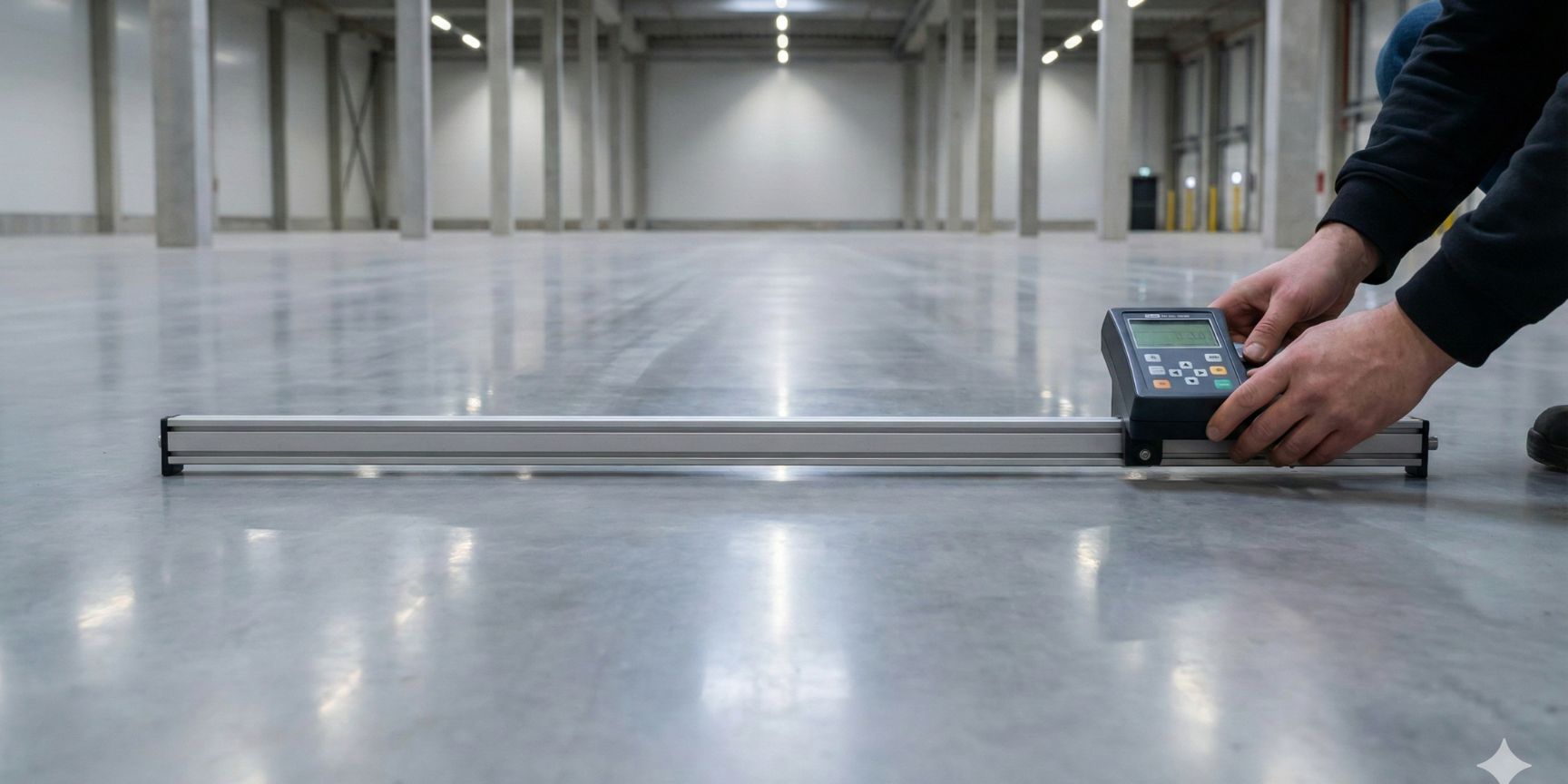
The most critical point is the flatness of the base plate. Narrow-aisle forklifts, especially at lifting heights of 15 meters and more, react extremely sensitively to the smallest unevenness. A slight inclination on the ground leads to a significant mast inclination at high altitudes, which drastically reduces positioning accuracy and, in the worst case, leads to a collision with the rack.
- Facts & Figures: For NAW, the floor must meet the strict tolerances of DIN 15185 (for mechanical guidance) or the even stricter VDMA guideline "Soil conditions for the use of narrow-aisle tapers" (especially for inductive guidance). This requires special installation methods (e.g. laser screed) and is a significant cost factor in the production of the hall. A renovation of a "normal" hall floor to NAW standard is extremely expensive.
Other structural aspects
- Clear height (LH): The clear height (lower edge of truss or sprinkler) must allow the shelving design (e.g. 17 meters) plus technical clearance (at least 1 meter).
- Fire protection: Due to the height and density, special fire protection concepts (e.g. ESFR sprinklers or in-rack sprinklers/shelf sprinklers) are often required, which place higher demands on the water supply.
- Staging Area: The NAW itself is often a "closed" system. It requires a sufficiently dimensioned pre-zone (P&D stations - Pick & Deposit), where pallets from standard forklifts (e.g. reach trucks) are transferred to the SGL machines.
Relevance in Contract Logistics (3PL)
For contract logistics service providers (3PL), NAW is a double-edged sword, but often a strategic tool.
- High space efficiency: In expensive logistics regions (e.g. metropolitan areas), NAW enables the 3PL to offer significantly more pallet spaces on the same footprint. This reduces the storage costs per pallet and is a strong selling point in tenders.
- Long-term commitment: Due to the high investment costs (real estate, technology) and inflexibility, an NAW of a 3PL is usually only realized for long-term contracts (e.g. 5-10 years) with stable, pallet-compatible goods (e.g. FMCG reserve warehouses, automotive production supply).
- Low flexibility: NAW is unsuitable for volatile customers, e-commerce fulfillment or short-term business. In a multi-user hall, a 3PL will therefore often only expand a part of the area as NAW, while the rest will serve as a flexible wide-aisle or block warehouse.
Cost-effectiveness: High investment (CAPEX) vs. low operating costs (OPEX)
The decision in favor of an NAW is primarily an economic consideration.
CAPEX (investment costs):
- Significantly higher than wide aisle warehouses.
- Costs for the "Super Flat Floor".
- Costs for forced management (esp. Inductive wire).
- Costs for the expensive NAW forklifts (often 2-3 times as expensive as a reach truck).
OPEX (Operating Costs):
- Lower (per parking space) during operation.
- Space costs (rent): The biggest lever. An NAW can increase the storage capacity by 40% to 50% on the same floor space compared to a wide-aisle warehouse.
- Personnel costs: High efficiency per operator is achieved through high automation of travel and lifting movements and optimized processes (e.g. double cycles).
The break-even point is where the savings in operating costs (especially rent and staff) compensate for the higher initial investment over the planned useful life (often 7-10 years).
Summary: Advantages and disadvantages in practice
| Pros | Cons |
| Maximum use of space and space (up to 50% more parking spaces) | Very high investment costs (floor, forklift, guidance) |
| High storage density | High inflexibility (rigid layout, expensive customization) |
| Suitable for extreme lifting heights (up to 17m+) | System bottleneck (only 1 forklift per aisle) |
| High handling capacity (with pure pallet movement) | Specialized, expensive industrial trucks required (high maintenance costs) |
| Protected operation (less collision damage due to forced guidance) | Extreme demands on the logistics property (flatness) |
| Good suitability for picking (for man-up devices) | Dependence on technology (failure of a forklift paralyzes the lane) |