




Nano-Warehouse in logistics
Table of contents
- Was ist ein Gewerbemakler für Logistikimmobilien?
- Die Kernaufgaben in der Logistikimmobilien-Vermittlung
- Wandel des Berufsbilds: Vom Vermittler zum strategischen Berater
- Wer nutzt die Dienste eines spezialisierten Maklers?
- Der konkrete Mehrwert: Warum ein Gewerbemakler unverzichtbar ist
- Was kostet ein Gewerbemakler? Die Maklerprovision erklärt
- Zukunftsaussichten: Digitalisierung und Nachhaltigkeit als Treiber
- Sustainability and Energy Efficiency in the Modern Warehouse
- What are the security aspects of a warehouse?
- Key Success Factors for Entrepreneurs in Choosing the Optimal Warehouse
What is a Nano Warehouse?
A nano warehouse, also known as a nano warehouse or micro depot, is a highly compact, often fully automated storage unit designed to store a maximum number of items in a minimal footprint. In contrast to traditional, sprawling logistics centers on the outskirts of cities, nano warehouses are purposefully placed in urban areas. They can be accommodated in vacant shops, basements, multi-storey car parks or custom-built small modular buildings.
The core idea is proximity to the end customer. By strategically positioning themselves in neighborhoods, they drastically shorten the last mile, resulting in faster delivery times (same-day or even same-hour delivery), lower transport costs and a reduction in CO2 emissions. They serve as buffer and picking warehouses for the immediate surroundings.
How does the technology behind nano-warehousing work?
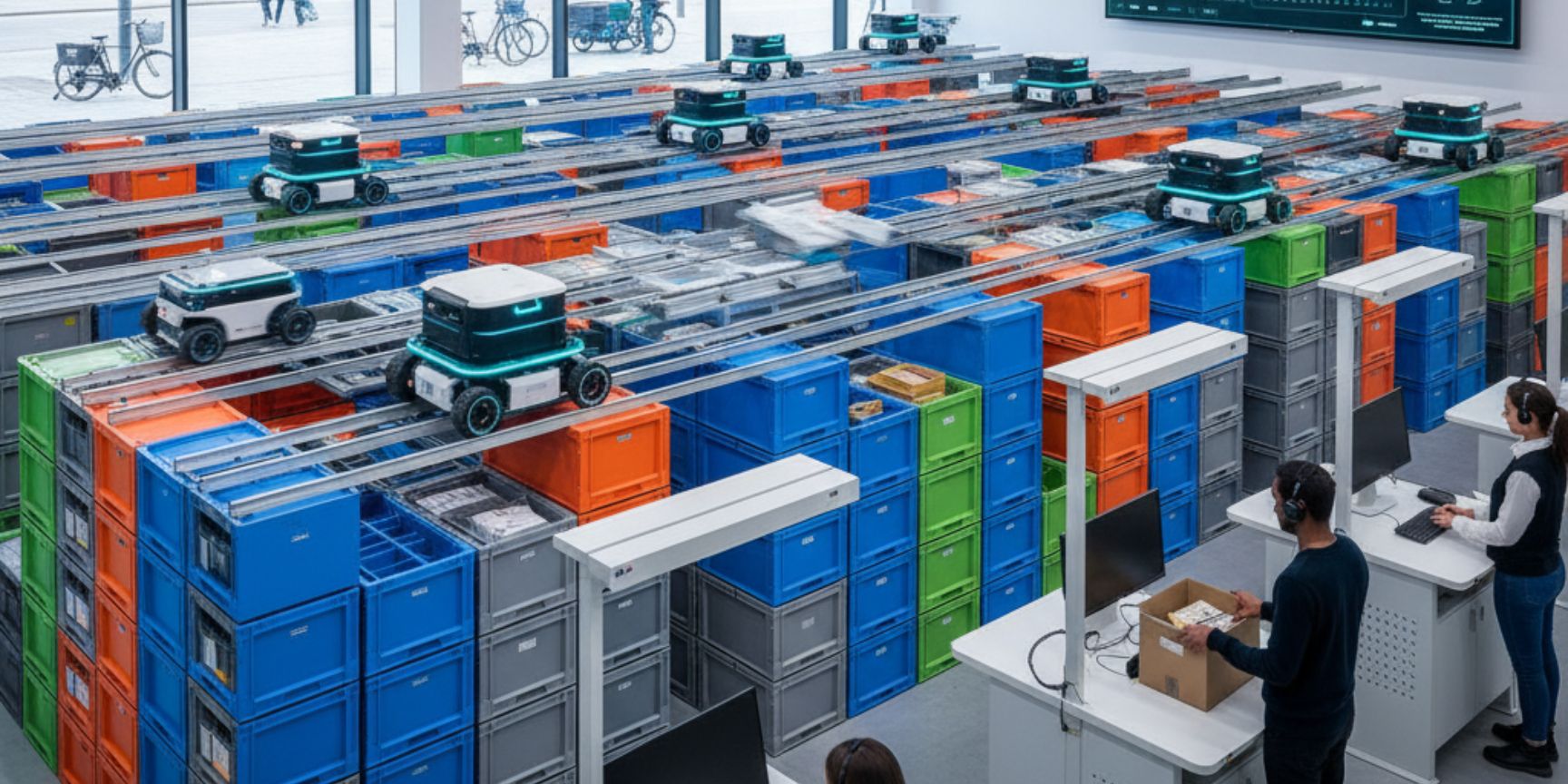
The heart of a nano warehouse is usually an automated small parts warehouse (AS/RS) or a cubi storage system. In these systems, goods are stored in standardized bins (often referred to as "bins") that are moved by autonomous robots or shuttles.
- Vertical and horizontal compaction: The robots move on rails or grids above, under and between the stacked containers. You can control each container individually, remove it and bring it to a picking station (a "port"). This principle, often referred to as "goods-to-person," eliminates the need for aisles for personnel and allows for extremely high storage density.
- Software control: A higher-level warehouse management system (WMS) controls all processes. It optimizes storage and retrieval based on order forecasts, item turnover frequency (ABC analysis), and courier route planning. The software ensures maximum efficiency and a smooth process.
Question: What role does robotics play in concrete terms? Answer: Robotics is crucial. Autonomous mobile robots (AMRs) or shuttle systems are the backbone of operations. They work 24/7, are more precise than humans and enable the physical implementation of the high storage density. A well-known example is systems in which robots move over the stacked containers on a grid, lift a container and transport it to the picking station.
Nano warehouses in contract logistics
For contract logistics service providers, nano-warehouses open up new business models and service levels. Instead of distributing shipments from a central large warehouse over long distances, they can offer their customers (e.g. e-commerce retailers) to store fast-moving products directly in the target markets.
This results in:
- Ultra-fast delivery promises: Services such as "delivery in less than 60 minutes" are becoming feasible and a decisive competitive advantage.
- Flexible scalability: A network of multiple nano warehouses can be flexibly ramped up or down based on demand. Seasonal peaks (e.g. during the Christmas season) can be absorbed by temporarily renting additional small spaces.
- Value-added services: Service providers can not only store on site, but also offer returns management, small packaging or personalized deliveries.
Requirements for the logistics property
The property for a nano-warehouse is fundamentally different from a classic "big-box" hall. The requirements are more specific and demanding in relation to urban conditions.
Question: What do you have to pay attention to when choosing a property for a nano-warehouse? Answer: The most important criteria are:
- Location: The absolute priority is proximity to a high density of end customers. Good accessibility for vans, cargo bikes or couriers is essential.
- Floor load capacity: The high storage density due to stacked containers generates a high point and surface load. A standard screed in a former shop is often not enough. Load capacities of 1,000 kg/m² or more may be required.
- Ceiling height: Although the footprint is small, height is crucial for storage capacity. A clear height of at least 4-6 meters is ideal for making the most of vertical storage.
- Power supply and data connection: The automation technology and the robots require a stable and powerful power supply as well as a fast and redundant Internet connection for the WMS.
- Fire protection: The high density of goods and the use of robotics require a well thought-out fire protection concept that often goes beyond the standard requirements.
Facts, figures, data: efficiency and potential
Although the market is still young, the first projects are showing impressive figures:
- Space efficiency: Nano warehouse systems can store several thousand to ten thousand different items (SKUs) in a footprint of just 50-500 m². Compared to a manual rack warehouse, the storage density can be increased by 4 to 10 times.
- Speed: The retrieval output of a single robot system can be 100 to 400 containers per hour . A connected order picker can thus create significantly more picks per hour than in a traditional warehouse.
- Investment costs: The costs for automation technology are considerable, but they are amortized by the savings on rent (less space in an expensive location), personnel costs and transport costs on the last mile.
Challenges and outlook
Despite the many advantages, there are also hurdles. The high initial investment in robotics and software technology can be a deterrent. In addition, the search for suitable inner-city properties with the appropriate structural conditions (esp. Ground load) is a challenge. Residential permitting procedures for 24/7 operations can also be complex.
However, the trend is clear: With the growing volume of e-commerce and customers' increasing demand for delivery speed, nano-warehouses are becoming an indispensable component of the urban logistics infrastructure. They are the logical consequence of the need to organize the flow of goods more intelligently, sustainably and closer to people.