



Net Zero Logistics
Table of Contents
- Definition: Net Zero vs. Carbon Neutrality
- The Logistics Property: From Energy Consumer to Power Plant
- Warehouse Logistics: Efficiency through Technology and Software
- Contract Logistics: Scope 3 as the Biggest Challenge
- Facts, Figures, Data: The Business Case
- Questions & Answers (FAQ)
- Practical Checklist for Logistics Decision-makers
- Conclusion
Definition: Net Zero vs. Carbon Neutrality
In the professional world, these terms are often used synonymously, but the differences are striking for strategic planning. While "climate neutrality" is often achieved through offsets, the Net Zero Standard (according to the Science Based Targets initiative, SBTi) requires an emission reduction of at least 90% across the entire value chain. Only the remaining 10% may be neutralized by carbon removal.
The Logistics Property: From Energy Consumer to Power Plant
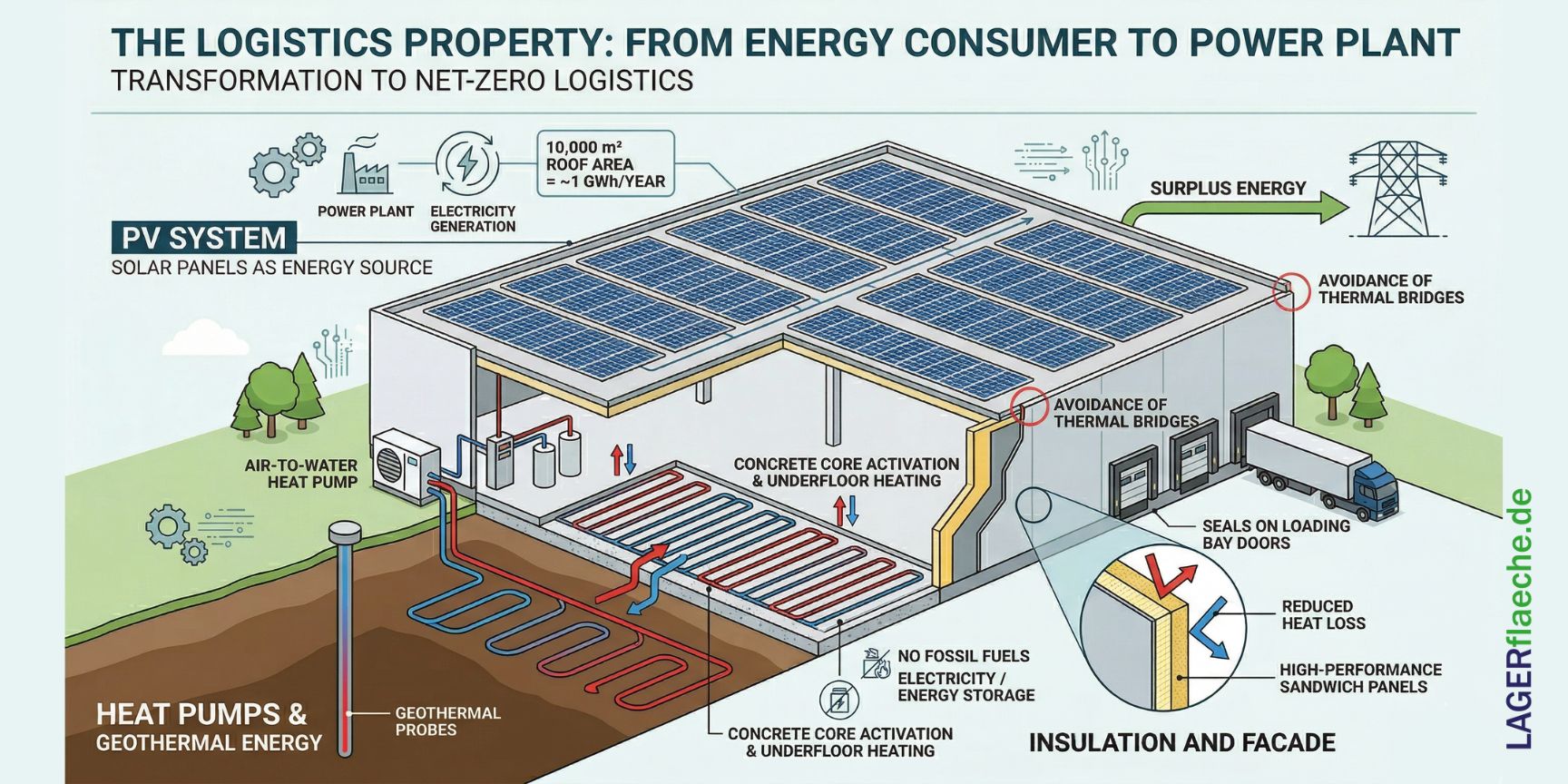
Logistics real estate plays a key role, as buildings are responsible for around 40% of energy-related CO2 emissions globally. A Net Zero hall is defined by two factors: embodied energy (during construction) and operating energy.
- Photovoltaics (PV): Modern logistics roofs are "power plants". A 10,000 m² hall can generate up to 1 GWh of electricity per year – far more than is necessary for pure hall operation.
- Heat pumps & geothermal energy: The renunciation of fossil fuels is mandatory. Air-to-water heat pumps in combination with underfloor heating in the hall areas (concrete core temperature control) set the standard.
- Insulation and façade: High-performance sandwich panels and the avoidance of thermal bridges at loading gates massively reduce heating and cooling requirements.
Expert tip: Pay attention to the "stranded asset" risk in existing properties. Properties that miss the decarbonization path (CRREM curve) lose massive market value.
Warehouse Logistics: Efficiency through Technology and Software
Within the "four walls", Net Zero focuses on electrification and intelligent control.
- Lighting: Switching to LED with presence detectors saves up to 80% of the electricity required for light.
- Industrial trucks: Moving away from lead-acid batteries to lithium-ion technology not only increases efficiency, but also enables opportunity charging that harmonizes perfectly with PV power peaks.
- Automation: Shuttle systems and automated small parts warehouses (AS/RS) are more energy-efficient than manual high-bay warehouses because they require no lighting and less heating ("dark warehouse").
Contract Logistics: Scope 3 as the Biggest Challenge
For contract logistics companies, the trick lies in the details – more precisely, in Scope 3 emissions. While Scope 1 (direct emissions from own vehicles/heating) and Scope 2 (purchased electricity) are controllable, indirect emissions from the upstream and downstream chain often account for over 90% of the total footprint.
| Area | Measure to reduce | Potential |
| Transport | Switching to HVO100, bio-LNG or e-trucks | High |
| Packaging | Reusable Packaging & Volume Optimization | Medium |
| Returns | AI-based avoidance & local treatment | High |
Facts, Figures, Data: The Business Case
Sustainability in logistics has long since ceased to be a cost driver, but an insurance policy against rising CO2 prices (BEHG/ETS).
- CO2 price: With the increase in certificate prices in the EU, the "business as usual" approach is becoming more expensive every year.
- ROI of PV systems: As a rule, PV systems on logistics roofs pay for themselves after 5 to 7 years.
- ESG reporting: From 2024/2025, the CSRD (Corporate Sustainability Reporting Directive) will oblige almost all major logistics companies to disclose detailed emissions data.
Questions & Answers (FAQ)
Question: Is Net Zero even possible in a rented hall?
Answer: Yes, but requires close cooperation (Green Lease). The tenant optimizes the processes, the landlord invests in the building envelope and PV. The savings on ancillary costs can refinance the investment rent.
Question: Is green electricity enough to be net zero?
Answer: No. Green electricity only covers Scope 2. For true Net Zero, emissions from the production of racks (Scope 3) and refrigerant losses from air conditioning systems (Scope 1) must also be considered.
Question: What role does digitization play?
Answer: A decisive one. Without an Energy Management System (EMS) and precise CO2 software, emissions can neither be measured nor controlled. "You can't manage what you can't measure."
Practical Checklist for Logistics Decision-makers
- Status quo: Creation of a carbon footprint according to GHG Protocol.
- Roof potential: Static test for PV retrofitting.
- Lighting concept: Immediate switch to LED sensors.
- Vehicle fleet: Piloting of e-infrastructure in the depot.
- Partner audit: Selection of subcontractors according to their net-zero roadmap.
Conclusion
Net Zero Logistics is a marathon, not a sprint. However, for operators of logistics properties and contract logistics companies, the transformation offers the opportunity to stand out from the competition through operational efficiency and future-proof assets. If you don't invest in decarbonisation today, you risk being relevant in the market tomorrow.