




Renner-bum principle or ABC analysis in the warehouse
Table of Contents
What is the Renner-bum principle? A definition
The Renner-bum principle is a method of classifying inventory items based on their relevance, which is usually measured by turnover rate or value contribution. It divides products into categories to differentiate management and warehouse strategies:
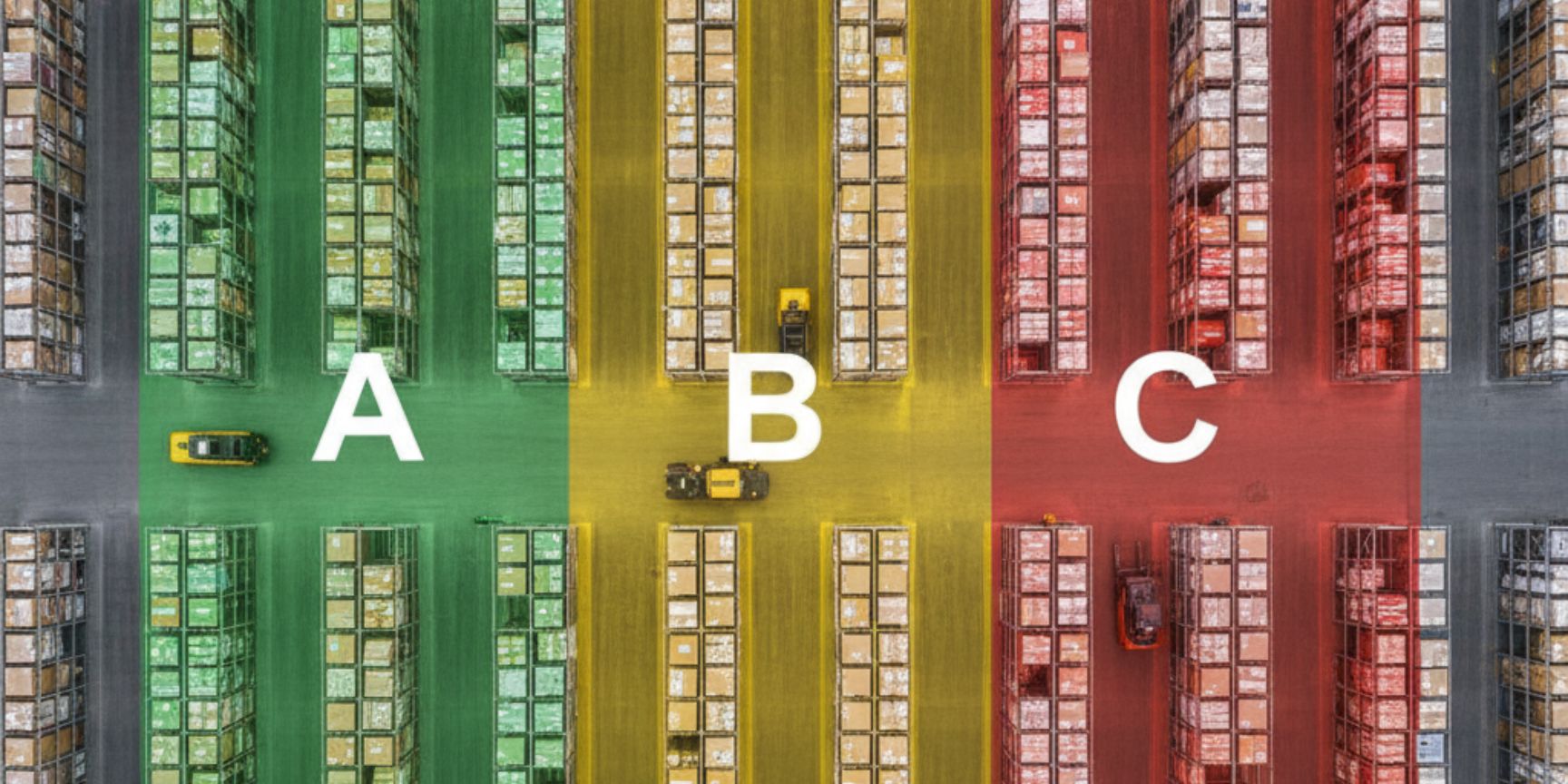
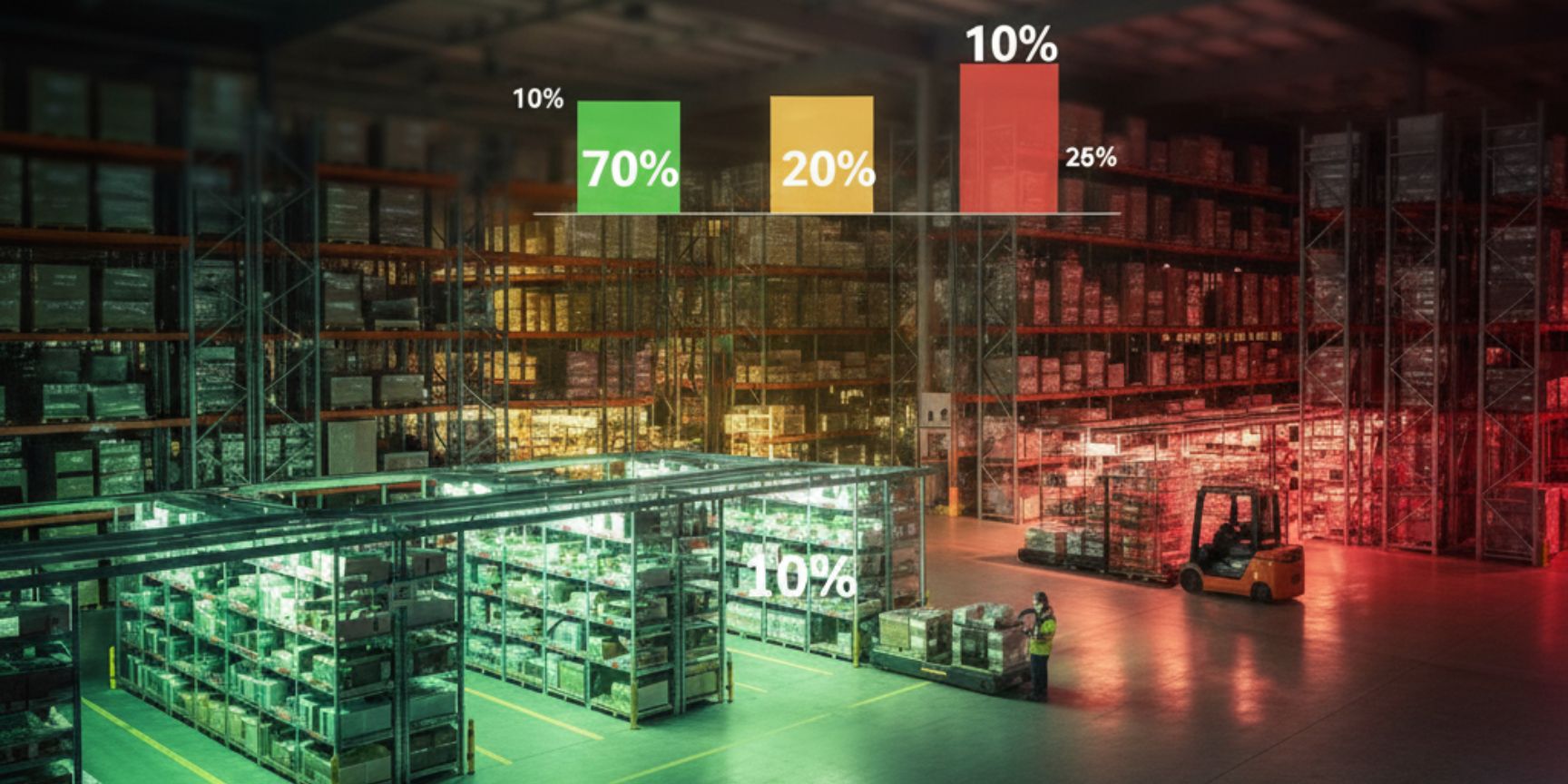
- A-article (racer): These are the fast-moving ones. They account for a small volume share of the total inventory (approx. 10–20%), but generate the largest share of sales or inventory movements (approx. 70–80%). Their high turnover rate requires the highest level of attention and optimal processes.
- B-article (mid-runner): These articles form the mid-range. Their quantity and value share is moderate (approx. 20–30% of the quantity, 15–25% of the value) and their predictability is often lower than for A items.
- C-article (bum): These are the slow-moving ones. At 50–70%, they represent the lion's share of the variety of articles, but at only about 5–10%, they hardly contribute to value or movement. Their storage is often cost-intensive in relation to their benefits.
This classification is a direct application of the Pareto principle (80/20 rule), which states that 80% of the effect is achieved by 20% of the causes. For a warehouse, this means that a small group of items is responsible for the majority of the work and revenue.
The core application: Optimization of warehouse logistics
In warehouse logistics, the principle is the decisive lever for reducing costs and increasing performance. The focus is on minimizing travel times, which often account for 50 to 60% of the total picking time.
- Intelligent slotting: Racers (A-items) are stored in the strategically best places. This means: close to the ground or at an ergonomic gripping height ("golden zone") and as close as possible to the packaging and shipping areas. Bums (C-items) are housed in peripheral or hard-to-reach storage locations (e.g. on the highest shelf levels).
- Increased picking performance: By shortening the distances for the most frequently picked items, the number of picks per hour increases significantly. This not only reduces personnel costs, but also reduces the throughput times of orders.
- Inventory management: Analysis helps determine the right inventory strategies. For A-items, high availability and close control are crucial, while for C-items it must be considered whether storage is economical at all or whether they should be removed from the range.
Question: How often does a Renner-Penner analysis (ABC analysis) have to be carried out?
Answer: The frequency depends heavily on the industry and the volatility of the assortment. In e-commerce with rapid trend changes, a monthly or even weekly analysis may be necessary. In a stable B2B environment or in mechanical engineering, a quarterly or semi-annual revaluation is often sufficient. Regularity is crucial in order to be able to react dynamically to changes in demand behavior.
Relevance for contract logistics
For a logistics service provider, understanding the article structure of its customers is existential. The ABC analysis is a central tool for operational planning and commercial costing.
- Quotation calculation: A service provider must precisely analyze the ABC distribution of a potential customer in order to realistically assess the required personnel, space and technology requirements and to be able to submit a competitive offer.
- Resource planning: A customer with a high proportion of A-items requires different storage and picking strategies (e.g., pick-by-light, conveyor technology) than a customer with a wide range of C-items, where chaotic warehousing may be more efficient.
- Service Level Agreements (SLAs): The assurance of late cut-off times for same-day delivery can only be implemented profitably if the warehouse layout is perfectly matched to the customer's bestsellers and enables extremely short throughput times.
Effects on logistics real estate
The Renner-Bum principle not only shapes the processes in the hall, but also the hall itself. The design of a modern logistics property takes into account the formation of zones from the very beginning.
- Zoning of the layout: The most valuable area of a logistics hall is the area directly at the gates of incoming and outgoing goods. This is where the zones for A-items are planned. These areas are often equipped with special technology (e.g. flow racks, pallet shuttles) for high throughput.
- Requirements for the infrastructure: The floor in the Renner zone may have to be more evenness for the use of narrow-aisle forklifts. The IT infrastructure (Wi-Fi coverage) must be particularly powerful in order to guarantee error-free data collection in real time.
- Flexibility and third-party usability: A property is particularly stable in value if its zones can be flexibly adapted to the changing property structures of a tenant or to the needs of a new tenant.
Question: Does the separation between Renner and Bum always have to take place physically?
Answer: No, not necessarily. In addition to the classic horizontal separation (racer at the front, bum at the back) and vertical separation (racer at gripping height), modern, automated systems enable virtual separation. In an automated small parts warehouse (AS/RS) or an AutoStore system, the Warehouse Management System (WMS) software ensures that the containers with the A-items are always held in the top position in order to minimise the robots' access times.
Digitization as a driver
The consistent implementation of the principle is hardly conceivable today without digital support. Modern warehouse management systems (WMS) carry out ABC analyses automatically and in real time. You will constantly monitor the turnover frequencies and proactively suggest stock transfers in order to keep the warehouse layout in optimal condition at all times (permanent "slotting").
Conclusion: A strategic foundation
The Renner-Bum principle is much more than a simple sorting rule. It is a fundamental strategy for increasing efficiency that runs through all areas of logistics. From the arrangement of the pallet on the shelf to the pricing of a service provider to the concrete foundation of a logistics property – the deliberate focus on the bestsellers frees up capital, reduces process costs, increases delivery speed and thus creates a decisive competitive advantage.

Your Ideal Logistics Warehouse
Browse listings for warehouse space, logistics real estate, industrial land, and contract logistics solutions.
Browse Exposés
Maximize Exposure for Your Warehouse Space
Showcase your logistics properties and attract qualified inquiries.
Discover Products