




AutoStore in Warehouse
Table of Contents
What is AutoStore? A definition
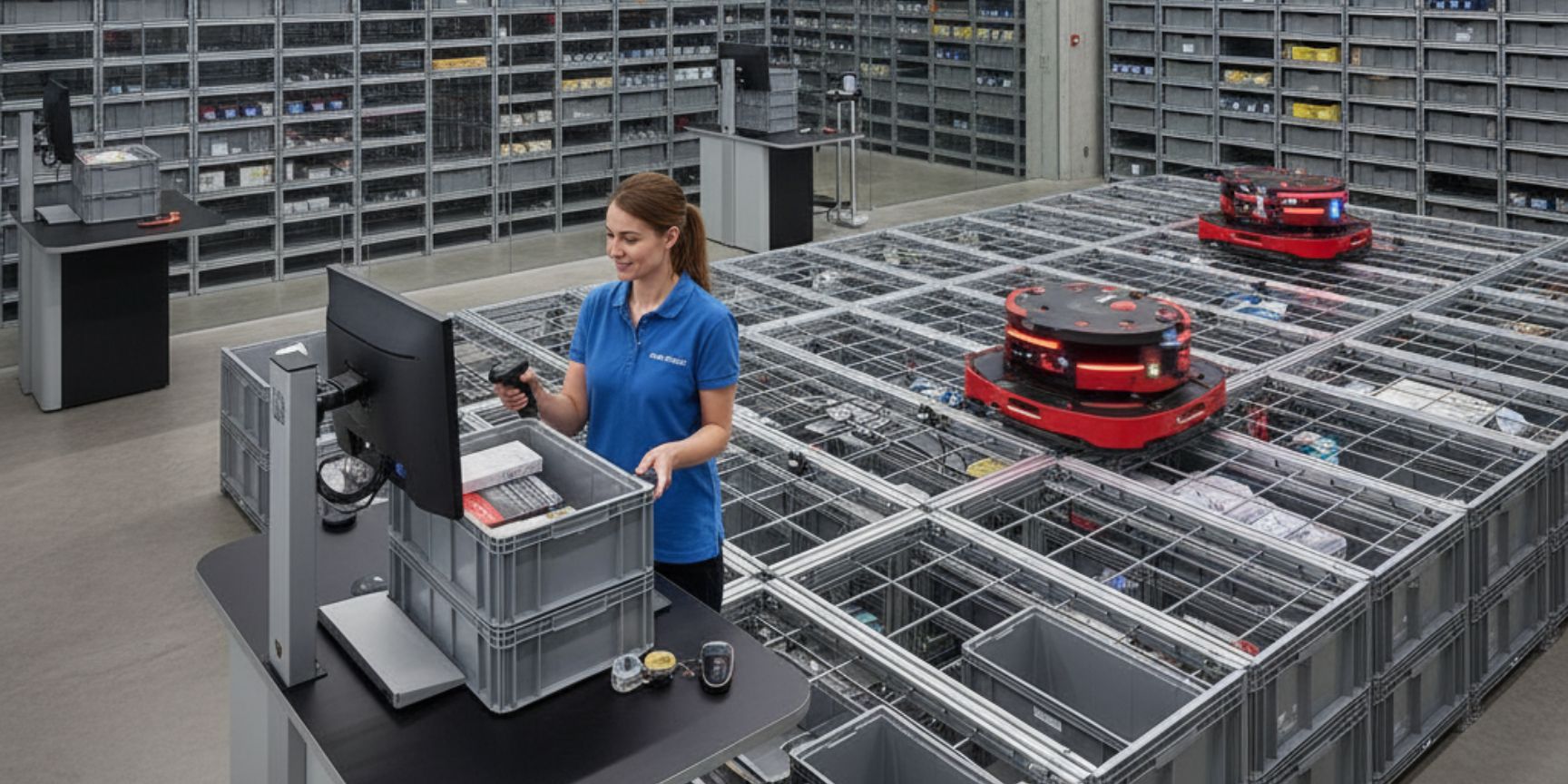
AutoStore is a so-called "goods-to-person" system that was developed in Norway in the 1990s. At its core, it consists of three main components:
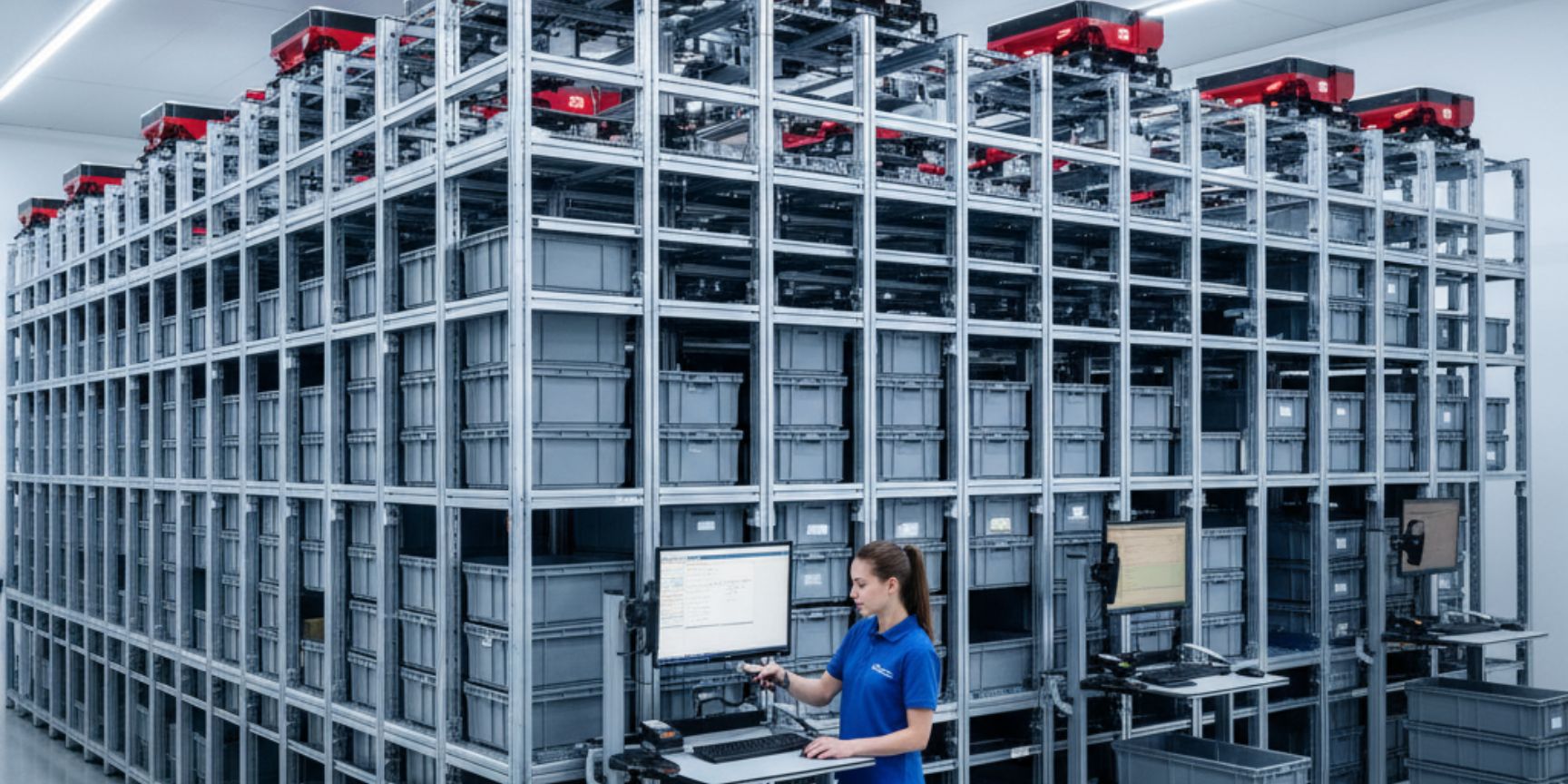
- The Grid: A self-supporting aluminium structure that fills the entire storage area. It serves as a rail network for the robots and as a frame for the storage containers.
- The bins: Standardised plastic containers that are stacked directly on top of each other and next to each other in the grid. They contain the goods. There are no shelves and no aisles, which makes the extremely high storage density possible.
- The robots: Autonomous, battery-powered robots that drive on the top level of the grid. They lift, sort and transport the bins to the workstations.
- The ports (workstations): The interface between man and machine. Here, the bins delivered by the robots are presented to the employee for picking (removal) or storage (filling).
The system works on the principle of "organized chaos". The software remembers the position of each individual item and ensures that frequently needed items (A-items) are automatically stored higher up in the grid through permanent reshuffling in order to minimize access times.
How it works in detail: How robots dominate the warehouse
The process in an AutoStore warehouse is highly efficient. When an order is received in the warehouse management system (WMS), it is transmitted to the AutoStore software. This locates the required bin in the grid.
One or more robots drive to the corresponding X-Y coordinate. If the target bin is obscured by other bins, the robots lift the containers above them and place them on nearby free stacks. This process is called "digging". Once the target bin is exposed, it is picked up by the robot and transported to the designated port.
At the port, the employee removes the required quantity of the item and acknowledges the process. The robot then brings the bin back to the grid and stores it again. Meanwhile, the next robot with the next bin is already on its way to the port, creating a continuous flow of goods without waiting times for the employee. The robots charge themselves independently at charging stations at the edge of the grid if necessary.
Key benefits for warehouse logistics
An AutoStore system offers decisive advantages over traditional storage methods, such as shelving units:
- Maximum use of space: By eliminating aisles and stacking the bins, up to four times more goods can be stored on the same footprint. The system can use the entire height of the hall up to the roof. This reduces the space required by up to 75%.
- High performance and scalability: The performance of the system can be flexibly adjusted. As demand increases, more robots can simply be added to increase throughput. The grid can also be expanded during ongoing operations to increase storage capacity.
- Energy efficiency: The robots consume very little energy. Ten AutoStore robots together require about as much energy as a standard vacuum cleaner.
- Error reduction: The goods-to-person principle and scanner-supported processes at the ports reduce the error rate during picking to almost zero.
AutoStore in contract logistics: The key to flexibility
AutoStore is particularly attractive for contract logistics service providers (3PL). The ability to handle multiple clients with a wide variety of SKUs and order volumes on one system is a huge competitive advantage. Seasonal peaks, such as the Christmas business or Black Friday, can be managed without major investments by temporarily renting robots ("Robot-as-a-Service").
The high density allows the 3PL to offer storage capacity to its customers in a smaller, more cost-effective space. In addition, value-added services such as quality controls, returns processing or special packaging can be efficiently integrated at the ports.
Requirements for the logistics property and the hall
The implementation of an AutoStore system places specific demands on the logistics property, but at the same time is more flexible than many other automation solutions:
- Floor slab: The most important requirement is a high point load capacity of the hall floor. The feet of the grid dissipate the entire weight (structure, bins, goods) to small points. A standard floor plate for forklift traffic is often not enough; accurate static testing is essential. A high level of flatness of the floor in accordance with DIN 18202 is also critical.
- Hall height: A clear height of at least 6 meters is recommended to exploit the potential of the system. However, since the grid is flexible in height, it can also be integrated into existing properties with lower ceiling heights ("brownfield" approach).
- Column grid: A major advantage is that the grid can be built around existing hall columns. This makes AutoStore extremely adaptable to existing buildings.
- Infrastructure: A reliable power supply for the robot charging stations and a stable IT infrastructure (network cables, WLAN) are required.
Frequently Asked Questions (FAQ) about AutoStore
Question: What happens if a robot fails?
Answer: The system is redundant. The other robots simply work around the stationary device. The failed robot can be lifted out of the grid from above during operation and maintained without having to stop the entire system.
Question: For which goods is AutoStore not suitable?
Answer: The system is designed for small-scale, bin-capable goods. It is not suitable for pallets, bulky goods or very heavy individual items. The maximum payload per bin is around 30 kg, depending on the type.
Question: How high is the investment and when will it pay for itself?
Answer: The investment costs are significant and depend heavily on the size of the grid, the number of bins and robots, and the number of ports. Projects often start in the seven-figure range. The return on investment (ROI) is typically achieved through massive savings in personnel costs and, most importantly, in the cost of renting or building warehouse space, and is often around 3 to 5 years.
Your Ideal Logistics Warehouse
Browse listings for warehouse space, logistics real estate, industrial land, and contract logistics solutions.
Browse Exposés
Maximize Exposure for Your Warehouse Space
Showcase your logistics properties and attract qualified inquiries.
Discover Products