




Storage capacity in logistics
Table of Contents
What is meant by storage capacity?
Storage capacity describes the maximum volume or quantity of goods that can be stored in a given storage facility (e.g. a hall, a shelf or a defined storage area). At first glance, this seems to be a simple geometric quantity – length times width times height. However, in professional logistics, this metric is far more complex and is divided into two main categories:
- Theoretical (gross) capacity: This is the purely physical volume of space (m3) or the floor area (m2) of a warehouse, without taking into account aisles, columns, office space, social areas or technical facilities. This figure is relevant for an initial assessment of a logistics property, but has only limited significance for operations.
- Effectively usable (net) capacity: This is the decisive factor for logistics. It indicates how many goods can actually be stored after all areas necessary for operation (traffic routes, safety distances, manoeuvring areas for industrial trucks, fire protection systems, etc.) have been removed. The effectively usable capacity is usually not given in cubic metres, but in the practice-relevant unit of parking spaces (e.g. Euro pallet parking spaces).
How is storage capacity calculated and measured?
The calculation of storage capacity is highly dependent on the storage system and the type of goods. There is no general formula, but the approach can be divided into steps.
Question: How do I determine the storage capacity of my warehouse?
Answer: To determine the effective parking space capacity, proceed as follows:
- Define net storage space: Subtract from the total floor area of the hall all areas that are not directly used for storage (offices, loading zones, traffic routes).
- Determine shelf space: Plan the layout of the racking systems on this net area. The number of shelf rows and their length make up the total shelf space.
- Locations per Rack Field: Count how many pallets (or other load units) can fit in a single rack (horizontal) and on top of each other (vertical). Take into account the permissible shelf load and bay load of the racks.
- Calculate total capacity: Multiply the number of locations per shelf space by the total number of shelf spaces in the warehouse.
An important related KPI is the utilization rate (also called warehouse filling level). It is calculated as follows:
A permanently extremely high occupancy rate (e.g. > 95%) can limit operational flexibility and slow down processes, while too low a level indicates uneconomical use of space.
What factors influence real capacity?
In practice, the capacity calculated on paper can be significantly limited by a variety of factors. Key influences include:
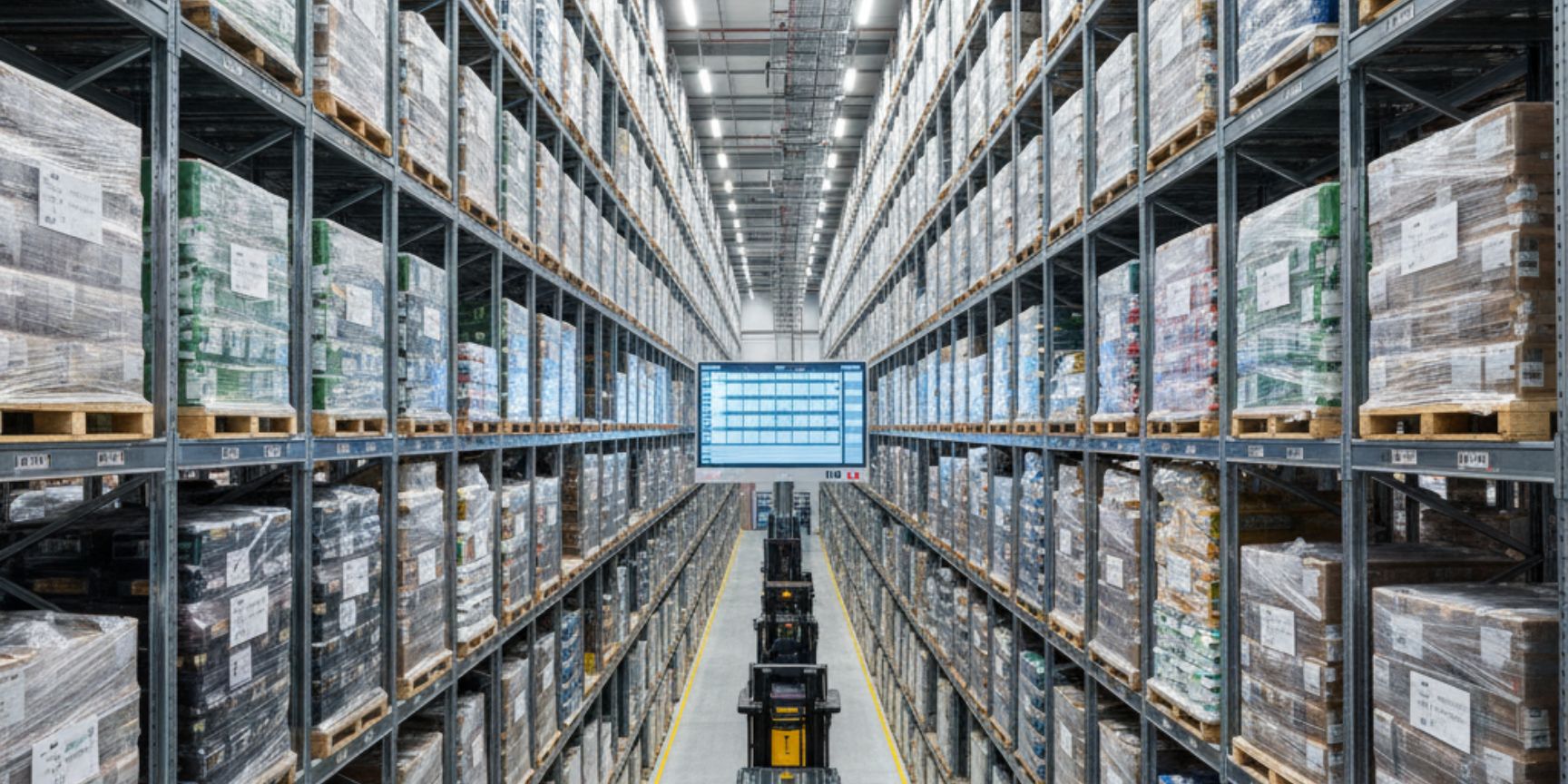
- Storage equipment: The choice of shelving system is crucial. A pallet rack allows for high capacity in a small footprint, while a shelving rack is optimized for small parts. Automated small parts warehouses (AS/RS) or mobile racking further maximize the use of space.
- Goods characteristics: The dimensions, weight, stackability and nature of the goods (e.g. dangerous goods, refrigerated goods) determine how and where they can be stored. Not every pallet can be stored in every location.
- Logistics processes: The selected storage and retrieval strategy (e.g. FIFO, LIFO) and the picking processes require space. Fast-moving items are often stored close to the ground and in easily accessible locations, leaving the theoretically possible capacity at higher levels for these items unused.
- Technical equipment: The type of industrial trucks used (e.g. forklift trucks, narrow-aisle forklifts) defines the required aisle width. Narrow-aisle forklifts require significantly less space and thus enable more rows of racks in the same area.
Perspective Contract Logistics: Capacity as a Flexible Service
In contract logistics, warehouse capacity is not just an internal metric, but the basis of the business model. A contract logistics company does not sell its customers pure space, but a service that includes storage, picking and other value-added services.
Question: How does capacity management differ in contract logistics?
Answer: In multi-user halls, where several customers are handled under one roof, capacity management is particularly dynamic. The challenge is to balance the fluctuating needs of different customers (e.g. due to seasonal business, promotions). Capacity is often managed in flexible zones and billing is per used parking space, per cubic metre or as part of a comprehensive flat rate. The ability to allocate capacity intelligently and with foresight is a key competitive advantage.
Logistics real estate perspective: The hard facts count
For developers, investors and tenants of logistics properties, specific structural features are crucial as they directly define the maximum achievable storage capacity and operational efficiency. These "hard facts" are decisive for the value and usability of a hall.
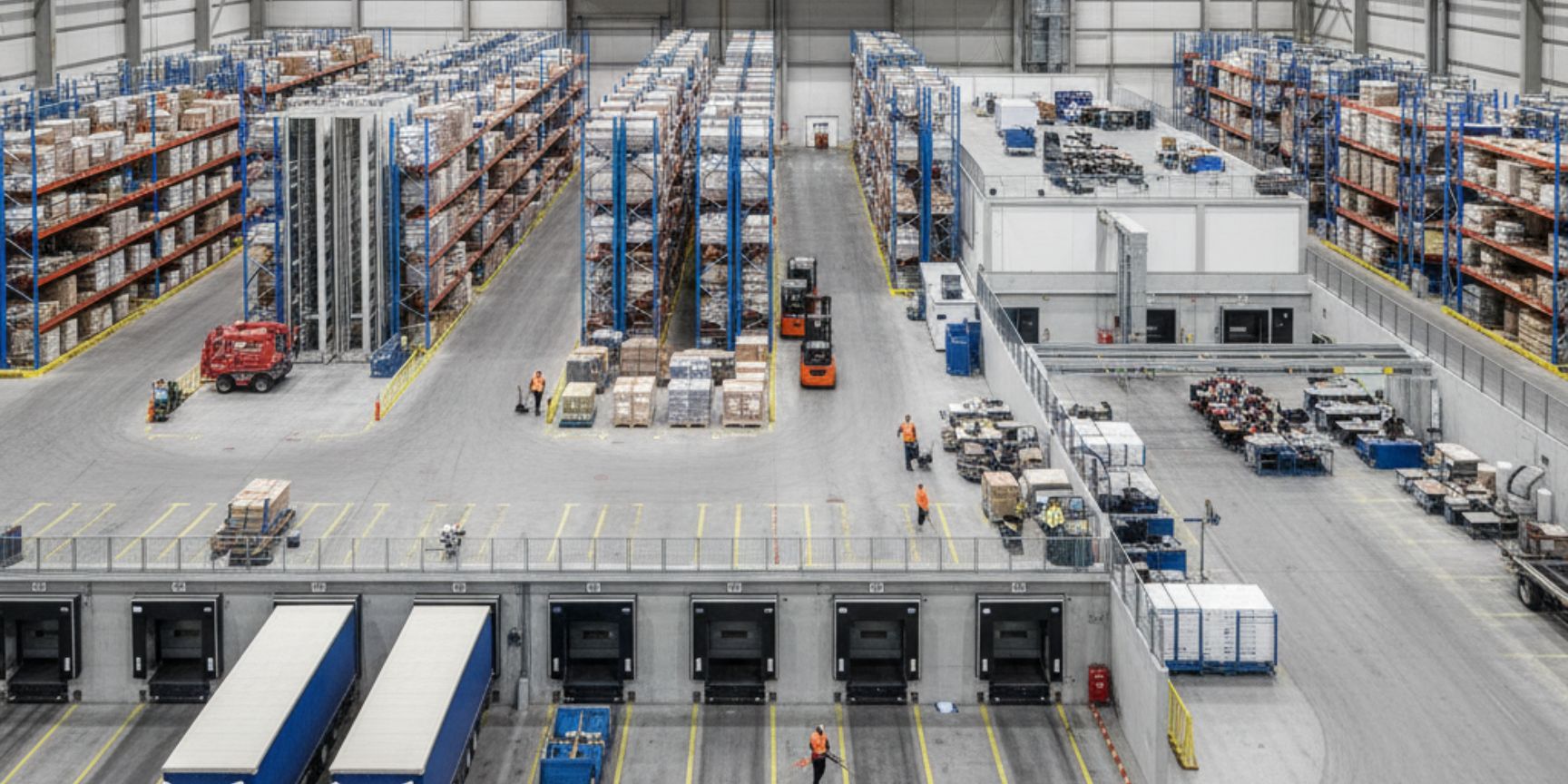
- Hall height: The clear height (lower edge of the truss) is the most important measure. Modern logistics halls today have a standard height of 10 to 12 meters to enable high-bay warehouses and high vertical capacity utilization.
- Floor load capacity: The load-bearing capacity of the hall floor, typically expressed in tons per square meter (), is crucial for heavy racking systems and goods. An industry standard is approx. 5 t/m².
- Column grid: A wide column grid (e.g. 12 x 24 meters) offers more flexibility in planning the layout and maximizes usable space as less space is blocked by columns.
- Delivery: The number and type of gates (ramp gates with loading bridges, ground-level gates) determine the potential handling of goods and influence the planning of internal traffic flows.
Conclusion: Storage capacity as a strategic success indicator
Storage capacity is much more than a specification of square or cubic meters. It is a dynamic and strategic key figure that is the result of a complex interplay of real estate, technology, processes and commodity structure. A deep understanding and continuous optimization of the effectively usable capacity are fundamental to the profitability and performance of any logistics operation – from the small operational warehouse to the large distribution center of a contract logistics provider.