




Office space in the warehouse
Table of contents
- The control center in the logistics center: Why office space in the warehouse is indispensable
- Strategic choice of location: integrated, mezzanine or solitaire?
- Legal Guardrails: Workplace Ordinance and Fire Protection
- The Role in Contract Logistics: Interface between Ramp and Desktop
- Modular room systems: flexibility as a competitive advantage
- Acoustics and Ergonomics: The Challenge of the "Office in the Hall"
- FAQ – The most important questions answered in a nutshell
- Conclusion: The warehouse office as an efficiency lever
The control center in the logistics center: Why office space in the warehouse is indispensable
For a long time, offices in warehouses were neglected – often only as glazed "master cabins" in a corner of the hall. But with the complexity of contract logistics and advancing digitalization, the picture has changed. Today, offices in logistics properties are highly functional interfaces. They connect the physical world of pallet movements with the digital world of warehouse management systems (WMS).
Whether for shipping processing, returns management or commercial administration directly on site: The physical proximity to the operational area saves time, shortens communication channels and enables real-time control of processes.
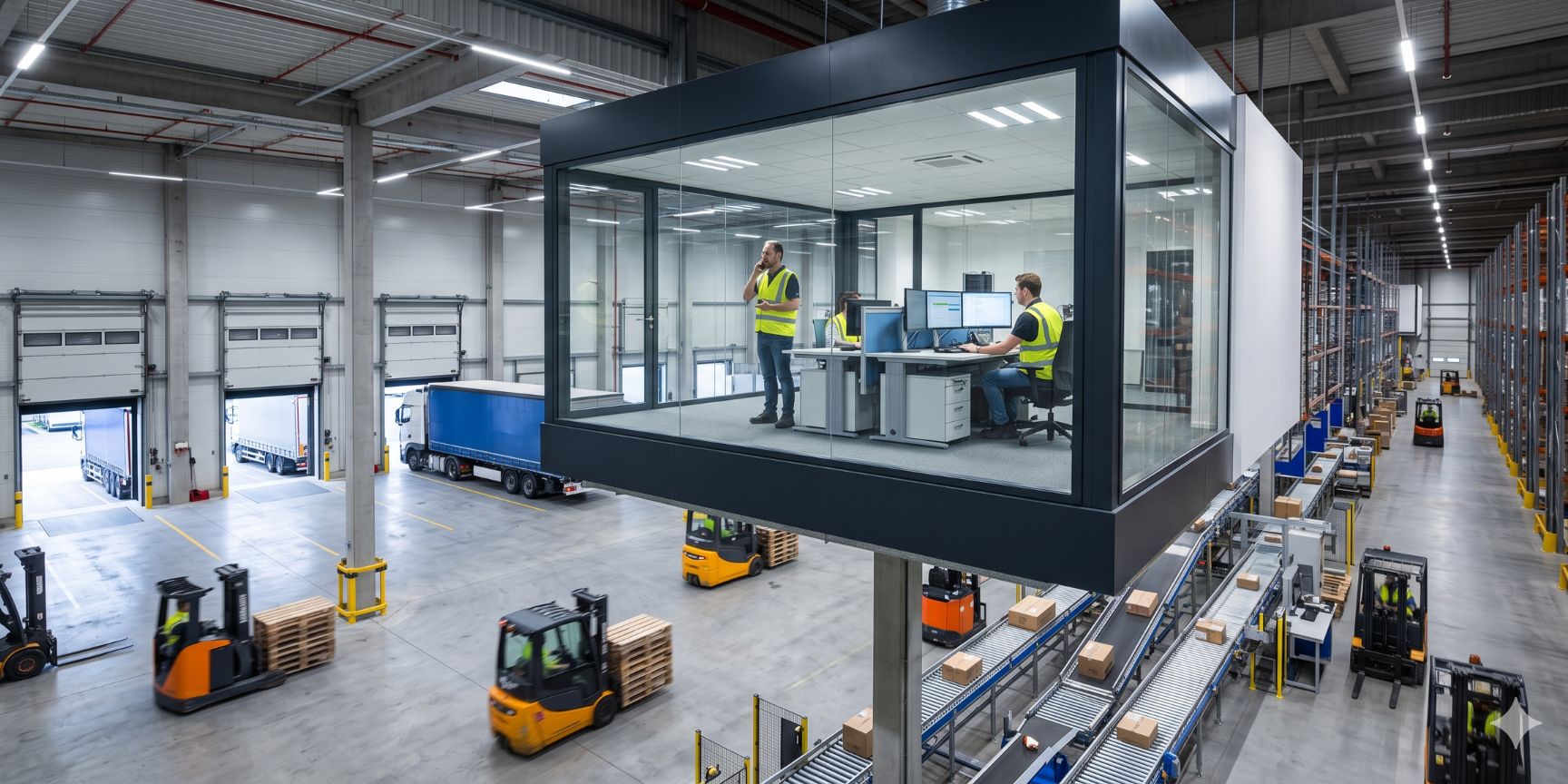
Strategic choice of location: integrated, mezzanine or solitaire?
When planning a logistics property , the question arises as to the placement of the office space. Three concepts have been established:
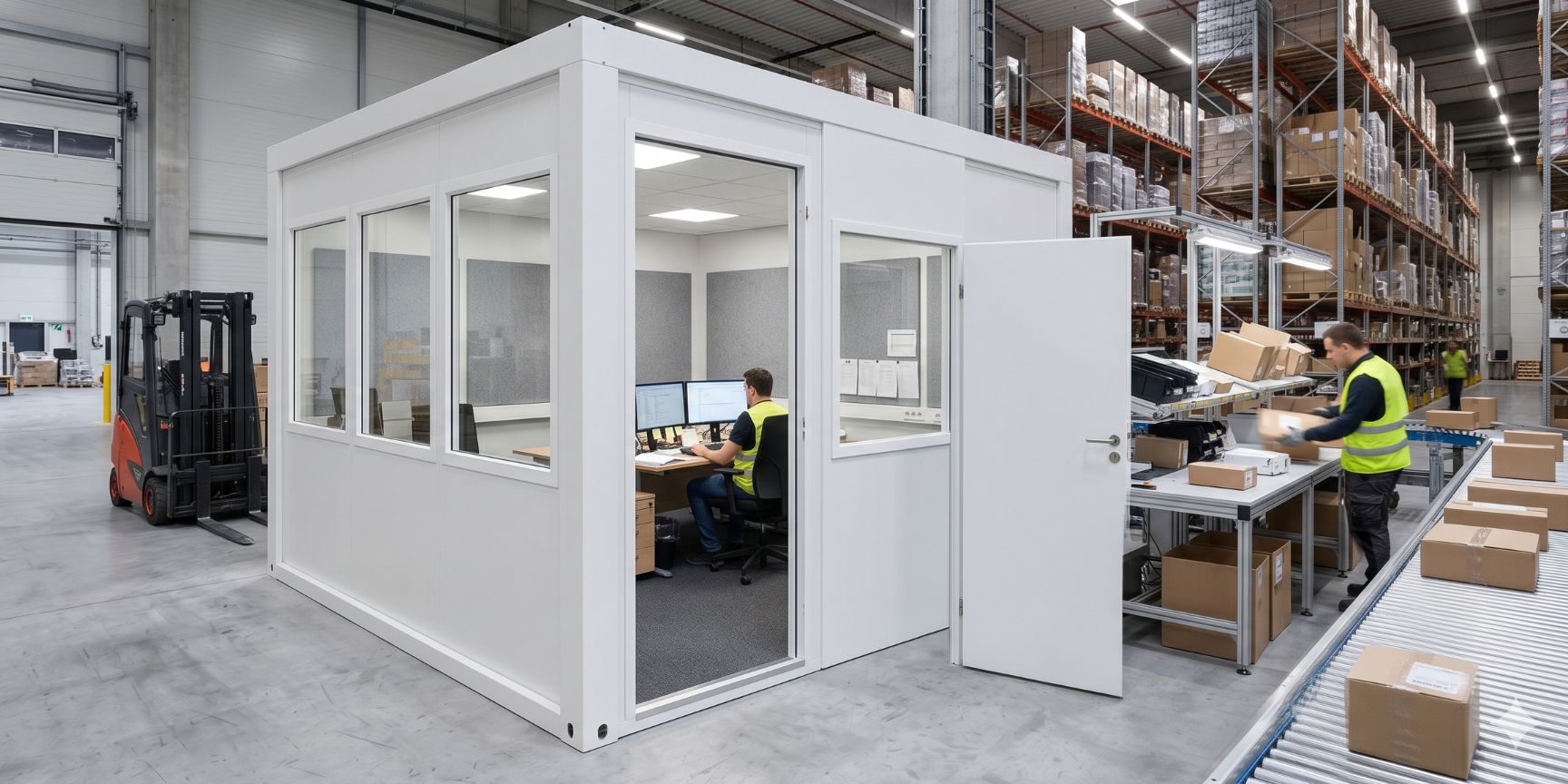
- The integrated hall office: Often built modularly as a "room-within-a-room system" directly on the hall area. Advantage: Maximum proximity to the action.
- The mezzanine solution: Offices are placed on a mezzanine level (steel construction platform). This makes optimal use of the hall height (often 12 meters UKB and more) without losing valuable storage space capacity for pallets.
- The head building: A classic office wing that is located in front of the hall. This is the standard for larger administrative units in contract logistics, as noise and dust pollution are minimal here.
Facts, figures, data: In modern standard logistics properties, office and social space accounts for around 3% to 5% of the total usable space. For specialized e-commerce centers, this share can increase to as much as 10%.
Legal Guardrails: Workplace Ordinance and Fire Protection
Legally, an office in a warehouse is not a "special case", but must meet the full requirements of the Workplace Ordinance (ArbStättV) and the associated Technical Rules (ASR ).
- Lighting: Sufficient daylight or equivalent artificial lighting (at least 500 lux for computer workstations) is also required in the hall office.
- Noise protection: In logistics companies, levels of 80 to 85 dB(A) often prevail. Offices must be insulated by soundproofing walls in such a way that the interior mirror does not exceed 55 dB(A) for concentrated activities.
- Fire protection: Since offices often cross escape routes, they must meet the requirements for fire resistance classes (e.g. F30 or F90) (especially as fixtures).
The Role in Contract Logistics: Interface between Ramp and Desktop
Complex value-added services (VAS) are handled in contract logistics. Here, the warehouse office takes on the function of the "control tower". Employees must have access to the freight documents (delivery notes, CMR) and the physical goods at the same time.
A well-planned office allows eye contact with the loading zone (ramp). This is crucial for yard management to proactively control truck inflows and minimize downtime. An efficient flow of information between the commercial staff in the hall and the dispatchers in the office significantly reduces the error rate in pick-and-pack processes.
Modular room systems: flexibility as a competitive advantage
The trend is moving away from solid brick walls to modular hall offices. Why? Logistics contracts in contract logistics often have terms of only 3 to 5 years. If the customer or the process changes, the property has to adapt.
Modular systems offer:
- Scalability: Easy to expand as staff grows.
- Relocatability: The entire office can be moved to a different position in the hall by forklift or crane if necessary.
- Tax advantages: Since modular offices are often considered an operating device, they can be depreciated more quickly than space that is permanently integrated into the building.
Acoustics and Ergonomics: The Challenge of the "Office in the Hall"
The biggest challenge for well-being is acoustics. Vibrations from forklifts, the hissing of pneumatics or the rumbling of conveyor belts penetrate through standard walls. High-quality office solutions in the warehouse are therefore based on:
- Double glazing with special soundproofing films.
- Decoupled floor systems to avoid structure-borne noise.
- Active ventilation systems to filter the often dusty storage air.
An ergonomic workstation in the warehouse increases employee loyalty – a critical factor in view of the shortage of skilled workers in the logistics industry.
FAQ – The most important questions answered in a nutshell
Question: Do I need a building permit for a modular office in the hall?
Answer: In most federal states, yes. Since it is a stationary facility in which people are permanently present, fire protection and structural evidence is required as part of a building application or notification.
Question: What is the cost of a hall office per square metre?
Answer: The range is large. Simple single-storey systems start at around €500/m², while high-quality, soundproofed and air-conditioned mezzanine offices can cost up to €1,500/m².
Question: Can I connect a warehouse office directly to the conveyor system?
Answer: Yes, many logistics companies use "pick offices", where conveyor lines run directly through the wall to bring documents or small parts directly to the desk for inspection.
Question: What do I need to consider when connecting to IT?
Answer: Due to the steel structures in halls, Wi-Fi is often unstable. Redundant cabling (CAT 7) and the placement of access points outside the "steel cage" office are essential.
Conclusion: The warehouse office as an efficiency lever
Office space in the warehouse is much more than just a place for the desk. They are the brain of logistics real estate. Those who invest in acoustics, ergonomics and strategic placement reduce travel times, increase employee satisfaction and create the basis for smooth contract logistics. At a time when "time equals money", the optimally placed warehouse office becomes a real competitive advantage.

Your Ideal Logistics Warehouse
Browse listings for warehouse space, logistics real estate, industrial land, and contract logistics solutions.
Browse Exposés
Maximize Exposure for Your Warehouse Space
Showcase your logistics properties and attract qualified inquiries.
Discover Products