




Octabin in logistics
Table of Contents
- The Lexicon: The Octabin in the Modern Logistics World
- Structure and technical specifications
- The octabin in warehouse logistics: space utilization and handling
- Requirements for the logistics property and the hall
- Contract logistics: Value-added services around the octabin
- Sustainability and circular economy
- Safety and risk aspects during handling
- Conclusion: The octabin as a strategic element
The Lexicon: The Octabin in the Modern Logistics World
The term octabin is derived from its octagonal shape (Greek okto = eight). It is a large-volume transport and storage container made of heavy corrugated cardboard that is primarily used for bulk materials such as plastic granules, food ingredients (sugar, spices) or small parts in industry. In contract logistics, it is considered an economical alternative to big bags or silo storage.
Structure and technical specifications
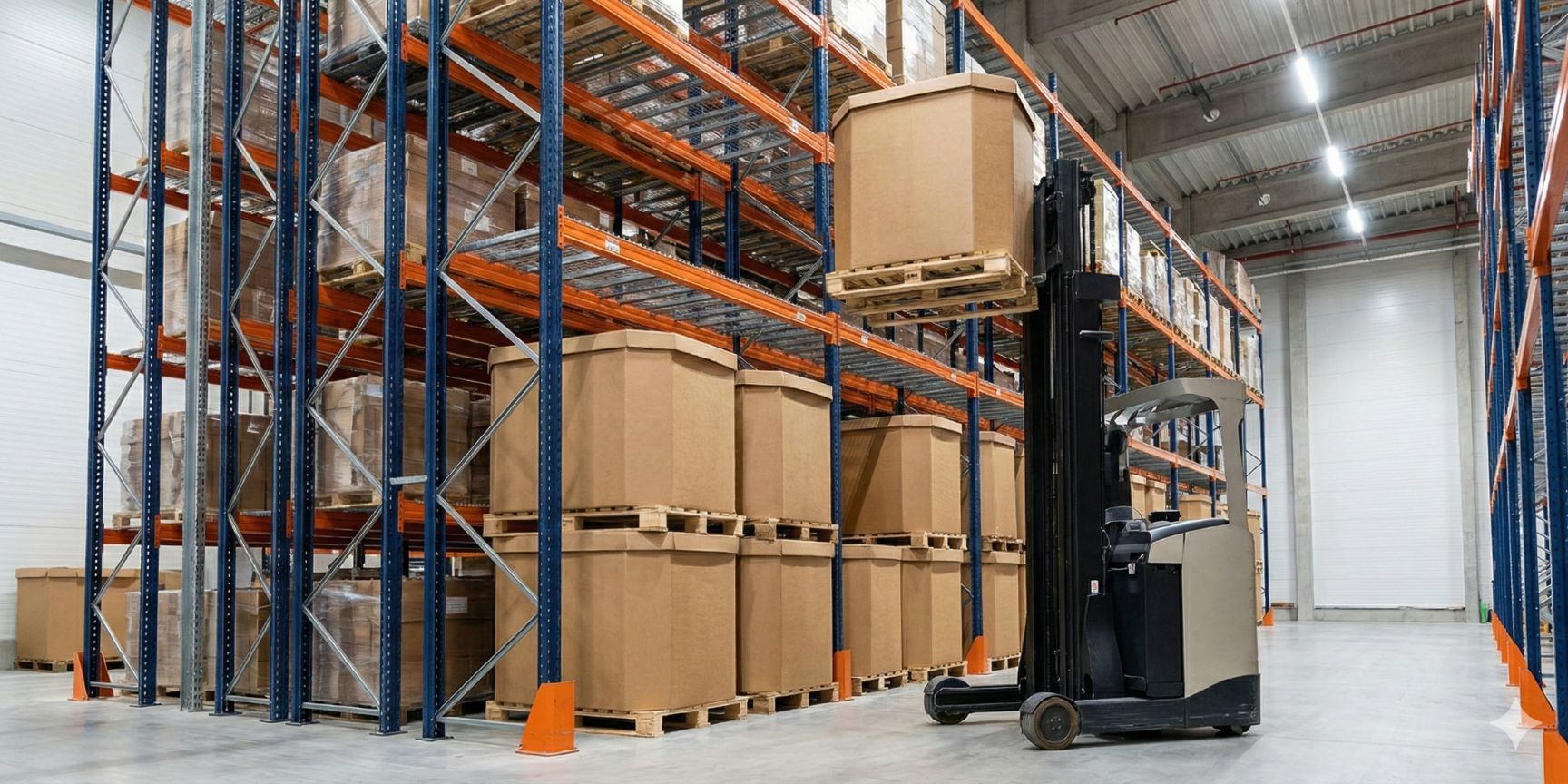
A standard octabin consists of four main components: base, sheath (frame), lid and a usually matching pallet (often chemical pallet CP3 or CP9). The octagonal shape is not a design element, but a static necessity. The eight corners optimally distribute the lateral pressure of the bulk material (the so-called horizontal pressure), which prevents the cardboard from bulging.
- Standard dimensions: The standard sizes are adapted to common pallet dimensions: 1140 x 1140 mm (typical for export/chemical pallets), 1200 x 1000 mm (ISO pallet), 1160 x 745 mm (example size for specific applications).
- Height: Variable, often between 600 mm and 2000 mm.
- Load capacity: Depending on the quality of the corrugated board (often 2- to 3-corrugated), designed for heavy goods, typically up to 1000 kg - 1250 kg per unit.
- Stackability: Delivered flat when empty (space-saving), often stackable 1+1 or 1+2 when filled, depending on inliner and stability.
The Octabin in Warehouse Logistics: Space Utilization and Handling
In warehouse logistics, the octabin poses a challenge for the use of space. Since it exerts a punctual load on the pallet, the storage strategy must be chosen precisely.
Question: Can octabins be stored in conventional pallet racks?
Answer: Yes, but with caution. Due to the high point loads and the risk of the floor deforming due to moisture or fatigue, gratings or shelf panels should be used in the shelving system. Slipping of the pallet due to deformation of the carton must be excluded by design.
In addition, handling with industrial trucks (FFZ) is demanding: Due to the high centre of gravity of the filled octabin, there is a risk of tipping over when cornering. In high-bay warehouses, the sensors must be calibrated to the often irregular contours of the corrugated board.
Requirements for the logistics property and the hall
A logistics centre that primarily handles octabins requires specific structural requirements. This is where the soil load capacity comes into focus.
- Point loads: Since octabins are often stacked, enormous point loads are generated on the industrial floor. The floor must be designed accordingly in accordance with DIN 18202.
- Fire protection: Corrugated cardboard is oxidizing. A hall in which thousands of octabins are stored massively increases the fire load. This often requires more powerful sprinkler systems (ESFR sprinklers) and a tighter fire alarm infrastructure.
- Air conditioning: Since corrugated cardboard is hygroscopic (attracts water), an octabin loses its stability in high humidity. Logistics properties for paper products therefore require controlled humidity to prevent the stacks from collapsing.
Contract logistics: Value-added Services around the Octabin
For contract logistics companies, the octabin offers lucrative opportunities for value-added services (VAS). It is often part of a complex outsourcing model.
Question: What value-added services are typical for Octabin logistics?
Answer:
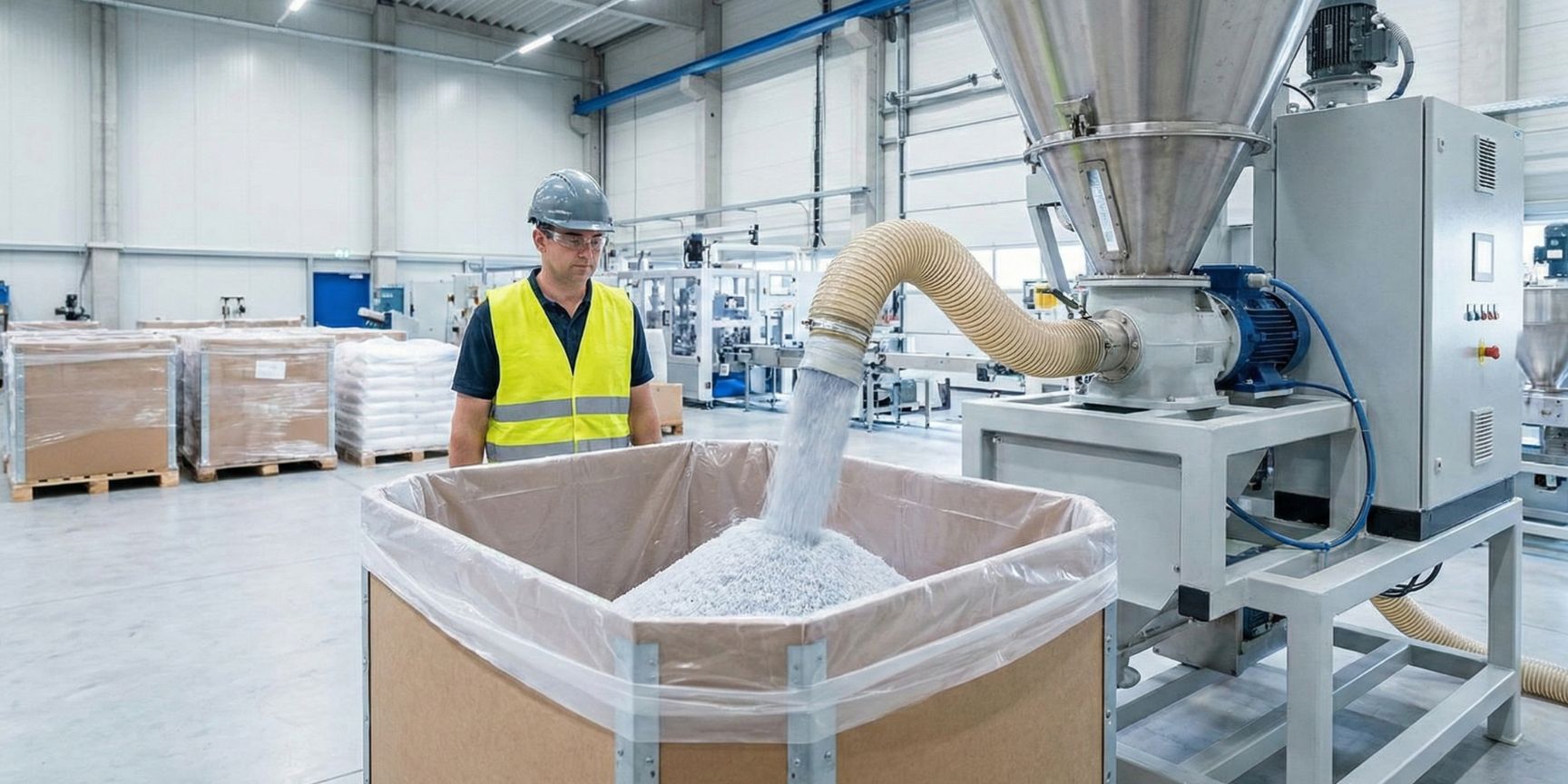
- Decanting: The decanting of big bags or bagged goods into octabins for production-related provision.
- Inliner management: The use of specialized inliners (e.g. aluminum composite film for oxygen barriers or antistatic films for explosive granules).
- Sampling: Qualified employees take samples directly from the container for the quality assurance of the chemical or food industry.
Sustainability and circular economy
In times of ESG criteria (Environmental, Social, Governance), the octabin scores with its material properties. It consists almost entirely of renewable raw materials and is 100% recyclable.
Compared to rigid plastic intermediate bulk containers (IBCs), the octabins do not require the expensive return transport of empties, as the frames can be folded flat. This saves CO2 and freight costs in load carrier management. Nevertheless, the disposal logistics (pressing of the used cardboard packaging) in the hall must be planned spatially.
Safety and risk aspects during handling
An underestimated factor is load securing. Due to their shape, octabins have gaps in the load on the truck (at the "cut-off" corners).
Facts & Figures on Security:
- Coefficient of sliding friction: Corrugated cardboard on wooden pallets has a relatively good coefficient of friction, but the goal is still a tight fit.
- Deformation: A belly of more than 2-3 cm can already lead to the container no longer being able to safely bear the vertical load of the container above it.
- Tipping torque: At a height of often up to (including pallet), the center of gravity is critically high.
Conclusion: The Octabin as a Strategic Element
The Octabin is a high-performance product of the packaging industry that efficiently serves the interface between production and logistics. Anyone planning a logistics property for this purpose or concluding a contract logistics contract must include the factors of floor load, fire load and moisture protection in the calculation. Only through a deep understanding of the static properties of corrugated board can accidents in the warehouse be avoided and processes optimized.