




Offshoring in Logistics
Table of contents
- Definition and demarcation: Offshoring in a logistical context
- The strategic fit: Why offshoring in contract logistics?
- Requirements for the logistics property in the offshoring scenario
- The Role of Warehouse Logistics: Inventory Management and Buffer Functions
- Cost-benefit analysis: Facts, figures, data
- Risk management and resilience in the global chain
- Q&A – Questions and answers on the topic of offshoring
- Conclusion: The future lies in "smart shoring"
Definition and demarcation: Offshoring in a logistical context
Offshoring refers to the relocation of operational activities abroad, where the geographical distance is often considerable (e.g. from Western Europe to Southeast Asia). In contrast to outsourcing, which describes organizational separation (awarding to third parties), offshoring focuses purely on the location.
In the logistics world, this often means that not only production, but also the associated warehouse and contract logistics are shifted to low-wage countries or strategically located hubs. We distinguish between the following:
- Farshoring: Relocation to distant countries (e.g. China, Vietnam).
- Nearshoring: Relocation to nearby border regions (e.g. from Germany to Poland or the Czech Republic).
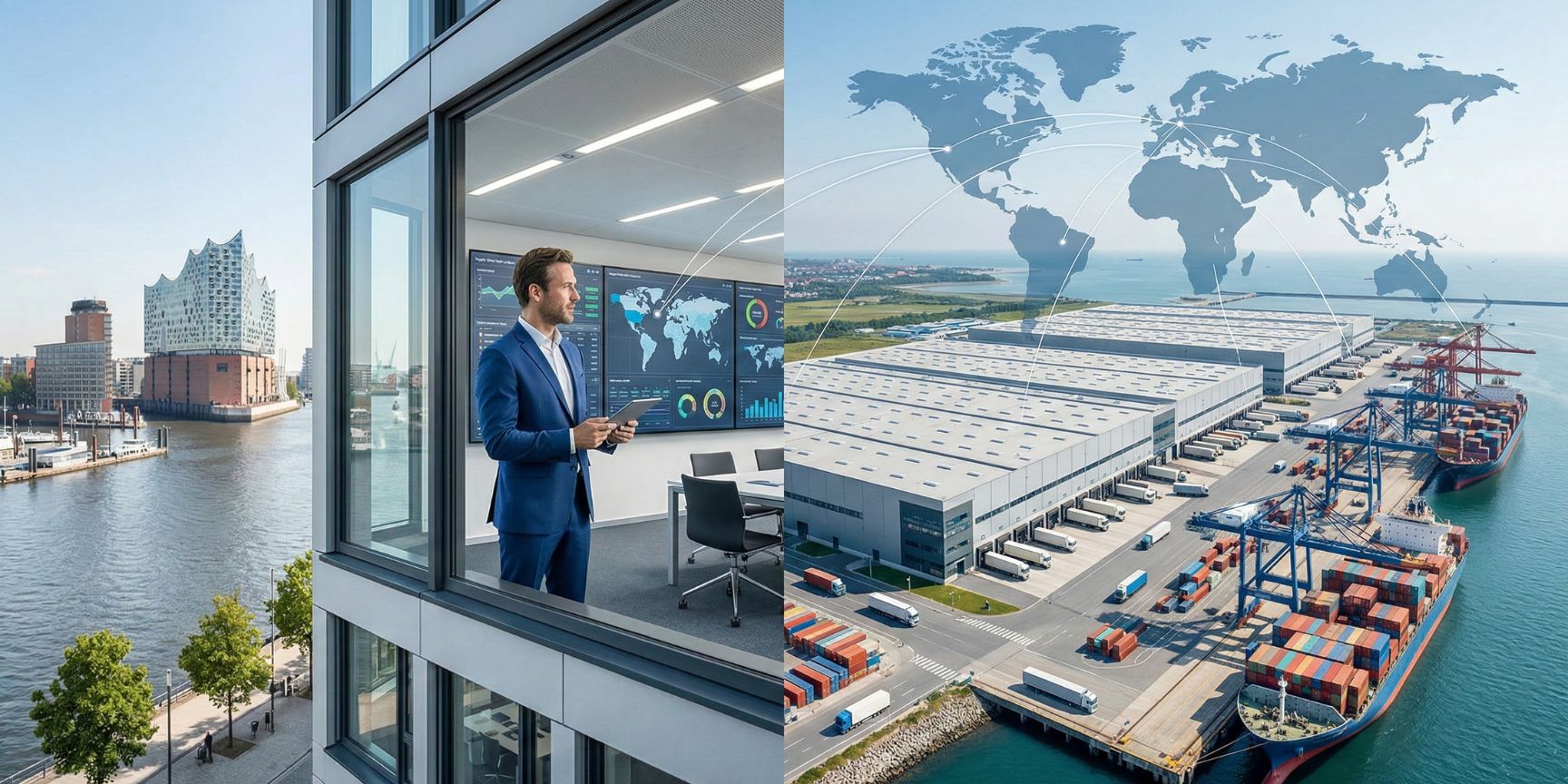
The strategic fit: Why offshoring in contract logistics?
The decision to offshoring is usually driven by the total cost of ownership (TCO). While wage costs in logistics often account for 40-50% of operating costs in Germany, they are significantly lower in classic offshoring destinations.
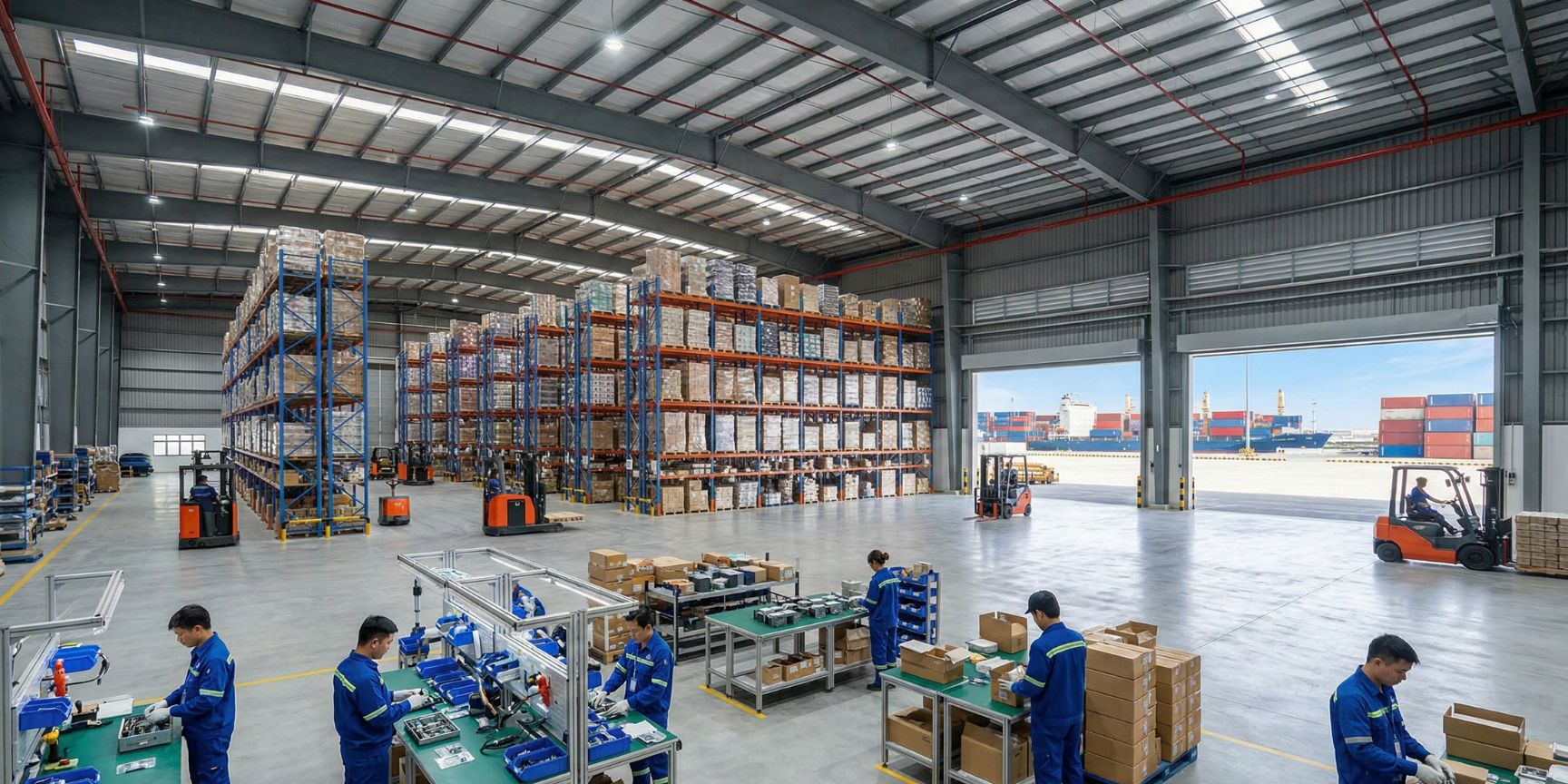
Practical benefits: For a contract logistics provider (3PL), offshoring means that it shifts complex value-added services such as assembly, labeling or quality inspection to locations where these labor-intensive processes can be scaled more cost-effectively.
Requirements for the logistics property in the offshoring scenario
When logistics processes go "offshore", the requirements for the hall and the infrastructure change massively. Today, an offshoring hub must meet the same standards as a European central warehouse in order to ensure process quality.
- Building standards: "Grade A" properties with a clear height of at least 10.50 m, high floor load capacity (at least 5 t/m²) and modern sprinkler technology (ESFR) are in demand.
- Connectivity: Proximity to deep-sea ports or major airport hubs is essential. The property acts as a buffer for the long lead times of sea freight.
- Flexibility: Since offshoring markets can be more volatile, halls must be modular in design to accommodate different tenants or process changes (e.g. switching from pure storage to cross-docking).
The Role of Warehouse Logistics: Inventory Management and Buffer Functions
Offshoring inevitably extends lead times. Where a truck used to deliver within 24 hours, the goods are now on the road by sea for 4-6 weeks. This has a direct impact on warehouse logistics:
- Increased safety stocks: To mitigate the risk of supply chain disruptions, storage capacity often needs to be increased by 20-30% on site or at the receiving hub.
- Transparency through IT: A powerful warehouse management system (WMS) is mandatory in offshoring in order to track stocks in transit ("In-Transit Inventory") in real time.
Cost-benefit analysis: Facts, figures, data
An informed comparison between onshoring (home market) and offshoring must include the following factors:
| Cost factor | Onshoring (DE) | Offshoring (e.g. SE-Asia) |
| Wage costs / hour | ~€25.00 - €35.00 | ~€2.00 - €7.00 |
| Rent logistics property (m²) | €6.50 - €9.50 | €2.00 - €4.50 |
| Transport costs | Low (Truck/Rail) | High (Sea/Air Freight) |
| Capital commitment costs | Low (fast turnover) | High (long transport distances) |
Important: The savings in personnel costs must exceed the higher transport and risk costs. Often, the bill tips over for products with low value and high volume at the same time.
Risk management and resilience in the global chain
The last few years have shown that offshoring carries risks. Geopolitical tensions or blocked shipping lanes (e.g. Suez Canal) make logistics real estate at home more attractive again – as a strategic security warehouse.
Practical tip: Rely on a "China + 1" strategy. Don't relocate everything to one location, but keep capacities in a second, geographically diversified region.
Q&A – Questions and answers on the topic of offshoring
Question: Is offshoring still worthwhile with rising automation costs?
Answer: Yes and no. In highly automated warehouses, the share of labor costs drops so much that the locational advantage of low-wage countries dwindles. Reshoring is often more economical in order to be closer to the customer.
Question: What role does ESG (Environmental Social Governance) play in offshoring real estate?
Answer: A central role. Today, investors and tenants are also demanding certifications such as DGNB, LEED or BREEAM abroad. A property without proof of sustainability becomes a "stranded asset".
Question: How does offshoring influence the choice of logistics location in Europe?
Answer: Offshoring is shifting the flow of goods away from pure production sites to distribution hubs on the coasts (Antwerp/Rotterdam/Hamburg) or large inland hubs (Duisburg/Venlo).
Conclusion: The future lies in "smart shoring"
Offshoring is no longer a static concept. We are moving away from the purely cost-driven shift towards smart shoring. Simple, high-volume processes will be offshored, while customer-oriented packaging and rapid distribution will remain close to the market in state-of-the-art, automated logistics properties. For experts in the field of logistics real estate, this means that the demand for specialised space at strategic interfaces will continue to grow, while the requirements for the technical equipment of the halls will increase globally.