




Outbound Logistics Processes
Table of Contents
- Definition: What is meant by outbound logistics at its core?
- Outgoing goods as the heart of warehouse logistics
- Requirements for the logistics property: The "hall" as a service provider
- Contract logistics: outsourcing of outbound processes
- FAQ: In-depth questions about outbound optimization
- Facts & Figures: Efficiency Potential at a Glance
- The role of sustainability (Green Outbound)
- Conclusion for practice
Definition: What is meant by outbound logistics at its core?
Outbound logistics (also known as distribution logistics) includes all processes that control the flow of goods from the end of the production process to the end customer or retailer. While inbound logistics secures procurement, outbound logistics transforms finished products into available market goods.
In practice, this is not a linear process, but a complex interplay of warehousing, picking, packaging and transport management. The aim is to comply with the "7 R's" of logistics: the right product, in the right quantity, in the right condition, in the right place, at the right time, for the right customer, at the right cost.
Outgoing goods as the heart of warehouse logistics
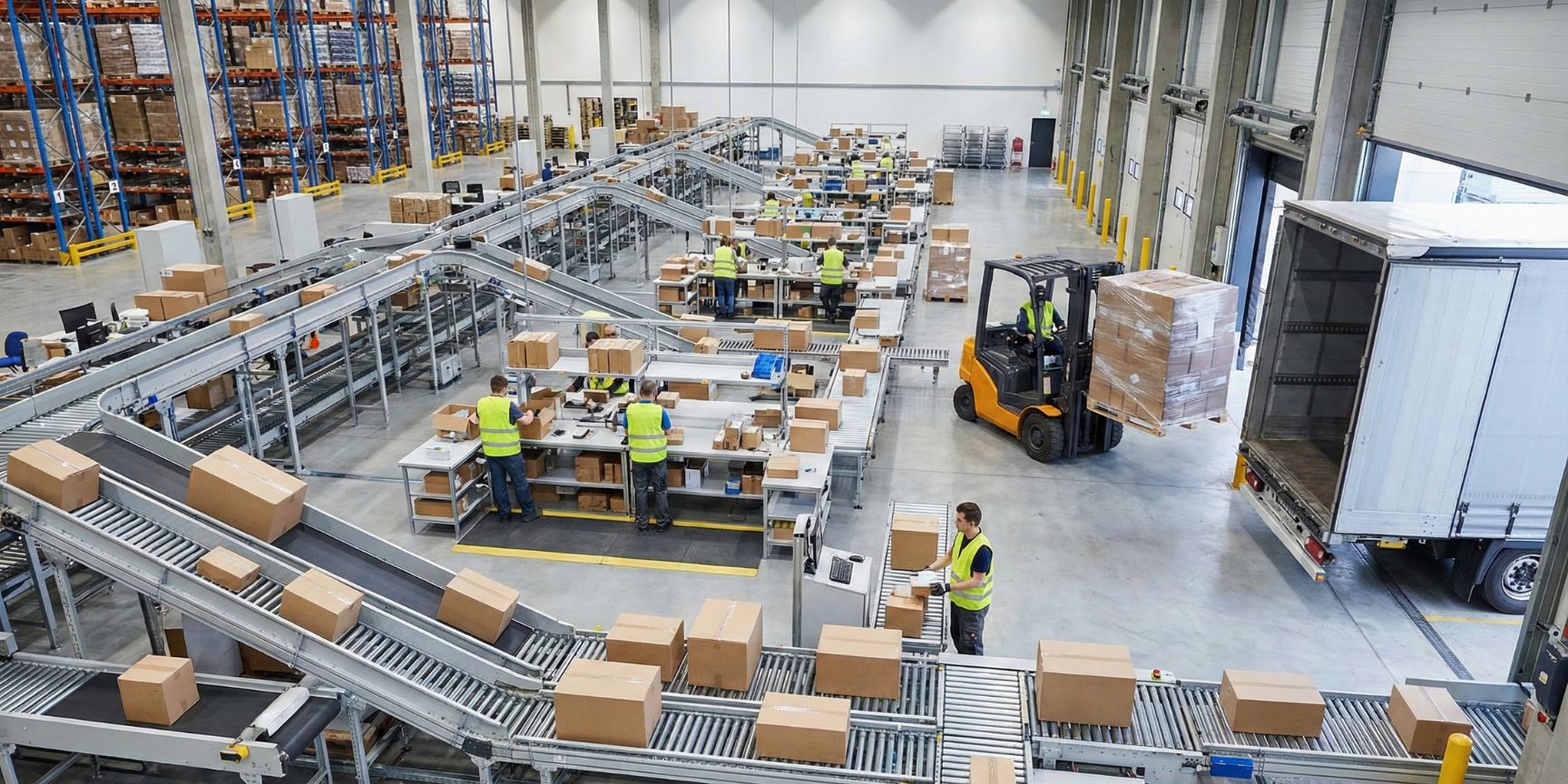
In operational warehouse logistics, the outbound area is often the zone with the highest dynamics. This is where the throughput time of an order is decided.
The phases in detail:
- Order transmission & picking: As soon as an order is received in the Warehouse Management System (WMS), picking begins. Specialist portals often emphasise the error rate here: A pick accuracy of less than 99% leads to massive return costs in outbound logistics.
- Consolidation: Individual picks are merged into shipments.
- Packaging & Value Added Services (VAS): Here, products are made ready for shipping, often supplemented by customer-specific additions or labels.
- Loading: The final staging area.
Requirements for the logistics property: The "hall" as a service provider
An outbound-optimized logistics property must meet different requirements than a pure supply warehouse. The following structural and technical aspects are critical for high throughput:
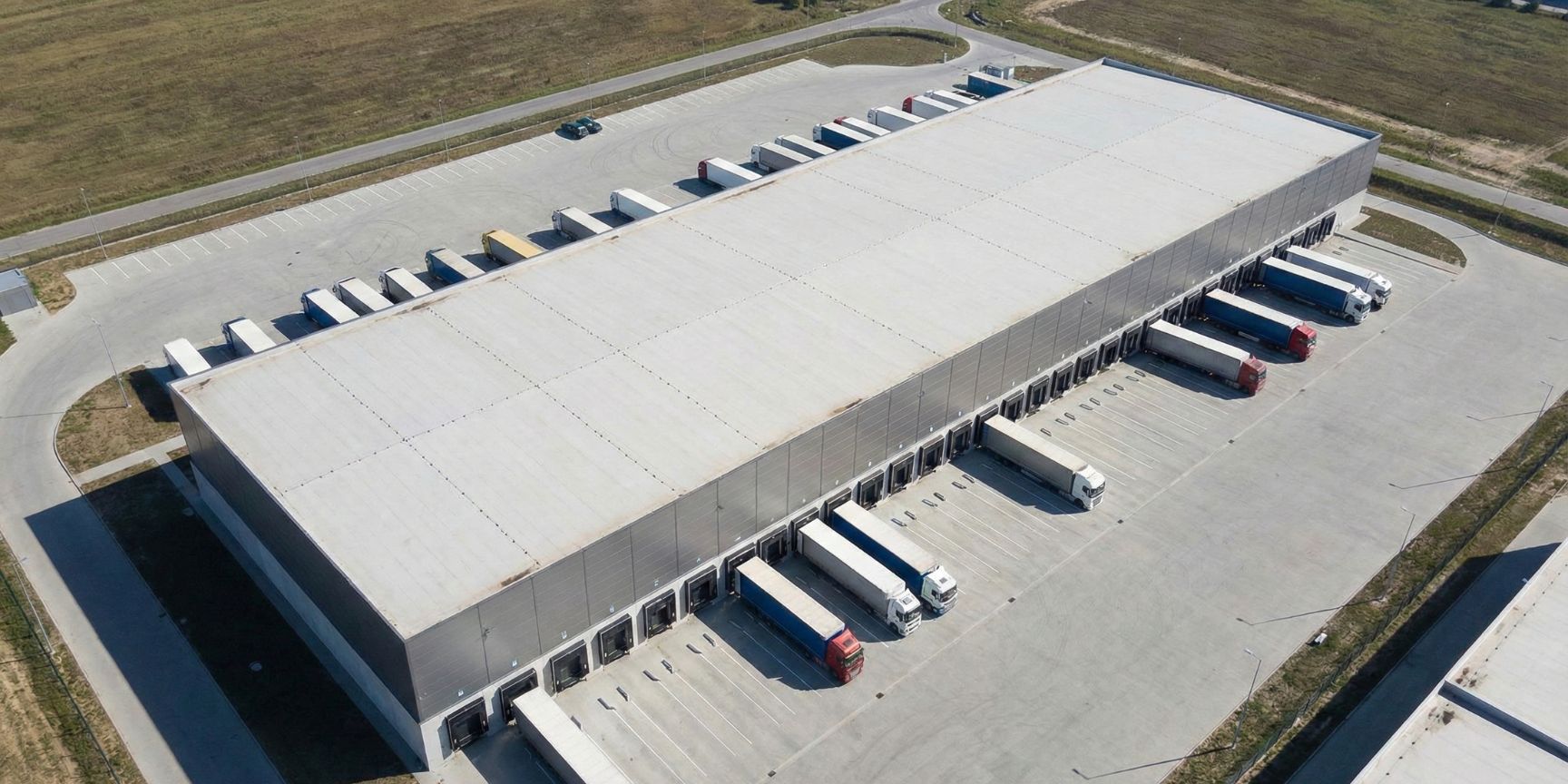
- Cross-docking capability: To route goods directly from inbound to outbound without storage, opposite loading gates (transshipment) are ideal.
- Number of ramps: As a rule of thumb in the industry, there should be at least one ramp per 400–600 m² of hall space to avoid traffic jams during loading.
- Hall height & floor load capacity: Modern halls use usable heights of 12 metres (lower edge of truss) or more. The soil has to withstand point loads of often 5 to 7 tons per square meter , especially when automated sorter systems are installed.
- Yard depth: For smooth outbound traffic, a shunting depth of at least 35 meters in front of the gates is necessary to maneuver 40-ton trucks efficiently.
Contract logistics: outsourcing of outbound processes
Many companies outsource outbound logistics to contract logistics companies. This is not only about transport, but also about long-term cooperation (contract term usually 3-5 years).
Why contract logistics in outbound? The service provider assumes the risk of volatility. While an in-house warehouse can collapse during seasonal peaks (e.g. Black Friday), the contract logistics provider offers scalability. A closer look shows that billing models are often based on activity-based pricing, in which each pick, pack and label is priced individually. This creates transparency in the unit costs per item shipped.
FAQ: In-depth questions about outbound optimization
Question: How does e-commerce logistics influence outbound structures?
Answer: Massively. Instead of pallet shipping, parcel shipping (small parcel) dominates. This requires more space in the hall for packing stations and automated sorters, which can sort up to 15,000 parcels per hour. The logistics property will become an "urban hub".
Question: What role does WMS play in outbound efficiency?
Answer: The WMS is the brain. A modern system uses algorithms for route optimization and batch picking. Without real-time data connection to the carriers (shipping service providers), modern outbound logistics is not competitive due to a lack of tracking options.
Question: What are the most important KPIs in outbound logistics?
Answer:
- Order Cycle Time: Time from the order to the time it leaves the ramp.
- Perfect Order Rate: Percentage of error-free, on-time shipments.
- Shipping Cost per Unit: The total outbound cost divided by the number of shipments.
Facts & Figures: Efficiency Potential at a Glance
To understand the economic significance, it helps to take a look at the cost structure:
| Area | Cost share of outbound (approx.) | Potential for optimization |
| Picking | 40% - 60% | High (due to automation/pick-by-light) |
| Packaging material | 5% - 10% | Medium (sustainable solutions/volume optimization) |
| Freight costs | 25% - 40% | High (through freight tenders/consolidation) |
| Real estate costs | 10% - 15% | Low (fixed, but efficiency can be optimized through layout) |
The role of sustainability (Green Outbound)
In the niche sector, "green outbound logistics" is gaining in importance. This is not just about electric trucks, but about reducing air in the packages. Since freight rates are often calculated according to dimensional weight , a reduction in the size of the packaging directly leads to a reduction in the CO2 balance and costs. Logistics properties are increasingly being certified according to DGNB or BREEAM standards , which makes the outbound location stable in value in the long term.
Conclusion for practice
Today, outbound logistics is much more than just loading boxes. It is a strategic discipline that starts with the selection of the right logistics property (location, number of doors, degree of automation) and extends to the selection of the right contract logistics partner and IT-supported process optimization. Those who master their outbound process not only reduce their process costs by up to 15-20%, but also secure the decisive competitive advantage through delivery reliability.