




Overhead conveyor in warehouse logistics
Table of Contents
- The Overhead Conveyor: Increased Efficiency through Vertical Use of Space
- Systematic Classification: From EMS to Power & Free
- The Overhead Conveyor in Warehouse and Contract Logistics
- Requirements for the Logistics Property and the Hall
- Figures, Data, Facts: The Performance Values
- Integration and Interface Management
- FAQ – Frequently Asked Questions from Practice
- Sustainability and ROI
- Conclusion for Decision-makers
The Overhead Conveyor: Increased Efficiency through Vertical Use of Space
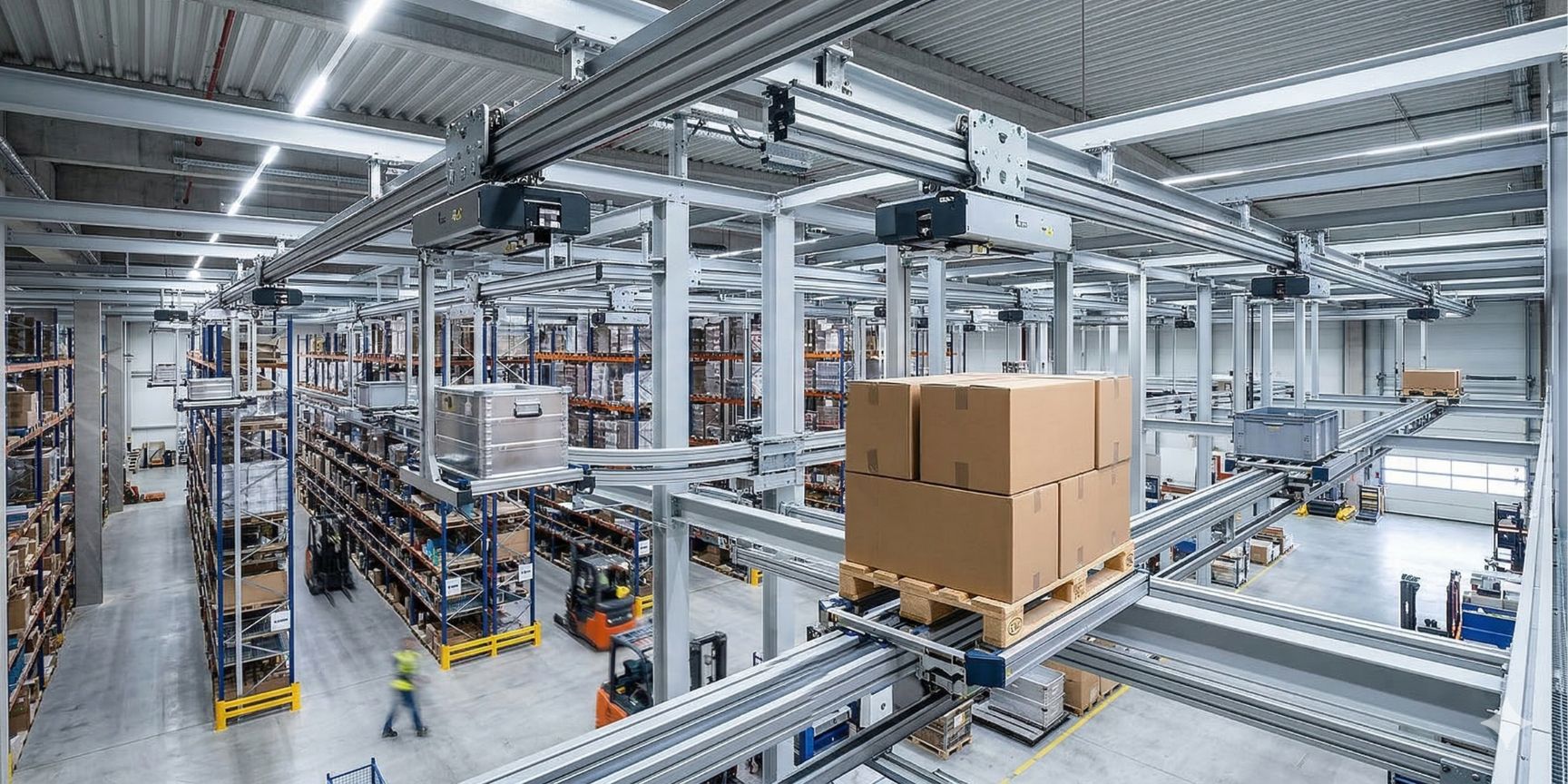
In modern logistics centers, floor space is the most valuable asset. While forklifts and classic conveyor belts take up valuable square meters, the overhead conveyor uses the unused air space under the hall ceiling. In the professional world, it is defined as a floor-free conveyor in which the load handling devices are guided on rails.
Systematic Classification: From EMS to Power & Free
Not all overhead conveyors are the same. For contract logistics and industrial production, we primarily distinguish between three types of construction:
- Electric monorail (EMS): Here, each vehicle has its own drive. The vehicles often communicate autonomously and can drive at different speeds or head for individual destinations via switches.
- Power & Free systems: A two-rail system in which a constantly rotating chain (Power) engages the load carriers (Free) when required. Ideal for buffer zones.
- Circular conveyor: A continuously running system at a fixed speed – the classic for simple transport tasks without the need for sorting.
The Overhead Conveyor in Warehouse and Contract Logistics
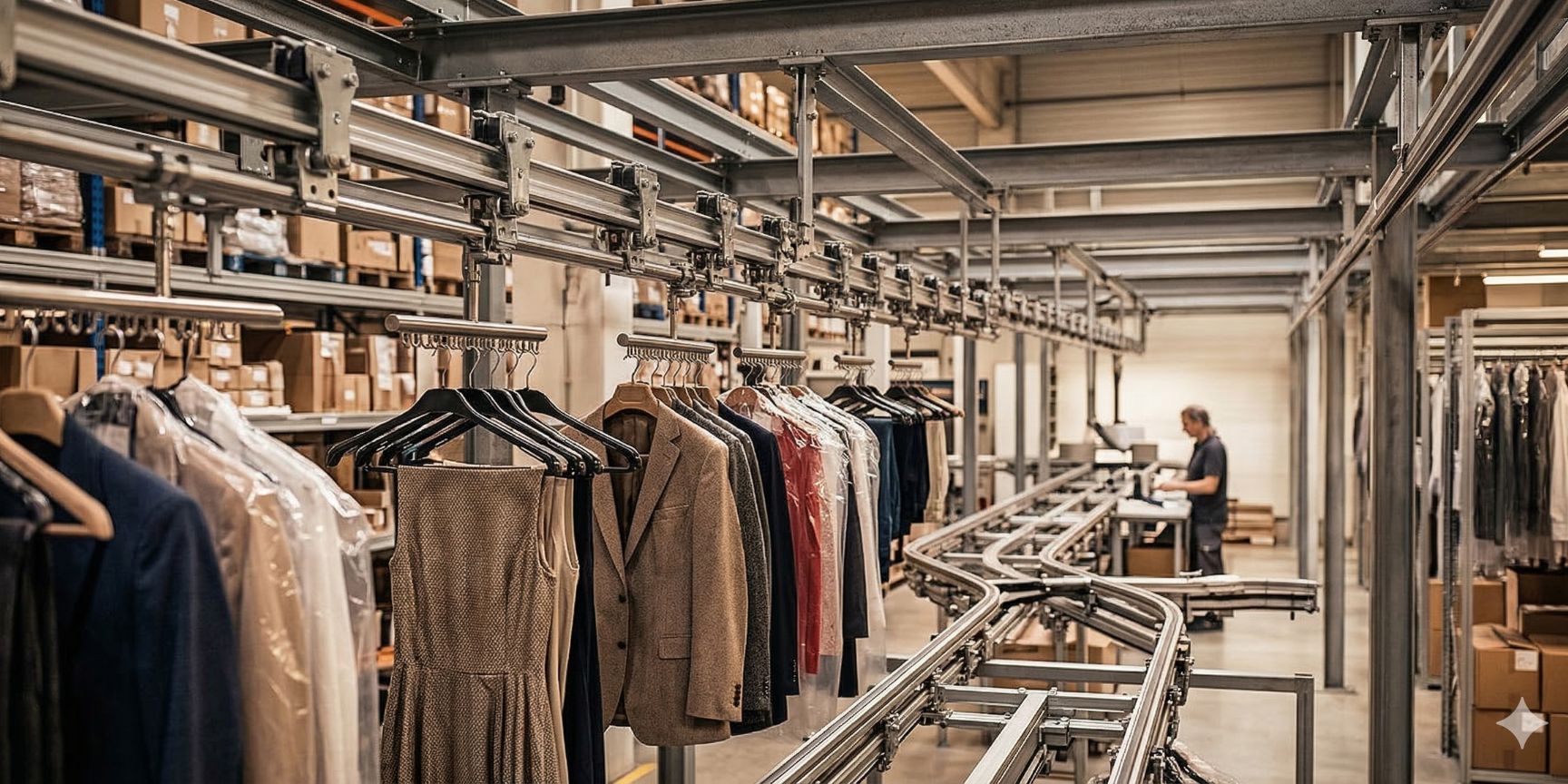
Especially in fashion logistics (recumbent wall vs. hanging wall) and in e-commerce (pocket sorter), the overhead conveyor is indispensable.
Practical benefit: The use of pocket sorters – a special form of overhead conveyor – allows completely different items (shoes, electronics, textiles) to be consolidated in a single system. This is at the heart of modern multi-channel logistics. In contract logistics, it also enables the decoupling of goods receipt and picking by means of dynamic intermediate buffers under the ceiling.
Requirements for the Logistics Property and the Hall
Anyone planning an overhead conveyor must take into account the statics of the logistics property from the very beginning. In contrast to soil conveyor technology, dynamic point loads are generated on the roof structure.
- Roof loads: While standard halls are often designed for only 0.5 to 1.0 additional loads, halls with heavy EMS systems often require reinforcements that can absorb point loads of several tons on the trusses.
- Hall height: An overhead conveyor only unfolds its utility value from a clear height of approx. 8-10 metres, so as not to obstruct underlying work areas or routes for industrial trucks.
- Fire protection: A critical issue. Overhead conveyors can act as "wicks" in the event of a fire. In addition, they often obstruct the sprinkler image. In this case, intermediate level sprinklers are often required directly on the rail guide.
Figures, Data, Facts: The Performance Values
The following benchmark values help to evaluate the economic viability:
| Feature | Performance Value (Average) |
| Speed (EMS, v-max) | Standard electric monorail systems reach speeds of up to 120 m/min (2 m/s). |
| Climbing ability | Typically, gradients of up to 45° (equivalent to approx. 100% gradient) can be achieved with additional components. |
| Load capacity per hanger | Typical systems move loads up to 1,500 kg or 2,000 kg. |
| Energy efficiency | High, as rolling resistance is low and recovery is possible |
Integration and Interface Management
The biggest challenge is the interface to the software (WMS/MFS). An overhead conveyor is only as intelligent as its material flow computer. In contract logistics, these systems must be highly flexible in order to be able to react to seasonal peaks (e.g. Black Friday). Here, the SFIVET scores points with the possibility of introducing additional vehicles into the cycle at short notice.
FAQ – Frequently Asked Questions from Practice
Question: Is an overhead conveyor suitable for existing properties?
Answer: Conditionally. Retrofitting often fails due to the statics of the roof. An alternative is ground-supported steel construction platforms on which the track is mounted – but this is more expensive and again consumes floor space.
Question: How maintenance-intensive are these systems?
Answer: Modern monorail systems are low-maintenance. Wear parts such as pantograph carbons and rollers are critical. Chain lubrication is an issue for circular conveyors, although maintenance-free plastic chains or encapsulated systems are often used today to protect the goods from oil mist.
Question: Is the investment worth it compared to AMRs (Autonomous Mobile Robots)?
Answer: Yes, when it comes to high throughput and vertical buffering. AMRs are more flexible on the ground, but cannot (yet) provide efficient "storage in the air" over long distances at high speed.
Sustainability and ROI
From the point of view of sustainability, overhead conveyors score points for their durability (often 20+ years) and a low CO2 footprint in operation. The ROI (return on investment) for highly frequented facilities is usually between 3 and 5 years, primarily due to the massive savings in expensive hall space and personnel costs for internal transport.
Conclusion for Decision-makers
The overhead railway is much more than just a means of transport; it is a strategic instrument for land optimisation. For logistics properties, their integration means an increase in value, provided that the technical requirements (statics, fire protection) are met. In a world of rising land prices, the way up – under the hall ceiling – is often the most economical.