




Sprinkler System in Warehouse
Table of contents
- What is a sprinkler system and how does it work?
- Why are sprinkler systems indispensable in logistics properties?
- Which sprinkler systems are suitable for warehouses?
- VdS, FM Global and legal requirements
- Facts, figures and figures on fire safety in logistics
- Cost-effectiveness: costs and maintenance in practice
- Frequently Asked Questions (FAQ)
- Conclusion: Fire protection as a quality feature of contract logistics
What is a sprinkler system and how does it work?
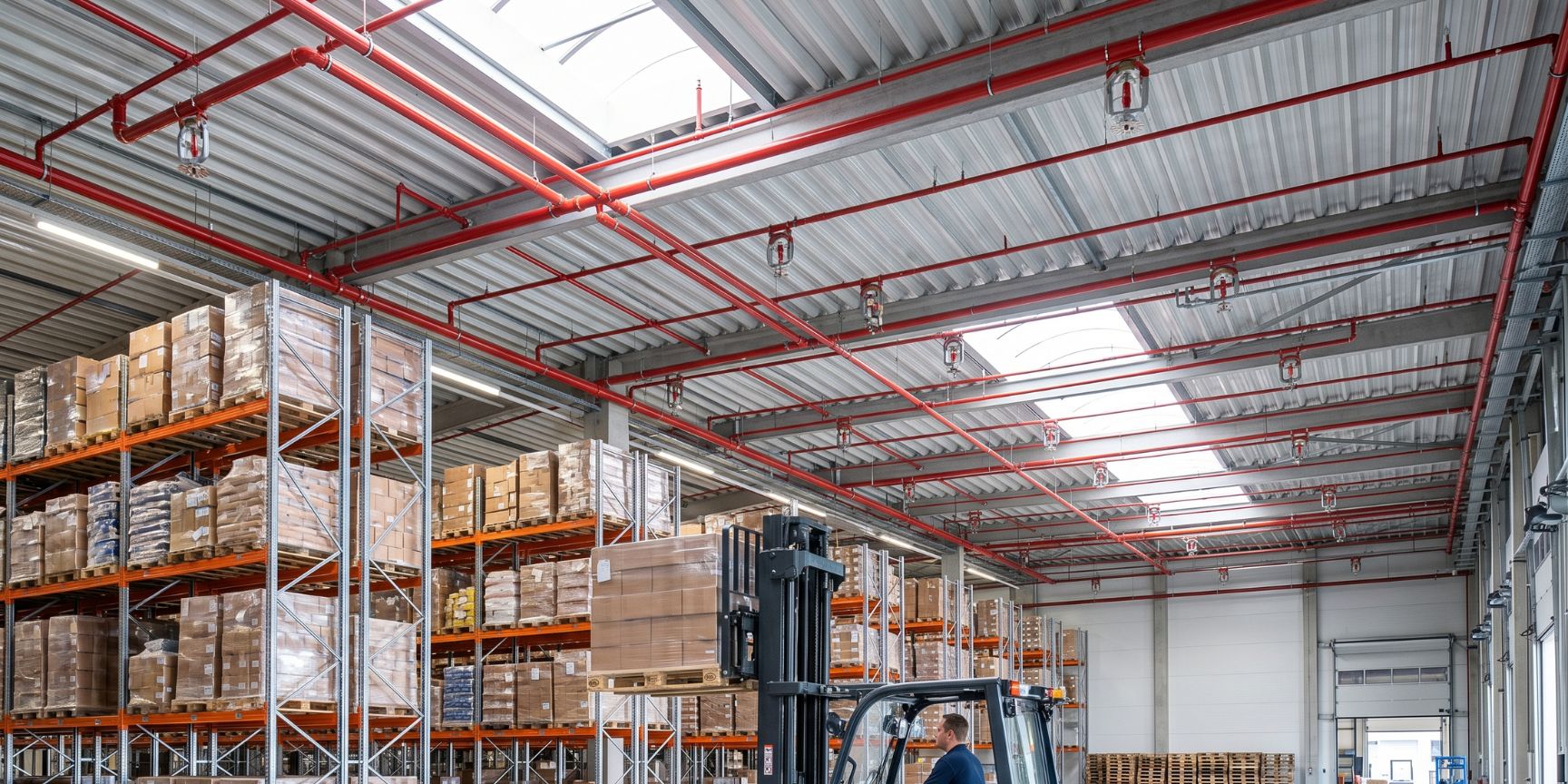
A sprinkler system is an automatic fire extinguishing system that detects and fights fires as they develop. Contrary to the widespread Hollywood myth, all sprinkler heads in a hall never trigger at the same time in the event of a fire. Each sprinkler head is sealed with a heat-sensitive glass barrel (glass ampoule) containing a special liquid. If the ambient temperature reaches a defined threshold value (usually 68 °C), the liquid expands, the glass bursts and the extinguishing water is released precisely over the source of the fire. This cools the fire, displaces the oxygen and prevents the flames from spreading to neighboring areas.
Why are sprinkler systems indispensable in logistics properties?
In warehouse and contract logistics, enormous material assets meet extremely high fire loads. Packaging materials such as cardboard and films, pallets, hazardous substances or lithium-ion batteries pose a considerable risk. Especially in high-bay warehouses, a fire can spread vertically at breakneck speed due to the chimney effect. For operators of logistics properties and contract logistics companies, a sprinkler system is therefore essential for two reasons: First, it protects the property of the clients, which is essential for liability and customer loyalty. Secondly, industrial insurers and building permit authorities require installation from a certain hall size in order to minimise the risk of a total loss (and a month-long interruption of operations).
Which sprinkler systems are suitable for warehouses?
Depending on the use and construction of the logistics property, different sprinkler systems are used:
- Wet systems: The pipe network is permanently under water pressure. They are the standard in heated logistics halls.
- Drying systems: The pipe network is filled with compressed air. Water does not flow into the system until a sprinkler is triggered. Ideal for refrigerated warehouses or unheated halls where there is a risk of frost.
- Early Suppression Fast Response (ESFR) sprinklers: These special ceiling sprinklers drop massive amounts of water in a very short time. They are designed to not only control a fire, but to suppress it completely. They are often used in modern logistics centers, as they allow expensive shelf sprinklers to be dispensed with up to certain heights.
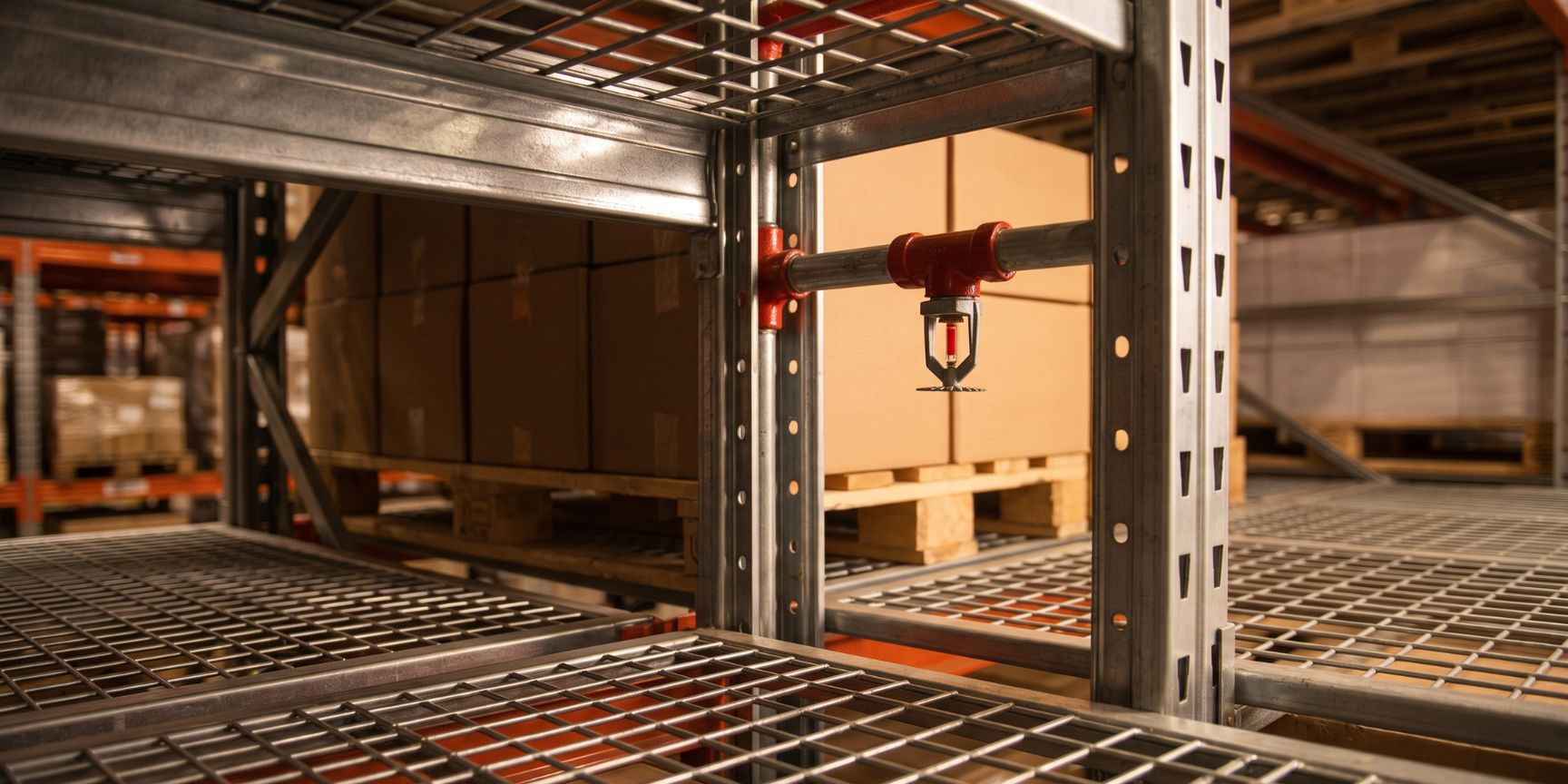
- Shelf sprinklers: In very high or densely packed high-bay warehouses, the water from the ceiling often does not reach the bottom. Here, additional sprinklers are installed directly on the shelf levels.
VdS, FM Global and legal requirements
Anyone planning or operating a logistics property in Germany must follow strict guidelines. Planning and installation is usually carried out in accordance with the specifications of VdS Schadenverhütung GmbH (e.g. VdS CEA 4001) or DIN EN 12845. For international investors and globally active contract logistics companies, the FM Global (Factory Mutual) standard is also of massive importance. Logistics properties that are sprinkled according to FM-Global standards (Highly Protected Risk) benefit from significantly lower insurance premiums worldwide and are easier to rent or sell on the real estate market.
Facts, figures and figures on fire safety in logistics
A well-founded look at the figures shows the enormous effectiveness of these systems in practice:
- Success rate: In over 98% of cases, sprinkler systems succeed in extinguishing a fire or controlling it until the fire brigade arrives.
- Triggering temperature: Standard sprinklers in halls usually trigger at 68 °C (red ampoule). In areas with a higher ambient temperature (e.g. under glass roofs), ampoules with 93 °C (green) or 141 °C (blue) are used.
- Water requirements: An ESFR system in a high-bay warehouse can release up to 600 liters of water per sprinkler head per minute. The sprinkler tanks (storage tanks) on the factory premises must be correspondingly dimensioned, often holding 500 to 1,000 cubic meters of water.
- Deployment statistics: In most fire cases, 3 to 5 triggered sprinkler heads are sufficient to successfully fight the fire.
Cost-effectiveness: costs and maintenance in practice
The investment costs for a sprinkler system in a logistics hall make up a significant part of the technical building equipment (TGA). Depending on the risk class, storage height and system type (ESFR vs. rack sprinklers), costs can vary greatly. In addition, the system is extremely maintenance-intensive. In addition to weekly visual and functional inspections by the sprinkler attendant on site, regular inspections must be carried out by recognised experts (e.g. VdS or TÜV). Despite these running costs, the system pays off: Thanks to massive discounts on fire and business interruption insurance, a sprinkler system in large logistics centers often pays for itself after just a few years.
Frequently Asked Questions (FAQ)
Question: Do sprinkler systems trigger when smoke develops?
Answer: No. Sprinklers react exclusively to heat. Smoke, dust (e.g. from forklift trucks) or exhaust fumes do not cause triggering. Fire alarm systems (BMA) are responsible for pure fire detection (smoke).
Question: Doesn't the extinguishing water ruin all the stored goods in the warehouse?
Answer: Since only the sprinklers are triggered directly above the source of the fire, the water damage remains narrowly limited locally. The damage caused by an uncontrolled fire, toxic fire smoke and soot precipitation throughout the building would be many times higher.
Question: Can shelf sprinklers be damaged during storage and retrieval?
Answer: Yes, this is a well-known risk in manual warehouse logistics. If a forklift driver tears off a shelf sprinkler, water will leak out immediately. For this reason, shelf sprinklers are often equipped with special protective rails or impact protection grilles.
Question: What is a pre-action plant?
Answer: This is a pilot-operated drying system. It is often used where water damage must be avoided at all costs (e.g. in server rooms or hazardous materials warehouses). Water only flows into the pipe network when a smoke detector sounds the alarm independently of the sprinkler head.
Conclusion: Fire protection as a quality feature of contract logistics
In the modern supply chain, reliability is the top priority. A professionally planned and maintained sprinkler system is much more than a compulsory exercise under building law. For logistics service providers, it is a key promise of quality to their customers: it guarantees that the flow of goods entrusted to them remains protected even in the worst-case scenario and that the delivery capability of the entire logistics chain is maintained.
Your Ideal Logistics Warehouse
Browse listings for warehouse space, logistics real estate, industrial land, and contract logistics solutions.
Browse Exposés
Maximize Exposure for Your Warehouse Space
Showcase your logistics properties and attract qualified inquiries.
Discover Products