



Social rooms in the camp
Table of contents
- Definition: What are social spaces in warehouse logistics?
- Legal Guardrails: The Workplace Guidelines (ASR)
- Strategic placement in the logistics property
- Contract logistics and employee branding
- Equipment and well-being: More than just a coffee machine
- The hall as an interface: sanitary rooms and changing rooms
- FAQ – Frequently asked questions about social rooms in the warehouse
- Conclusion: Social spaces as a driver of returns
Definition: What are social spaces in warehouse logistics?
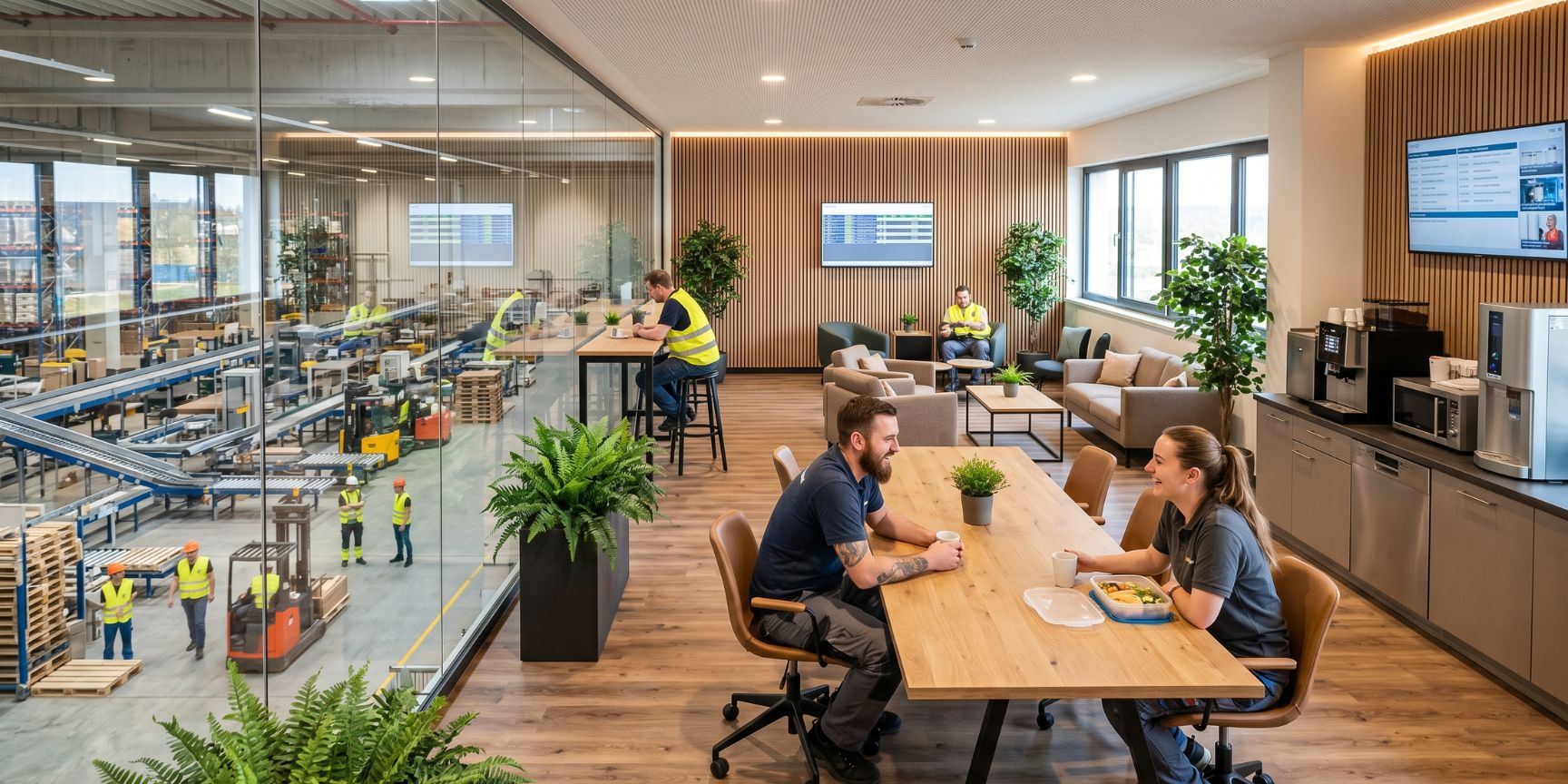
In business premises planning, social rooms are understood to be all rooms that are not directly used for work, but for recreation, hygiene and personal exchange between employees. In the context of warehouse logistics , this includes break rooms, on-call rooms, changing rooms, washing areas and sanitary rooms.
Especially in large logistics properties or in contract logistics with high personnel deployment, the strategic distribution of these spaces is essential. They act as places of retreat in an often noisy and physically demanding working environment (hall).
Legal Guardrails: The Workplace Guidelines (ASR)
If you are planning social rooms, there is no way around ASR A4.2 (break and standby rooms) and ASR A4.1 (sanitary rooms). These technical rules specify the Workplace Ordinance.
Important key figures at a glance:
- Break room obligation: From more than 10 employees (or in the case of special hazards such as heat, cold or noise), a break room is mandatory.
- Space requirement: At least 1.00 m² of floor space must be provided per user (including table and chair). However, a break room must be at least 6.00 m² in size.
- Clear height: Often not a problem in logistics halls, but important in interior design: At least 2.50 m (up to 50 m²) or 2.75 m (over 100 m²).
Strategic placement in the logistics property
In huge logistics centers (big boxes), the location of the social rooms is a question of efficiency. If an order picker has a 10-minute walk to the next break room, he loses 20 minutes of productive time with two breaks per shift.
- Centralised vs. decentralised solutions: While the headquarters usually uses central social rooms, large hall operators are increasingly relying on "break islands" or "mezzanine solutions".
- Route optimization: Social rooms should be placed in such a way that they can be reached on foot from the main work areas (incoming goods, picking, outgoing goods) in a maximum of 5 minutes.
- Noise protection: Since the background noise in intralogistics (conveyor technology, forklift traffic) is often over 80 dB, social rooms must be structurally soundproofed.
Contract logistics and employee branding
In contract logistics , margins are often tight and the shortage of skilled workers is great. This is where social spaces become a tool for employer branding. A modern break room with Wi-Fi, ergonomic furniture and an attractive kitchenette signals appreciation.
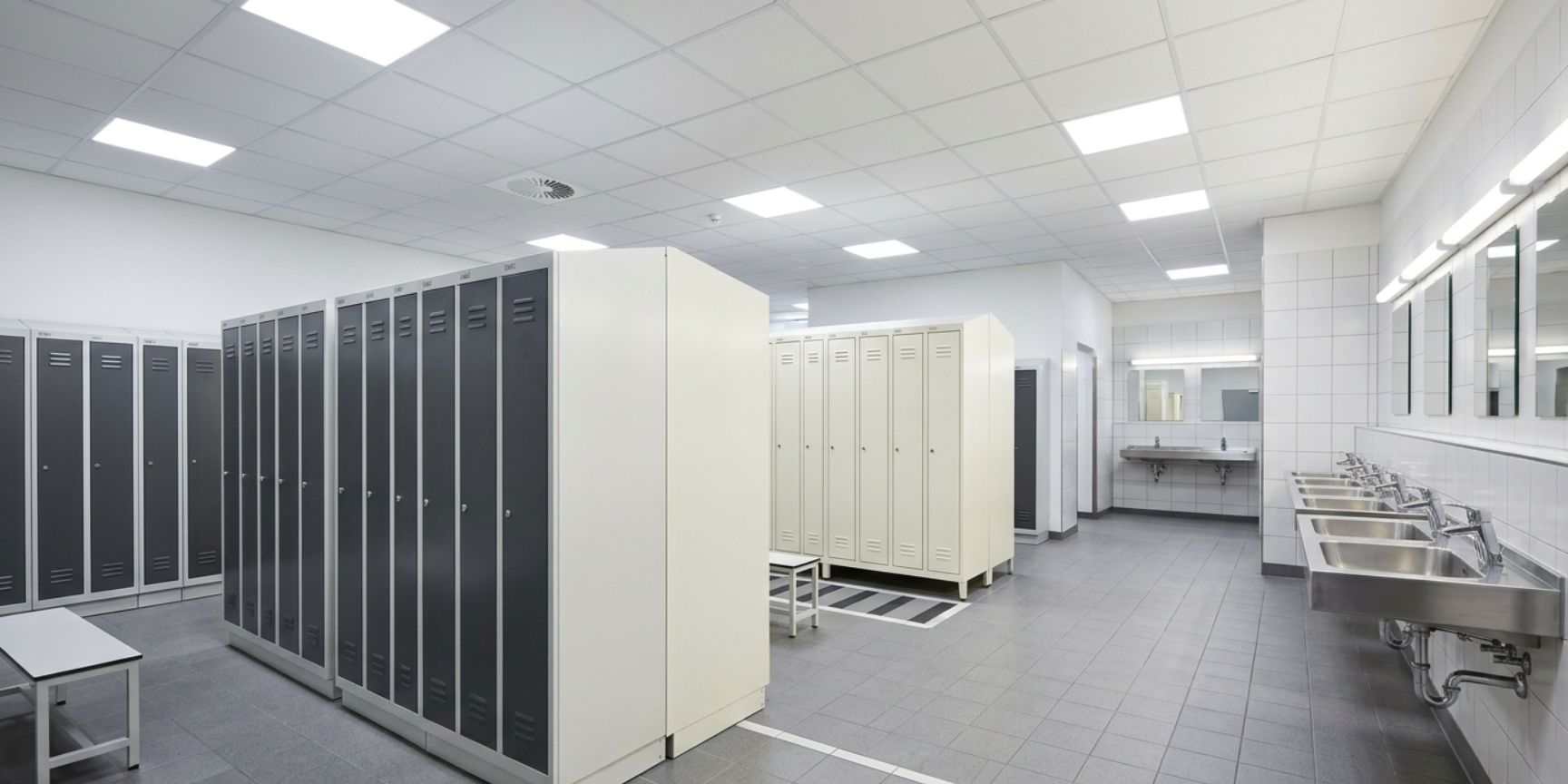
Practical tip: Use "black-and-white systems". In warehouses that work with hazardous substances or heavily contaminated goods, a strict separation between work clothing (black) and private clothing (white) in the changing rooms is required by law and hygienically necessary.
Equipment and well-being: More than just a coffee machine
A modern social space in the 21st century follows the "third place" concept: it is neither a workplace nor a home, but a place of regeneration.
- Indoor climate: Own ventilation (independent of the indoor air) is mandatory. The temperature should be at least 21 °C .
- Lighting: Daylight is preferred. In windowless hall areas, a natural rhythm must be simulated by high-quality LED systems (biodynamic light).
- Digitalization: Charging stations for smartphones and digital info boards (for shift schedules or company news) are now standard.
The hall as an interface: sanitary rooms and changing rooms
Often neglected, but crucial for industrial hygiene:
- Toilets: The number depends on the number of people present at the same time. (e.g. 2 toilets for up to 10 male/female employees).
- Washing facilities: In logistics, washbasins with running hot water are standard; Showers are mandatory if the work is dusty or physically very demanding.
FAQ – Frequently asked questions about social rooms in the warehouse
Question: Is smoking allowed in the break room? Answer: No. According to the ASR, the employer is obliged to protect non-smokers from the dangers of tobacco smoke. Smoking areas must be designated separately (usually in the outdoor area).
Question: Do social rooms have to be barrier-free? Answer: Yes, accessibility is now standard for new logistics properties in order to enable inclusion in warehouse operations (e.g. wide doors, no thresholds).
Question: Do the travel times to the social space count as working time? Answer: As a rule, the journeys to the break are part of the unpaid break time, unless individual contractual or company regulations say otherwise. A central location minimizes employee frustration here.
Conclusion: Social spaces as a driver of returns
Social spaces in logistics are not a "necessary evil", but an investment in operational excellence. Well-planned rooms reduce sick leave, increase employee loyalty and optimize internal travel times. Anyone who develops a logistics property or operates a warehouse today should focus on the people who work in it – because the best automation is of little use if the team cannot regenerate.
Your Ideal Logistics Warehouse
Browse listings for warehouse space, logistics real estate, industrial land, and contract logistics solutions.
Browse Exposés
Maximize Exposure for Your Warehouse Space
Showcase your logistics properties and attract qualified inquiries.
Discover Products