



Side loading in warehouse logistics
Table of contents
- Side loading: A specialist glossary for logistics real estate and operational processes
- Definition and demarcation: What is side loading?
- The logistics property: structural requirements and canopies
- Operational Logistics & Equipment: The Industrial Truck Factor
- Contract logistics: When is side loading economical?
- Challenges and disadvantages in practice
- Frequently asked questions (FAQ) about side loading
- Conclusion and outlook
Side loading: A specialist glossary for logistics real estate and operational processes
The loading and unloading of trucks is the interface where the material flow most often comes to a standstill. While rear loading via dock gates (dock levelers) is the standard for palletized consumer goods, side loading plays a decisive role in industrial and contract logistics. This article sheds light on the technical, structural and procedural depths of this process.
Definition and demarcation: What is side loading?
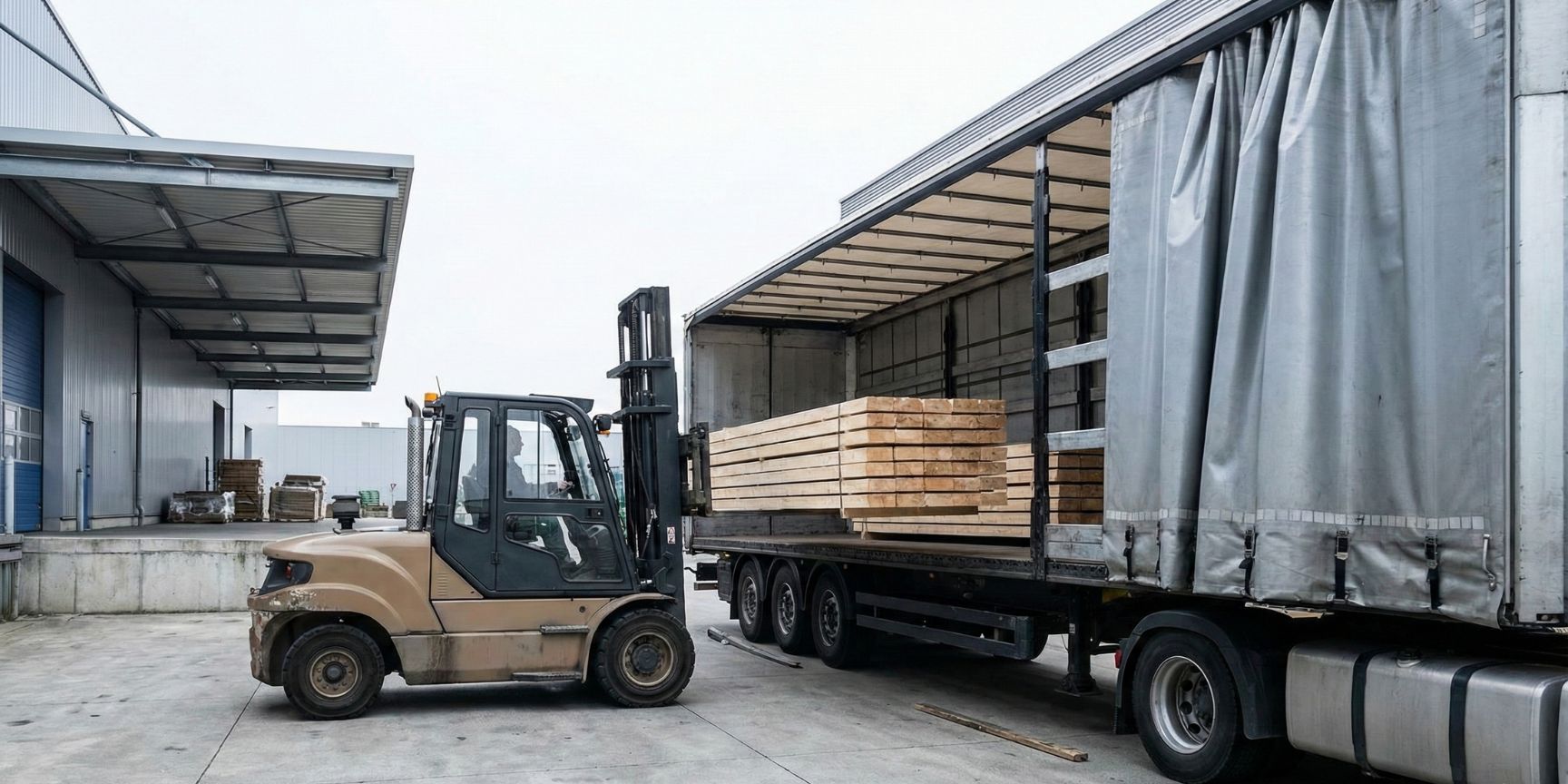
Side loading is the handling of goods over the long side of a transport vehicle. In contrast to rear loading, where the truck docks backwards to a ramp, the vehicle is usually parallel to the building or in an open space with side loading.
This requires specific vehicle types, primarily so-called curtainsiders (tarpaulin semi-trailers) or tautliners. In these vehicles, the side tarpaulin can be pushed open like a curtain, and stanchions and insertion slats can be removed to make the entire loading area (usually 13.6 loading metres) accessible from the side.
The logistics property: structural requirements and canopies
For developers and investors of logistics real estate, the ability to load on the sides is a key flexibility feature ("third-party usability"). A hall that only has ramp gates excludes tenants from industries such as mechanical engineering or timber trade.
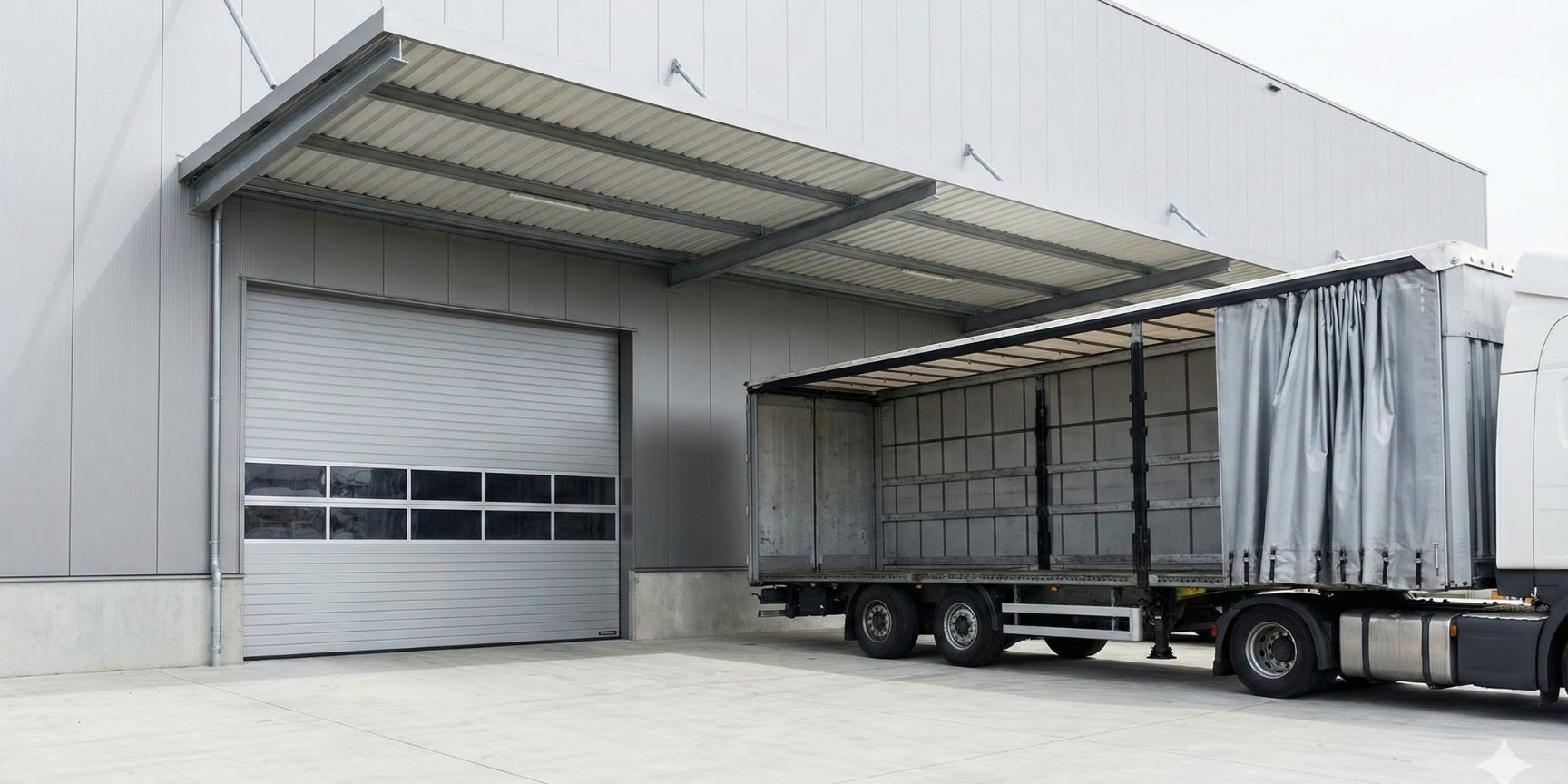
- Ground-level doors: Essential for side loading are large-dimensioned, ground-level sectional doors (often WxH: 4.00m x 4.50m), through which forklifts can move from the inside of the hall to the outside.
- Canopies: Since side loading often takes place outdoors, weather protection is critical. A standard canopy of 2 to 3 meters deep is not sufficient here. For effective, weather-protected side loading, canopy depths of at least 6 to 10 meters are recommended to cover forklift traffic and truck width.
- Ground conditions: The outer surfaces (apron) must be designed for high point loads, as forklifts with heavy loads maneuver here. Asphalt is often inadequate; Concrete surfaces are the standard for intensive side handling zones.
Operational Logistics & Equipment: The Industrial Truck Factor
The choice of equipment is fundamentally different from ramp handling. Electric pallet trucks are useless here.
- Forklift: The standard device. He removes the goods from the side and often has to go far. This requires wide routes (aisle width) next to the truck – usually 4 to 6 meters in addition to the vehicle width.
- Side loaders & four-way forklifts: Specially designed for long goods (pipes, profiles, wood). They can pick up loads from the side and transport them parallel to the direction of travel, which minimizes the space required for manoeuvring.
- Crane systems: In heavy industrial halls, side loading is often carried out by means of an overhead crane (overhead crane) through the open roof of the truck (crane loading), but this requires an "Edscha-Verdeck" (sliding roof) on the truck.
Contract logistics: When is side loading economical?
In contract logistics, the commodity dictates the process. Side loading is always superior or mandatory when:
- Handling long goods: Anything longer than the inner width of the truck (approx. 2.45m) or longer than a Euro pallet is difficult or impossible to load over the rear.
- Oversized cargo: Machines or components that do not fit on standard pallets.
- Speed for full loads: An experienced forklift driver can unload a complete truck faster than an ant driver via the ramp with free access from the side, as he can perform double cycles (two pallets at the same time) more easily and cover less distance in the truck.
Challenges and disadvantages in practice
Despite the necessity, side loading has specific disadvantages that must be taken into account in the hall layout:
- Land consumption: The space required in the outdoor courtyard is enormous. A truck effectively blocks about 20 meters long and 8-10 meters wide (truck + forklift manoeuvring area) during side loading. In conurbations with high land prices, this is a cost factor.
- Weather conditions: Even with a canopy, the goods (and the staff) are more exposed to moisture and temperature fluctuations than when docked to a thermal gate (dock shelter).
- Safety: Since forklifts and pedestrians often move at the same level, the risk of accidents is higher than at the ramp. Clear separation of traffic routes is mandatory.
Frequently asked questions (FAQ) about side loading
In order to shed light on the topic completely, we answer the most frequently asked questions from practice:
Question: Is it possible to carry out side loading at any logistics property?
Answer: No. It is imperative that there is a ground-level access road (gate) and a paved outdoor surface. Pure cross-docking systems that only have ramp gates (docks) are unsuitable for side loading, unless there is an external ramp to the courtyard level.
Question: How much time does side loading save compared to rear loading?
Answer: That depends heavily on the good. For homogeneous pallet goods, automated rear loading is faster. For long goods (e.g. 6-metre profiles), there is no alternative to side loading. In the case of mixed pallets, an experienced forklift operator can completely unload a tautliner from the side in about 20-30 minutes.
Question: What role does load securing play in side loading?
Answer: A decisive one. Since there are no solid walls (as in the box body), load securing must be ensured by tension belts (tie-down lashings) and certificates of the tarpaulin (Code XL). The shipper is jointly responsible here.
Question: What does "drive-through loading" mean?
Answer: In special properties ("tunnel halls"), the truck can drive completely into the hall. Side loading then takes place "indoors" protected from the weather. This is the most expensive but highest-quality solution.
Conclusion and outlook
Side loading remains a niche, but a gigantic one. While e-commerce relies almost exclusively on rear loading, supplying the manufacturing industry (automotive, construction, steel) is unthinkable without side loading.
For investors in logistics real estate , the following applies: A mix of ramp gates (approx. 1 per 1,000 m²) and ground-level gates (at least 1 per fire compartment or hall aisle) with generous canopies ensures that the property retains its value and can be rented to a wide range of logistics service providers.