




Single Order Picking in Warehouse Logistics
Table of Contents
- Definition and functioning: The basis of picking
- Process analysis: The factor of travel time and ergonomics
- Single-Order vs. Multi-Order: A Strategic Consideration
- Relevance in contract logistics: flexibility as a currency
- Requirements for the logistics property and hall layout
- Technological support in the single-order process
- Frequently asked questions (Q&A) about single-order picking
- Conclusion
Definition and functioning: The basis of picking
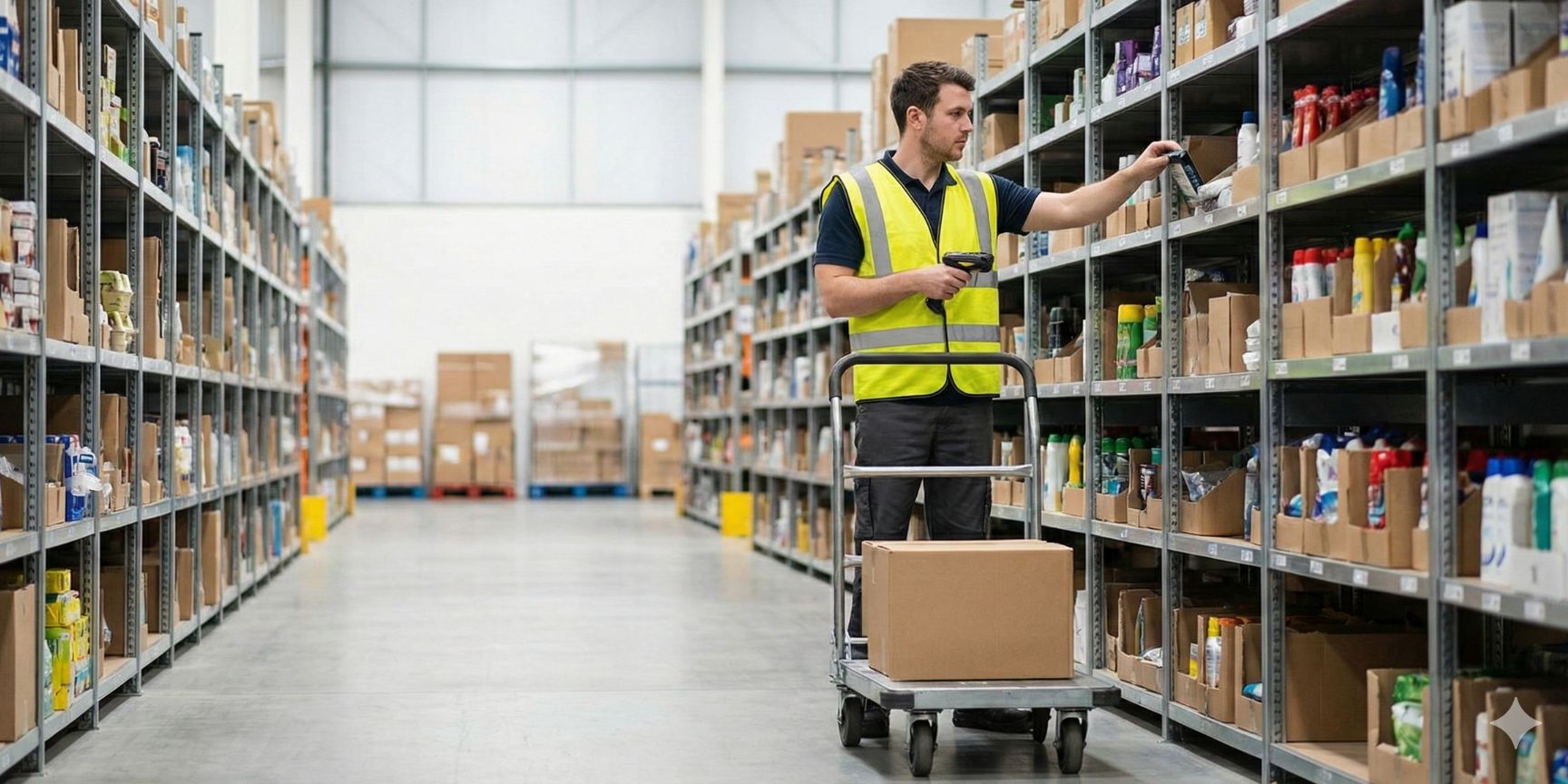
Single-order picking (to German: single-order picking) describes a warehouse logistics process in which an order picker completes a single customer order before starting the next one.
In practice, this means that an order generates a pick list (digital or analogue). The employee moves through the warehouse, picks the items of this specific order and brings them to the shipping zone. There is no mixing with other orders.
Although this process seems simple at first glance, it is irreplaceable in specific niches. It usually follows the "man-to-goods" principle, but can also be mapped as "goods-to-man" (e.g. at autostore ports) in fully automated systems, as long as the logical process order remains 1:1.
Process analysis: The factor of travel time and ergonomics
To understand the depth of the topic, one must analyze the picking time . This is made up of:
- Basic time (organizational matters)
- Travel time (walking/driving)
- Gripping time (removal)
- Dead Time (Search/Check)
In single-order picking, travel time is the most critical factor. Studies show that in conventional warehouses without optimization, travel time accounts for 50% to 60% of the total picking time.
Since the employee has to cross the warehouse again for each order, unfavorable article distribution results in enormous unproductive times. Intelligent warehouse zoning (ABC analysis) is therefore absolutely necessary: fast-moving items (A-items) must be close to the shipping facility in order to keep distances short in single-order mode.
Single-Order vs. Multi-Order: A Strategic Consideration
Why do companies still rely on single-order when multi-order picking (the merging of several orders) is more route-optimized?
- Error rate: The susceptibility to errors is significantly lower with single-order picking. Since items do not have to be sorted into different customer orders afterwards (no two-stage picking), the risk of incorrect packaging is reduced.
- Lead time: For rush orders (e.g. same-day delivery or spare parts logistics), single orders are unbeatable. The job starts immediately and is not held until a batch is full.
- Bulky goods: In the area of "large cubes" (furniture, white goods), multi-order is often physically prohibited, as the picking device (e.g. pallet truck) only offers space for one order.
Relevance in contract logistics: flexibility as a currency
For contract logistics companies that take on warehouse services for third parties, single-order picking is often the "safest" entry procedure.
- Billing: The service can be calculated transparently "per pick" or "per order" without having to explain complex algorithms for allocating travel costs for collective orders.
- Multi-client capability: In multi-user centers (halls in which several customers are processed), single-order picking allows a clear separation. An employee can flexibly switch between client A and client B by simply pulling the next individual order.
- Onboarding: The training time for seasonal workers is minimal, as the process (work through the list -> store goods) is intuitive.
Requirements for the logistics property and hall layout
From the point of view of logistics real estate , single-order picking places specific demands on the hall that investors and project developers must consider:
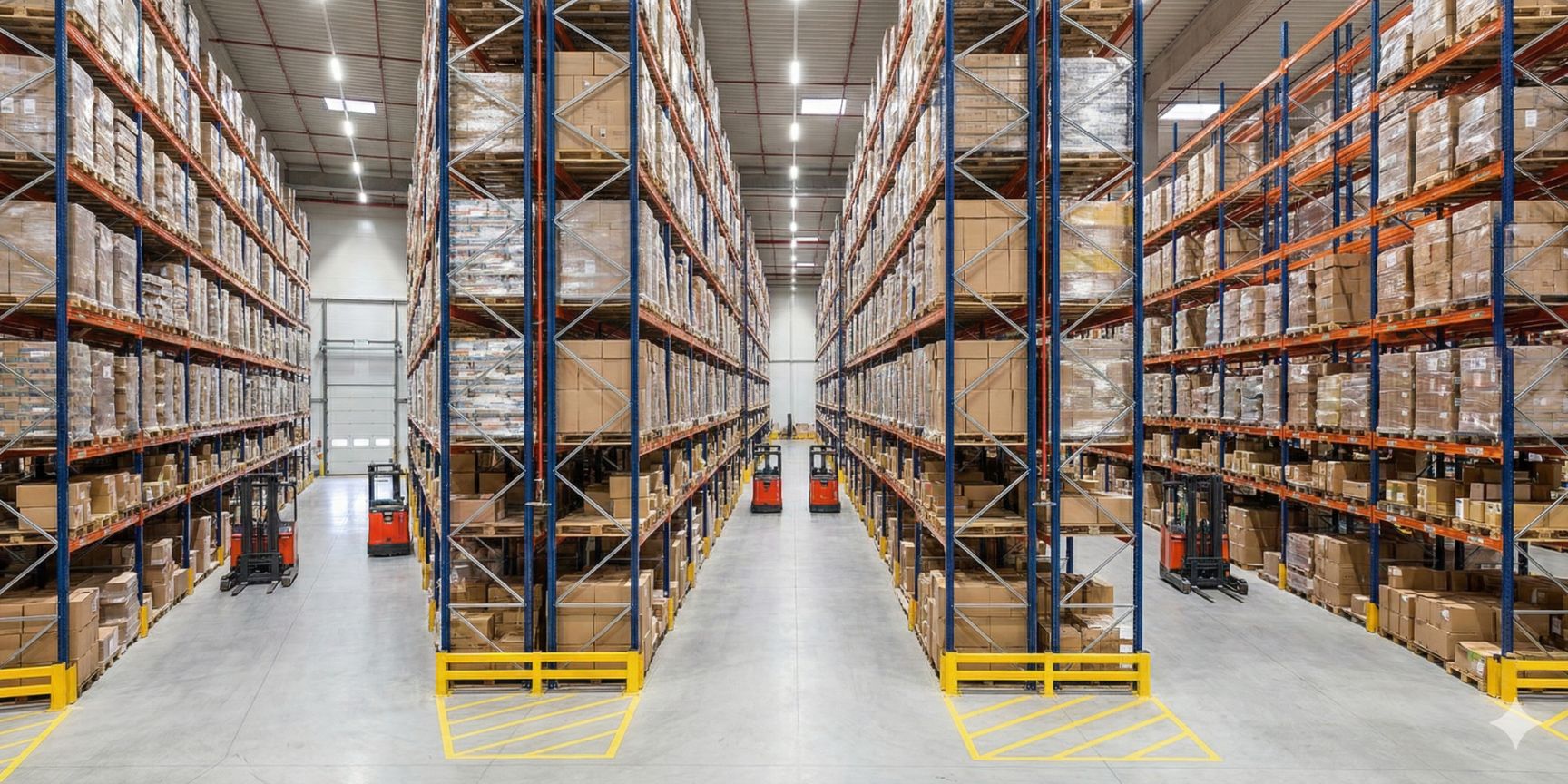
- Aisle widths: Since single-order picking often involves oncoming traffic (employees overtake each other because they are not synchronized as in batch processes), wider work aisles are necessary to avoid accidents and traffic jams.
- Picking tunnels: In modern halls, mezzanines (intermediate levels) are often installed. Low floor heights (approx. 2.50 m) are sufficient for single-order picking of small parts, which increases the space efficiency of the property.
- Shipping zone: Since the orders do not have to be consolidated (no sorting system required), the shipping staging area (outgoing goods) can often be smaller than in multi-order systems, where buffer areas are required for merging.
- Floor load capacity: If single-order picking is used for heavy loads (e.g. building materials), the floor slab must be designed for high point loads from industrial trucks, as the frequency of the journeys is higher than for bundled transports.
Technological support in the single-order process
Even if the process is linear, it is rarely "analog". Technologies are used to minimize the disadvantages (travel time) and maximize the advantages (accuracy):
- Route-optimized navigation: The MDE (Mobile Data Collection) or tablet calculates the "Traveling Salesman Problem" in real time and guides the picker through the alley on the ideal route so that he does not zig-zag.
- Pick-by-Voice / Pick-by-Vision: These technologies are ideal for single-ordering, as they release both hands to the employee ("hands-free"). Confirmation is done by voice, which makes the process smoother than constantly filing a handheld scanner.
Frequently asked questions (Q&A) about single-order picking
Question: When is single-order picking no longer economically viable?
Answer: Once the order volume is very high, the items are small, and the item structure (SKUs) is widely scattered across the warehouse. If an employee has to walk 500 meters for three toothbrushes, this destroys the margin. Here, the switch must be made to multi-order picking.
Question: How does the picking performance (picks per hour) behave?
Answer: In manual single-order systems, realistic values are often between 60 and 150 picks per hour, depending on the goods and distance. In comparison, multi-order systems can often reach 200-400 picks, but with higher investment costs for the sorting technology.
Question: Is single-order picking dead?
Answer: No. In the e-commerce age, the proportion of small orders ("one-piece orders") is growing. If a customer orders only one item, single-order picking (or a variant of it) is effectively the only logical process.
Conclusion
Single order picking is much more than just "working off a piece of paper". It is a strategic decision that prioritizes quality and speed over pure mass efficiency. For logistics properties, this means that layouts must be flexible enough to handle high traffic flow in the aisles, while contract logistics companies appreciate the process for its robustness and low error rate.