




Sectional door at the hall
Table of Contents
- Definition and principle of operation
- Constructive features and material properties
- The sectional door in logistics real estate and contract logistics
- Energy efficiency: U-values and thermal break
- Safety technology and standards (EN 13241-1)
- Drive technology and controls
- FAQ – Frequently asked questions from practice
- Profitability and investment decision
Definition and principle of operation
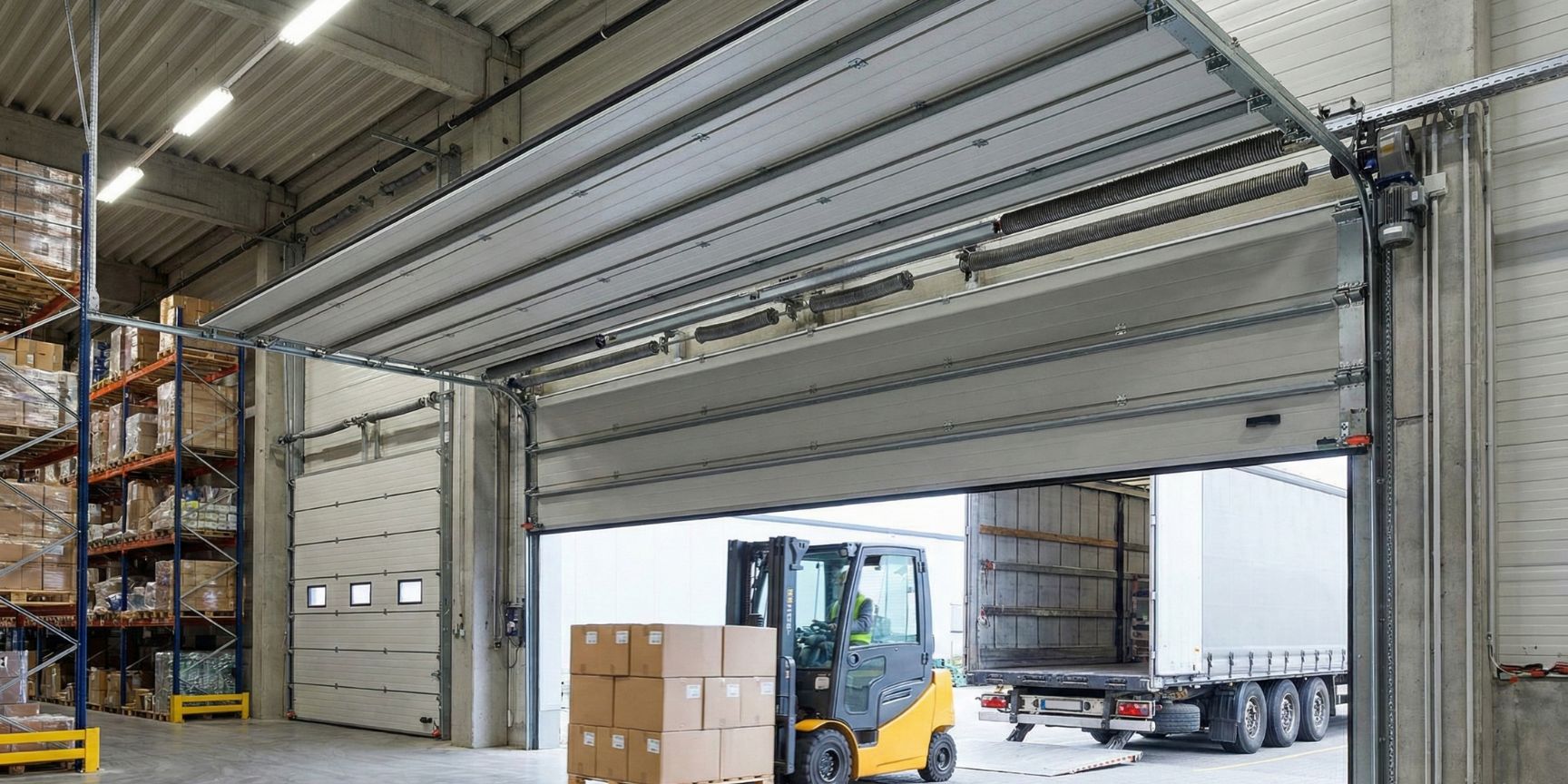
The sectional door is the most frequently installed door variant in commercial real estate, especially in warehouse and contract logistics. In contrast to the classic up-and-over door or the space-saving roller shutter, the sectional door consists of several horizontal elements – the so-called sections. These are connected to each other by hinges.
When opened, the door moves vertically upwards in lateral running rails and is usually led horizontally into the room under the hall ceiling. This principle ensures maximum use of the space in front of and behind the gate. This is essential in logistics, as trucks can dock directly to the ramp without having to take into account the swivel range of the door. This is referred to as the full use of the clearance height.
Constructive features and material properties
The quality of a sectional door in industrial use is primarily determined by the nature of the panels (sections). Double-walled steel slats are used as standard in hall construction, which are foamed with polyurethane rigid foam (PU foam).
- Installation depths: Common thicknesses are 40 mm for standard applications and up to 80 mm for areas with high insulation requirements (e.g. deep-freeze logistics).
- Surface: In order to minimise corrosion and mechanical abrasion caused by the harsh everyday logistics process, the steel surfaces are galvanised and often provided with a polyester base coating.
- Wicket doors: For passenger transport without having to open the entire door, so-called wicket doors can be integrated directly into the door leaf. From a fire protection point of view, these often serve as an escape route, provided they have a threshold-free design.
The sectional door in logistics real estate and contract logistics
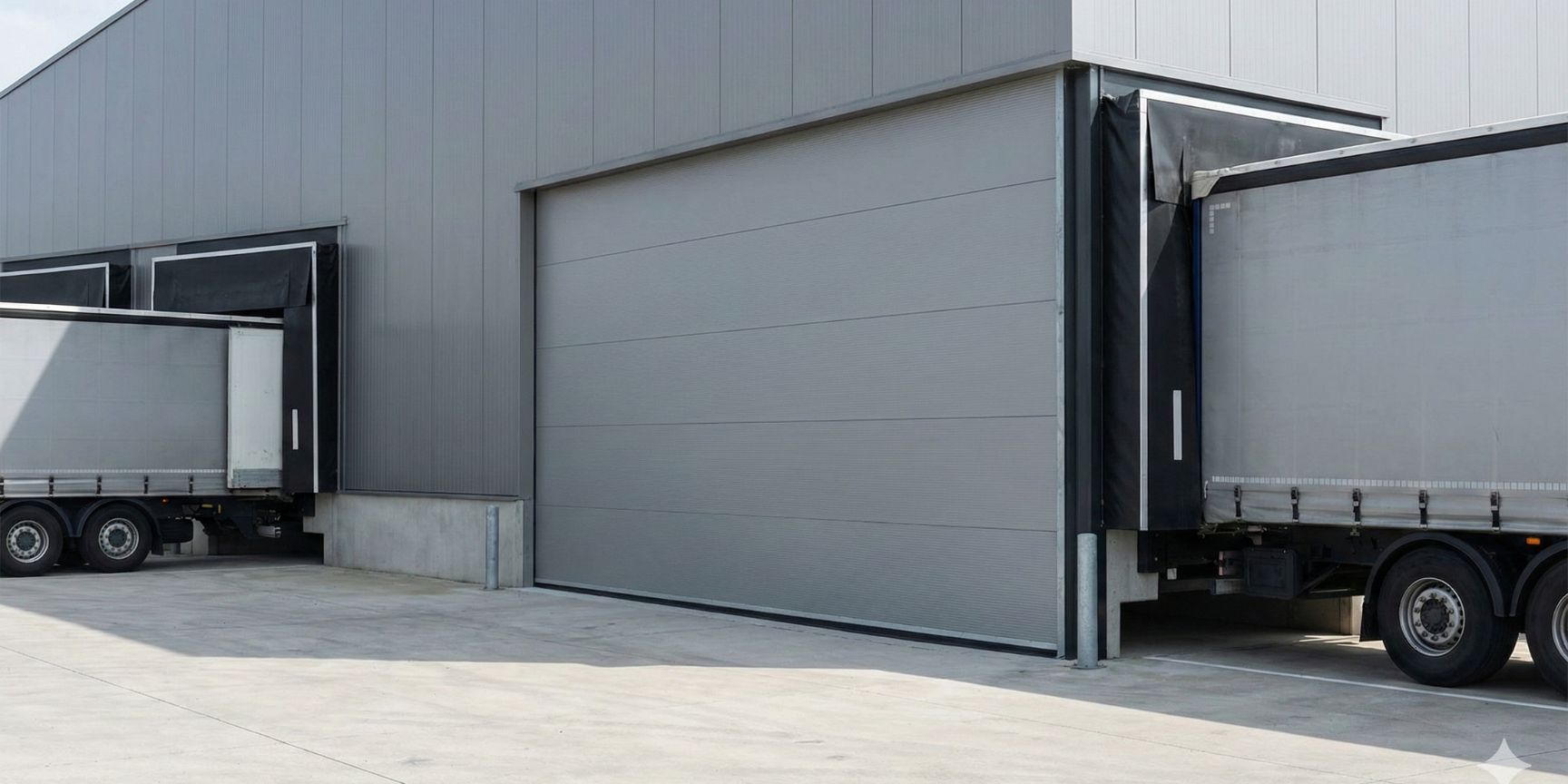
For operators of logistics centers and contract logistics companies, the gate is not just a closure, but a process component. It is part of the loading bay, often combined with a dock leveller and dock shelter.
In contract logistics, where types of use and tenants can change frequently, flexibility is the trump card. Sectional doors offer advantages here due to their adaptability to different types of fittings:
- Normal fitting: standard linkage.
- Raised fitting: The door first moves vertically up the wall (e.g. in high halls with crane runways) before it bends.
- Vertical fitting (guillotine): The door moves completely vertically upwards (only possible for very high halls).
In just-in-time logistics, a failure of a gate means a direct standstill at the ramp ("ramp jam"). For this reason, spring systems are designed in high-frequency warehouses that are designed for 50,000 to 100,000 cycles instead of the usual 20,000 load changes (opening cycles).
Energy efficiency: U-values and thermal break
With rising energy costs and stricter requirements (Building Energy Act - GEG), insulation is coming into focus. A poorly insulated gate often looks like an open hole in the façade of a surface.
The decisive factor is the heat transfer coefficient (value).
Especially in Temperature Controlled Logistics (pharmaceuticals, foodstuffs), the thermal separation of the steel sheets (inside to outside) is absolutely necessary to avoid cold bridges and condensation.
Safety technology and standards (EN 13241-1)
In the EU, all power-operated doors must comply with the product standard DIN EN 13241-1 . For the logistics manager and safety officer, the following features are non-negotiable:
- Spring break protection: Prevents the door leaf from falling off in the event of a torsion spring breaking.
- Slack rope protection: Stops the drive if a suspension cable breaks or becomes limp.
- Finger pinch protection: The shape of the panels prevents fingers from getting into the gap between the sections.
- Closing edge protection: Optosensors or anticipatory light barriers stop the door immediately if there is an obstacle (human or forklift) under the door.
Drive technology and controls
While reel chains (manual operation) are still used in small commercial halls, the electric drive (shaft drive) is standard in logistics. Modern controls are often integrated into the dock management system . This means that the door can only be opened when the truck has docked and the dock leveller is in position. This prevents accidents and energy loss.
For areas where speed is crucial, there are so-called high-speed sectional doors. While standard doors open more slowly, these variants reach significantly higher speeds and often eliminate the need for the additional installation of separate PVC high-speed doors.
FAQ – Frequently asked questions from practice
Question: Sectional door vs. roller shutter – which is better for logistics?
Answer: The sectional door is usually superior. It offers significantly better values (insulation) and stability than a roller shutter. In addition, the installation of viewing windows (sectional glazing) is easier. Roller shutters only score points where there is absolutely no space for guide rails on the ceiling.
Question: How often does an industrial sectional door need to be serviced?
Answer: According to ASR A1.7, power-operated doors must be inspected by an expert at least once a year (UVV inspection). In highly frequented logistics centers, however, a six-monthly maintenance interval is recommended in order to detect wear on rollers and springs at an early stage.
Question: What does "low lintel fitting" mean?
Answer: This is a type of construction for halls with a low height between the door opening and the ceiling. While a normal fitting often requires a lintel of 400-500 mm, low-lintel fittings get by with approx. 200 mm by placing the torsion springs at the back of the running rails instead of directly above the door.
Profitability and investment decision
The acquisition cost of a sectional door is only a fraction of the total cost of ownership (TCO). When planning a logistics property, you should not skimp on the gate. A "cheap gate" with poor rollers and weak springs causes high repair costs and expensive downtime in 24/7 operation.
Data for the calculation: A high-quality sectional door (approx. 3x3 metres) including electric drive costs between €2,500 and €5,000, depending on the equipment. The amortization of a thermally highly insulated door often takes place within 3-5 years in heated halls purely through the energy cost savings.