




IoT in Logistics
Table of Contents
- Internet of Things (IoT): The intelligent backbone of Logistics 4.0
- Definition: What does IoT mean in a Logistics Context?
- IoT in Warehouse Logistics: Transparency Down to the Smallest Unit
- Contract Logistics: Added Value through Data-based Transparency
- The Logistics Property as a "Smart Building"
- Q&A: Frequently Asked Questions from Practice
- Sensors and Hardware: The Eyes and Ears of the Hall
- Challenges: Why do Some Projects Fail?
- Conclusion: IoT as an Indispensable Competitive Factor
Internet of Things (IoT): The intelligent backbone of Logistics 4.0
In a world where "just-in-time" has long since become the standard, pure management is no longer enough. The Internet of Things (IoT) – to German the Internet of Things – is the technological answer to the increasing complexity in warehouse logistics and property management. It describes the networking of physical objects with the Internet so that they can collect, send and react to information independently.
Definition: What does IoT mean in a Logistics Context?
At the core of the IoT are sensors, actuators and software embedded in devices (such as forklifts, pallets or racking systems). While the classic Internet connects people, the IoT connects machines.
Technical term check:
- LPWAN (Low Power Wide Area Network): Radio technologies (such as Narrowband IoT or LoRaWAN) that send data over long distances with minimal energy consumption – ideal for huge logistics halls.
- Digital Twin: A virtual image of a logistics property or process that is fed by real-time IoT data.
IoT in Warehouse Logistics: Transparency Down to the Smallest Unit
In traditional warehouse logistics, inventory was often a "black box" that was only updated by manual scans. IoT is fundamentally changing this.
- Real-time inventory: Sensors on shelves or RFID tags on pallets report inventory changes without human intervention. According to industry studies, the error rate in picking is reduced by up to 50% with IoT-supported systems.
- Asset Tracking: Where is the forklift? Where is the special load carrier equipment located? Indoor localization systems (RTLS) reduce search times and optimize travel routes within the hall.
Question: Can IoT also be retrofitted in existing "legacy" halls?
Answer: Yes, through so-called "retrofitting". Inexpensive, battery-powered sensors can be easily attached to old shelves or gates without massively changing the statics or infrastructure.
Contract Logistics: Added Value through Data-based Transparency
For contract logistics companies, the IoT is a powerful tool for customer loyalty. It enables services that go beyond mere storage and transport.
- Condition monitoring: For sensitive goods (pharmaceuticals, food), IoT sensors monitor temperature, humidity and vibrations seamlessly.
- Predictive analytics: By analyzing data flows, logistics companies can precisely predict when capacity bottlenecks will occur.
- Transparent supply chain: The customer receives access to the exact status of his goods via dashboard – a decisive competitive advantage in contract logistics.
The Logistics Property as a "Smart Building"
The logistics property is evolving from a pure "concrete shell" to an intelligent asset. This is where the IoT shows its strengths above all in the areas of ESG (environmental, social, governance) and facility management.
Increasing efficiency through building IoT:
| Area | IoT application | Utility (facts) |
| Energy management | Intelligent LED Control & Smart Metering | Up to 30% reduction in energy costs |
| Maintenance | Predictive maintenance of roller shutters & conveyor technology | Reduction of downtimes by approx. 15-20% |
| Space optimization | Occupancy sensors in loading zones | Higher throughput at the ramp (dock management) |
Q&A: Frequently Asked Questions from Practice
Question: Isn't the adoption of IoT extremely expensive?
Answer: Hardware prices have fallen massively in the last five years. Simple Bluetooth beacons cost only a few euros. The real value lies in data analysis. An IoT project in warehouse logistics often pays for itself after just 12 to 18 months.
Question: How secure is the data in a networked logistics hall?
Answer: Cybersecurity is the be-all and end-all. Modern IoT systems use end-to-end encryption and private wireless networks that are physically separated from the public internet. However, a security concept should always be part of the implementation.
Question: What role does 5G play for the IoT in the hall?
Answer: 5G is the catalyst. It enables extremely low latency, which is especially critical for autonomous industrial trucks (AGVs) and robots that need to communicate with each other in real time.
Sensors and Hardware: The Eyes and Ears of the Hall
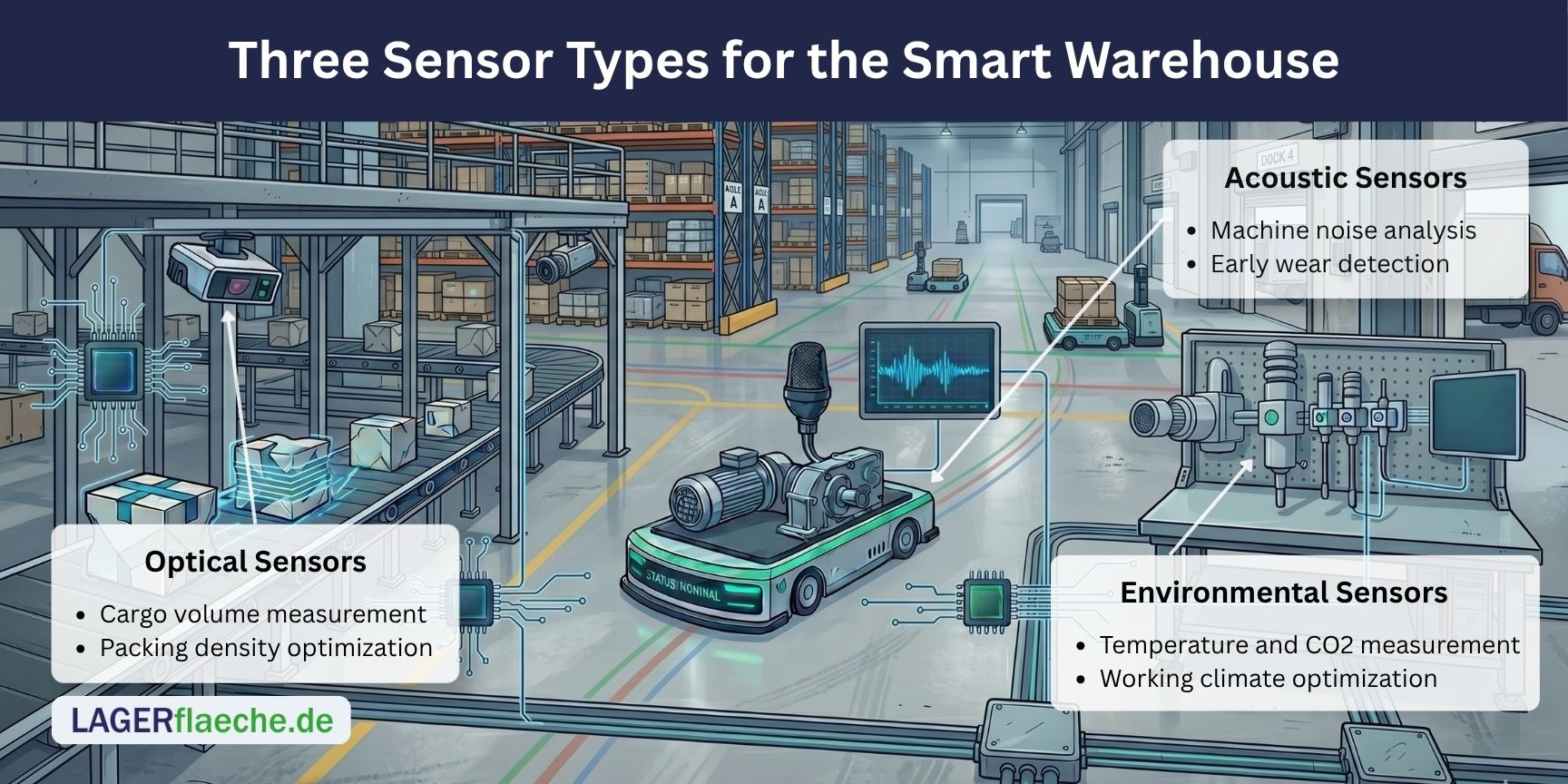
To make a logistics property "smart", different types of sensors are required:
- Optical sensors: For the volume measurement of freight.
- Acoustic sensors: For monitoring machine running noise (wear detection).
- Environmental sensors: Measurement of CO2, VOCs and temperature for an optimal working atmosphere (employee satisfaction).
Challenges: Why do Some Projects Fail?
Despite the advantages, there are hurdles. There is often a lack of a uniform interface architecture (API). If the data from the shelf sensors cannot communicate with the warehouse management system (WMS), data silos are created. In addition, the standardization of protocols (e.g. MQTT vs. OPC UA) is an issue that specialist personnel must address at an early stage.
Conclusion: IoT as an Indispensable Competitive Factor
The Internet of Things is no longer a trending topic for warehouse and contract logistics, but a necessity. Anyone who invests in or operates logistics real estate today must think about the digital infrastructure. Linking physical space and digital data streams leads to an increase in efficiency that can no longer be achieved manually.
Future outlook: The combination of AI (artificial intelligence) and IoT (often referred to as AIoT) will lead to warehouses almost organizing themselves in the next few years – from automatic reordering to predictive workforce scheduling.