



Digital Twin of Logistics 4.0
Table of Contents
- The Logistics Property as a Living Organism
- Deep Dive: Warehouse Logistics and Intralogistics Optimization
- Contract Logistics: Flexibility Through Simulation
- Technical Glossary: The Most Important Terms
- Practical Questions: What Decision-Makers Need to Know (Q&A)
- Figures, Data, Facts: The Impact
- The Hall of the Future: Autonomous Optimization
- Conclusion for Practice
The term "digital twin" describes much more than just a static 3D model. It is a dynamic, virtual image of a physical object or system that is connected to its real-world counterpart by real-time data. In 2026, this technology will be an integral part of the planning and operation of logistics clusters. While a simple model only shows what something looks like, the digital twin explains how it behaves, why it stagnates and when it needs maintenance.
The Logistics Property as a Living Organism
In the logistics real estate industry, the digital twin begins even before the groundbreaking ceremony. Building Information Modeling (BIM) creates a digital data set that accompanies the entire life cycle of the hall.
- Planning phase: Simulation of traffic flows at the depot (yard management) before the concrete is poured.
- Operating phase: Sensors record thermal loads, roof loads (important for PV systems) and the condition of the building technology (HVAC).
- ESG reporting: The digital twin provides precise data on the CO2 footprint and energy consumption per square meter – a basic prerequisite for modern certifications and investor expectations.
Deep Dive: Warehouse Logistics and Intralogistics Optimization
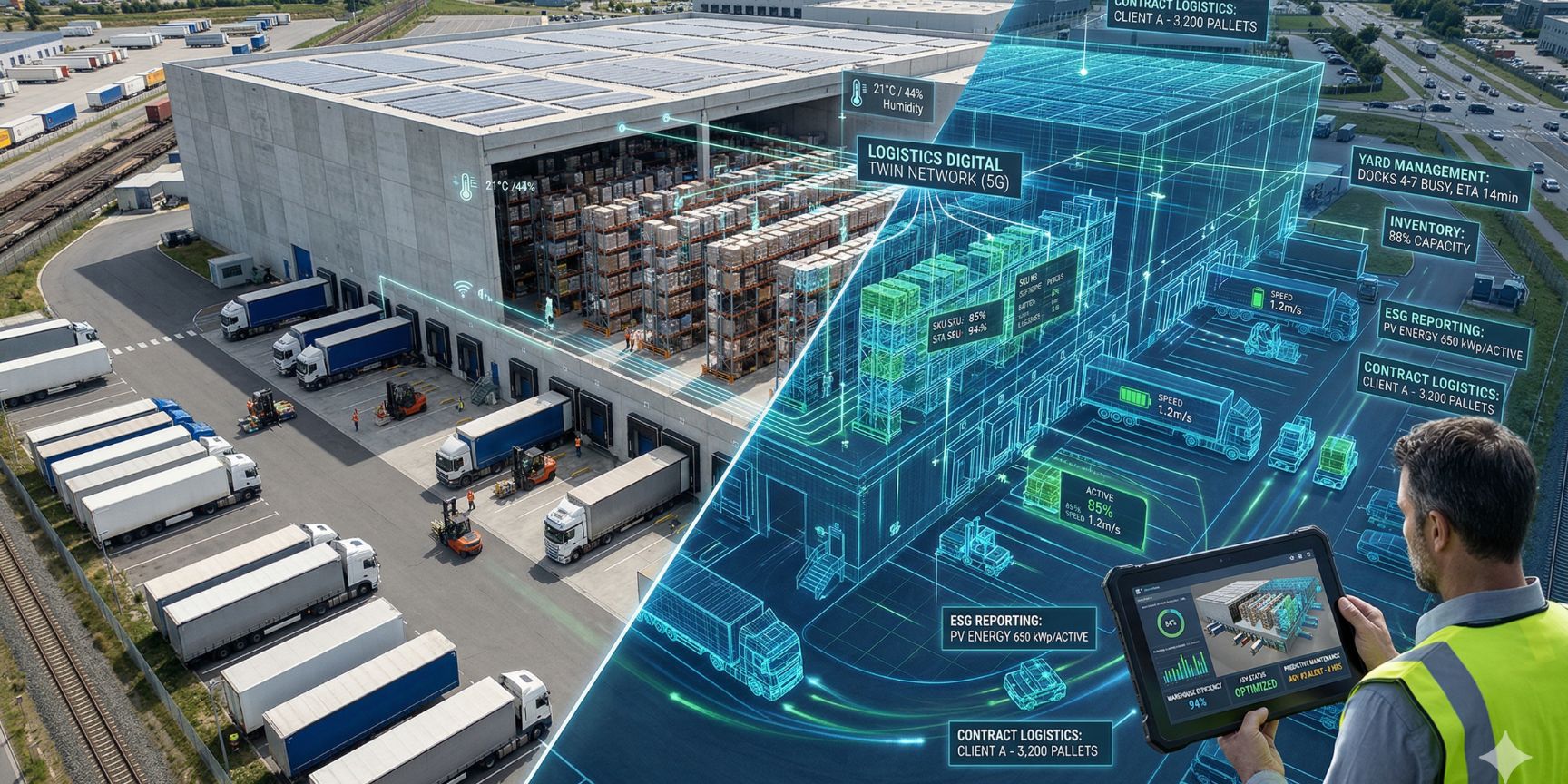
In warehouse logistics, the digital twin transforms the rigid hall into a highly flexible organism. This is primarily about the networking of warehouse management systems (WMS) with physical automation components.
By integrating sensor data (IoT) into the twin, throughput times can be visualized in real time. When an automated guided vehicle (AGV) issues an error message, the digital twin not only displays the location, but also immediately simulates the impact on the downstream picking processes. Studies show that companies can increase their picking performance by up to 15% by using digital images by anticipating bottlenecks before they physically occur.
Contract Logistics: Flexibility Through Simulation
Contract logistics is characterized by changing requirements and short contract terms. Here, the digital twin is the silver bullet for onboarding new customers.
Instead of laboriously carrying out physical test runs, the new customer's assortment is virtually integrated into the existing warehouse layout.
- How are the walking routes changing?
- Does the existing shelf structure fit the new SKU dimensions?
- What personnel capacities are necessary in peak scenarios? The digital twin provides the answers in minutes and significantly reduces the implementation risk.
Technical Glossary: The Most Important Terms
- Bidirectional data flow: The exchange takes place in both directions. The twin receives data from the sensor and can return control commands (with appropriate authorization).
- Predictive maintenance: Predicting maintenance intervals based on real wear and tear in the digital model, rather than rigid schedules.
- Latency time: The delay between data acquisition and mirroring in the model. For highly dynamic warehouse processes, latency in the millisecond range (5G standard) is essential.
Practical Questions: What Decision-Makers Need to Know (Q&A)
Question: Isn't a digital twin just an expensive toy for large corporations?
Answer: Not at all. While the initial costs for data structuring are in place, the system often pays for itself within 24 to 36 months through energy savings (approx. 10-20%) and minimized downtime. For SMEs in logistics real estate, too, the twin is becoming the standard for maintaining the value of the asset.
Question: What data sources are necessary for a functional twin in the hall?
Answer: The basis is CAD/BIM data. In addition, there is real-time data from the WMS (stock levels), the ERP (order situation), the building management system (temperature, electricity) and IoT sensors on machines and gates.
Question: How secure is the data in the digital twin?
Answer: Since the twin is at the heart of operational IT, cyber resilience is paramount. The use of edge computing (on-site data processing) and encrypted cloud interfaces is standard to prevent industrial espionage and sabotage.
Figures, Data, Facts: The Impact
- Space utilization: Digital twin simulations can often increase storage density by 8–12% without slowing down pick speed.
- Maintenance: Predictive maintenance reduces the costs of unplanned repairs to logistics facilities by an average of 25%.
- Energy efficiency: In logistics properties, up to 30% of energy costs can be saved by intelligent control of lighting and heating via digital twin.
The Hall of the Future: Autonomous Optimization
We are moving away from the purely observational twin to the prescriptive twin. This means that the system not only recognizes the problem, but also proposes or implements solutions independently. In a next-generation logistics property, the digital twin regulates the light irradiation via smart glass facades and controls the charging processes of the e-fleet in such a way that load peaks in the power grid are avoided (peak shaving).
Conclusion for Practice
The digital twin is not an isolated IT project, but a strategic investment in the transparency and resilience of your logistics chain. Whether as the owner of a logistics property or as the operator of a multi-user center: If you don't mirror your data, you lose track of things in a volatile market environment.