




Degree of space utilization in the warehouse
Table of Contents
- What is the degree of space utilization? A definition
- Calculating the degree of space utilization: The formula in practice
- Importance for warehouse and contract logistics
- Adjusting screws to optimize the degree of space utilization
- Perspective of the logistics property
- Frequently asked questions (FAQ) about the degree of room utilization
What is the degree of space utilization? A definition
The room utilization rate (also called volumetric utilization rate) is a business indicator that indicates the ratio of the space actually used to the total available space. It is expressed as a percentage and is used to evaluate the efficiency of the use of space in a defined volume, such as a warehouse, a container or a means of transport.
In essence, this key figure answers the question: What percentage of the potentially usable volume is actually used for the storage of goods?
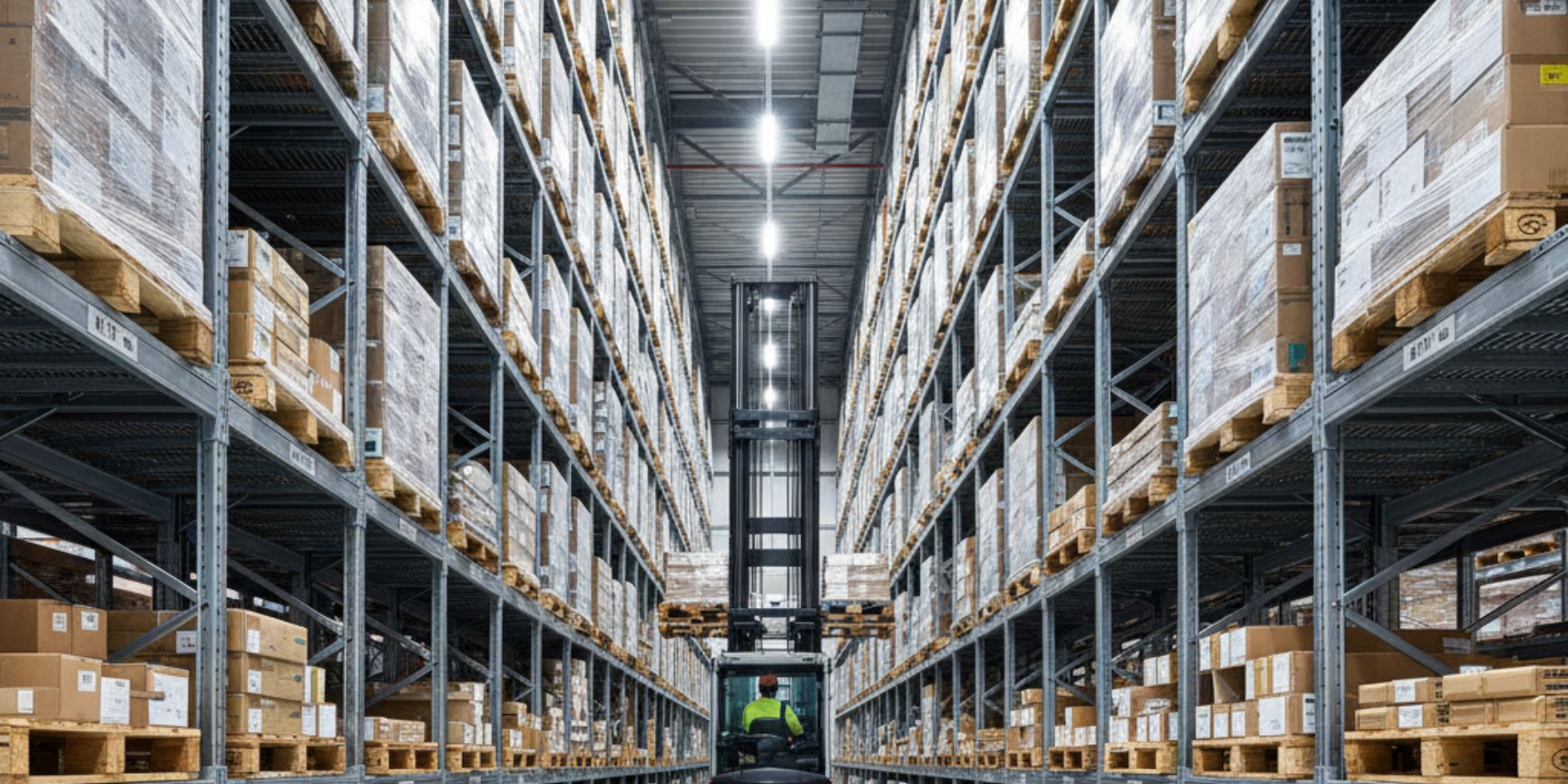
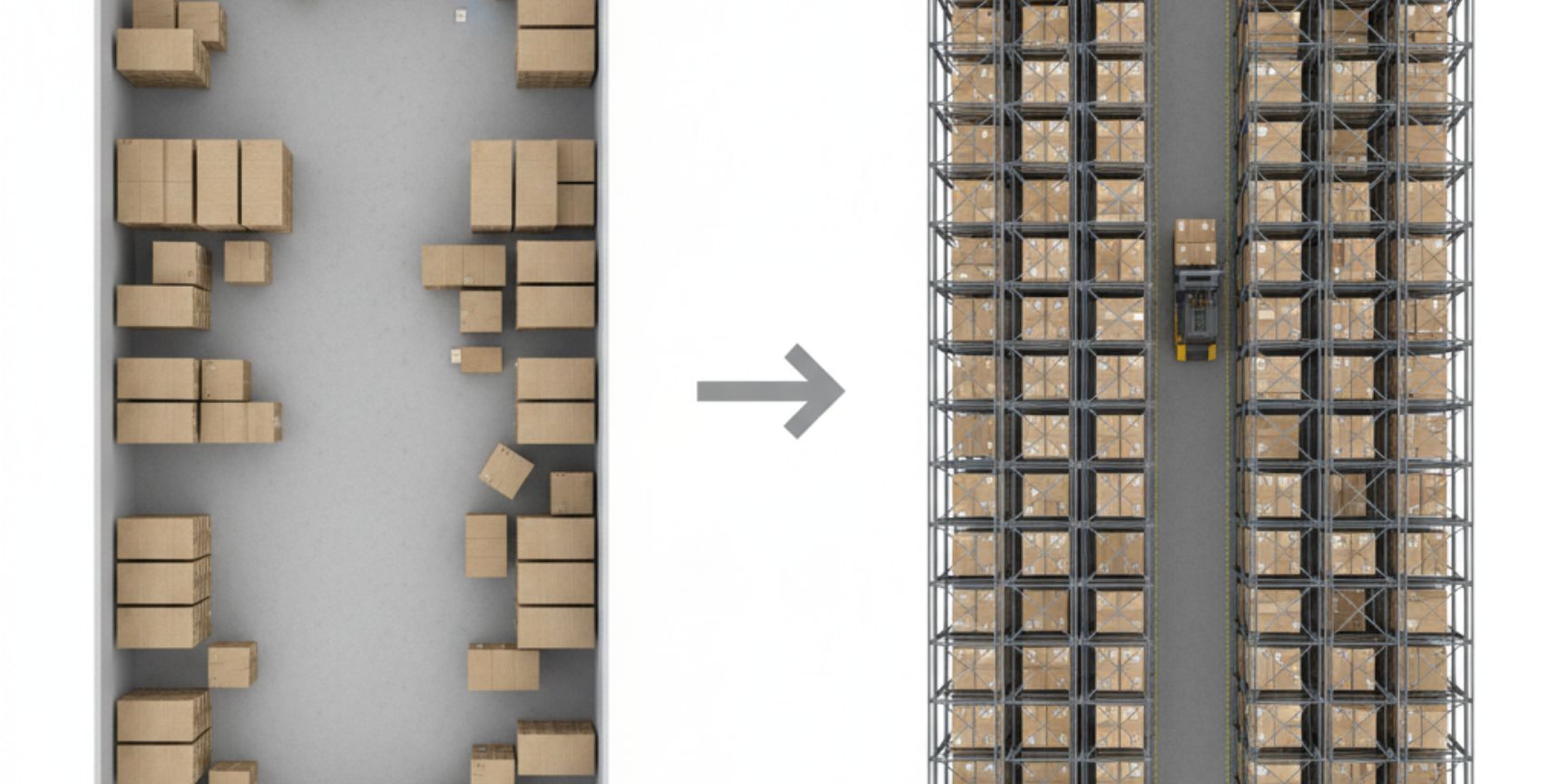
It is important to distinguish the degree of use of space from the degree of land use. While the degree of land utilization only evaluates the two-dimensional occupancy of the floor space (length × width), the degree of space utilization includes the third dimension – the height – and is therefore much more meaningful for the evaluation of high-bay warehouses or block warehouses.
Calculating the degree of space utilization: The formula in practice
The calculation is carried out using a simple formula, but the challenge lies in the exact recording of the data.
Formula:
- Used Volume: The volume that is actually taken up by stored goods. This includes the pure dimensions of the stored items on their load carriers (e.g. pallets).
- Total Available Volume: The gross volume of the warehouse (length × width × height of the hall), minus the areas and volumes that cannot be used for storage due to the system. These include traffic routes, manoeuvring areas, social rooms, offices and technical facilities.
Example: A warehouse has a usable gross volume of 50,000. After deduction of circulation and functional areas, a net storage volume of 35,000. Of these, 28,000 are currently occupied by goods. The room utilisation rate in this case is:
Room Utilisation Rate: (28.000/35.000)×100=80%
Importance for warehouse and contract logistics
For warehouse and contract logistics service providers, the degree of space utilization is one of the most important KPIs for controlling profitability. A high degree of space utilization means that the expensive resource "space" is used efficiently.
- Cost reduction: Every unused cubic metre in a logistics property causes costs (rent, heating, air conditioning, maintenance), but does not generate any revenue. Optimizing the degree of utilization directly reduces storage costs per unit stored.
- Capacity management: The key figure shows whether there is still free capacity or whether an expansion of the warehouse is necessary. In contract logistics, it serves as the basis for pricing and the negotiation of service level agreements (SLAs).
- Process efficiency: Too high a utilization rate (over 90-95%) can have a negative impact. It leads to more stock transfers, longer distances for the pickers and a lower handling rate, which drives up process costs.
Adjusting screws to optimize the degree of space utilization
Improving the degree of space utilization is a continuous process that starts at various points.
- Storage system and technology: Choosing the right racking system is crucial. Mobile racks, drive-in racks or automated small parts warehouses (AS/RS) enable a significantly higher storage density than standard pallet racks. The investment costs must be compared with the potential savings.
- Layout and slotting: An intelligent arrangement of the warehouse layout (ABC analysis) ensures that fast-moving items are stored in easily accessible places. Slotting, the optimized allocation of a storage location based on item dimension, weight, and turnover frequency, prevents wasted space.
- Compaction: Regular warehouse consolidation measures, in which gaps are closed and partially occupied pallets are consolidated, can increase the degree of utilization in the short term.
- Packaging optimization: Often, the cause of poor space utilization lies in the packaging of the products. Optimally dimensioned cardboard boxes and load carriers can significantly reduce the space requirement.
Perspective of the logistics property
From the point of view of an investor, project developer or owner of a logistics property, the degree of space utilization is an indicator of the quality and flexibility of the property.
- Building concept: Modern logistics properties are designed for maximum use of space. This is reflected in features such as hall heights of at least 10-12 metres (UKB - lower edge of truss), an optimised column grid for maximum flexibility in rack positioning and sufficient floor load capacity.
- Rentability and value: A hall that allows for a high density of use is more attractive to potential tenants (especially contract logistics companies) and can justify a higher rental price per square metre. This increases the value of the property.
- Third-party usability: A flexible floor plan that allows for different storage systems and thus high levels of space utilization for different industries and assortments is a decisive criterion for the long-term value of a logistics property.
Frequently asked questions (FAQ) about the degree of room utilization
Question: What is a "good" degree of space utilization?
Answer: That depends heavily on the industry and warehouse. In a narrow-aisle warehouse, a value of 40-50% can already be very good, while in a block warehouse for homogeneous goods, values above 80% are targeted. A value of 100% is neither achievable nor sensible in practice, as it no longer allows for operational flexibility. An optimal value is often between 85% and 90% to have a buffer for fluctuations.
Question: How does the degree of space utilization affect operating costs?
Answer: A low level of utilization leads to high fixed costs per unit stored. Too high a utilisation rate (over 90-95%) increases variable costs, as the processes (storage, retrieval, picking) become inefficient due to constant searching and relocation. The optimum is where the sum of space and process costs is lowest.
Question: Should I measure the degree of land or space utilization?
Answer: Always the degree of space utilization. The degree of land use can be misleading. A warehouse may have a high use of space because the floor is full, but if the height is not used (e.g. only one pallet is stacked up, when three would be possible), the actual use of space is catastrophic.