



Display Construction in Warehouse Logistics
Table of Contents
- What is display construction? A definition
- The Critical Interface: Display Construction Meets Logistics
- Challenges in warehouse logistics for displays
- Contract logistics: The solution as a value-added service
- Requirements for the logistics property and the hall
- The human factor and process reliability
- Conclusion: A symbiosis for success at the POS
What is Display Construction? A Definition
Display construction includes the conception, design, production and finishing of product presentation systems for the point of sale (POS). These displays – from the simple cardboard counter presentation box to the elaborate, permanent shop-in-shop system made of metal and plastic – are primarily used for sales promotion. Their goal is to make products stand out from the crowd, convey the brand message and generate impulse purchases. Displays are silent salespeople that act directly at the point of purchase decision.
Question: What materials are displays mainly made of? Answer: The most common material is corrugated cardboard or cardboard, as it is inexpensive, lightweight and easy to print. Depending on the requirements and service life, however, plastics (e.g. acrylic), wood, metal or material combinations are also used, especially in so-called permanent displays, which remain in use for months or years.
The Critical Interface: Display Construction Meets Logistics
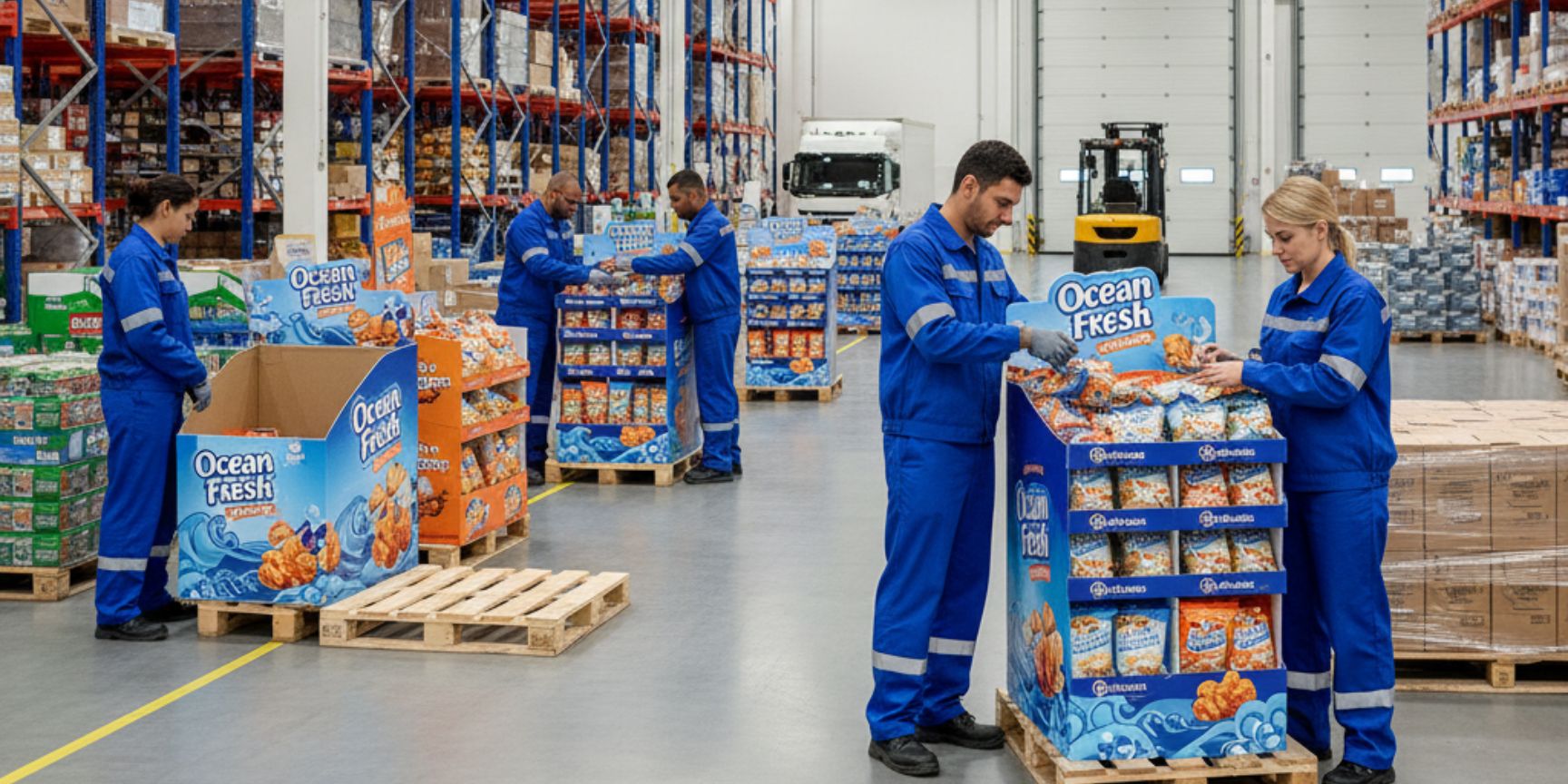
A perfectly designed display is worthless if it doesn't arrive at the right time, in the right configuration and undamaged in the right place. This is where the decisive role of logistics begins. The process does not end with the production of the display, but only with its successful placement in stores. This logistical chain includes storage, handling, packaging (assembly) and distribution. Precisely because displays are often bulky, sensitive and intended for short-term actions, their logistics pose special requirements that go far beyond standard pallet storage.
Challenges in Warehouse Logistics for Displays
The storage of displays is complex. Empty, flat-lying displays (so-called "flat mirrors") are still relatively easy to handle. However, as soon as they are set up or equipped, the space requirement explodes with high sensitivity at the same time.
Typical challenges are:
- High space requirement: Built-up displays have a very unfavorable ratio of volume to storage space. A pallet with four equipped 1/4 CHEP displays can quickly reach a height of 1.80 m and requires a lot of manoeuvring space.
- Sensitivity: Cardboard displays are susceptible to moisture, pressure, and impact. A damp warehouse or careless handling with the forklift can make an entire batch unusable.
- Seasonality: The business is strongly influenced by seasonal peaks (e.g. Christmas, Easter, barbecue season). Logistics service providers must be able to flexibly cushion extreme volume fluctuations.
- Complexity: Often, not only the display itself, but also the associated products from different suppliers have to be brought together, picked and assembled in one place.
Contract Logistics: The Solution as a Value-added Service
It is rarely economical for companies to maintain these specialized logistical capacities themselves. This is where contract logistics comes into play. Specialized service providers take over the entire process as a value-added service and integrate it into their processes.
Question: What does packaging and co-packing mean in display construction?
Answer: Packaging is the technical term for the process of assembling the flat displays. Co-packing is the next step: equipping these assembled displays with the goods. This can include hooking products, filling chutes, or placing items exactly according to a predetermined planogram. These activities require trained personnel and specially equipped work surfaces.
A contract logistics company therefore offers not only storage space, but a complete service: It receives the empty displays and the products, stores both professionally, assembles and co-packs as required and controls on-time distribution to hundreds or thousands of individual branches.
Requirements for the Logistics Property and the Hall
A standard warehouse is often only suitable to a limited extent for display logistics. A specialized logistics property must meet certain criteria in order to make the processes efficient and safe.
- Zoning: The hall should be divided into different zones: an area for storing the flat flat mirrors, separate, well-lit and clean areas for packaging (often referred to as the "VA area") and generous buffer and shipping zones for the ready-loaded, bulky pallets.
- Air conditioning: Drought is crucial. Constant, low humidity is essential for the stability of cardboard displays. Temperature fluctuations should be minimized.
- Floor conditions: Clean, dust-free floors are important so that the displays and the often unpackaged products do not get dirty during co-packing.
- Flexibility and scalability: The space must allow many assembly workstations to be set up at short notice for large campaigns and then dismantled again.
The Human Factor and Process Reliability
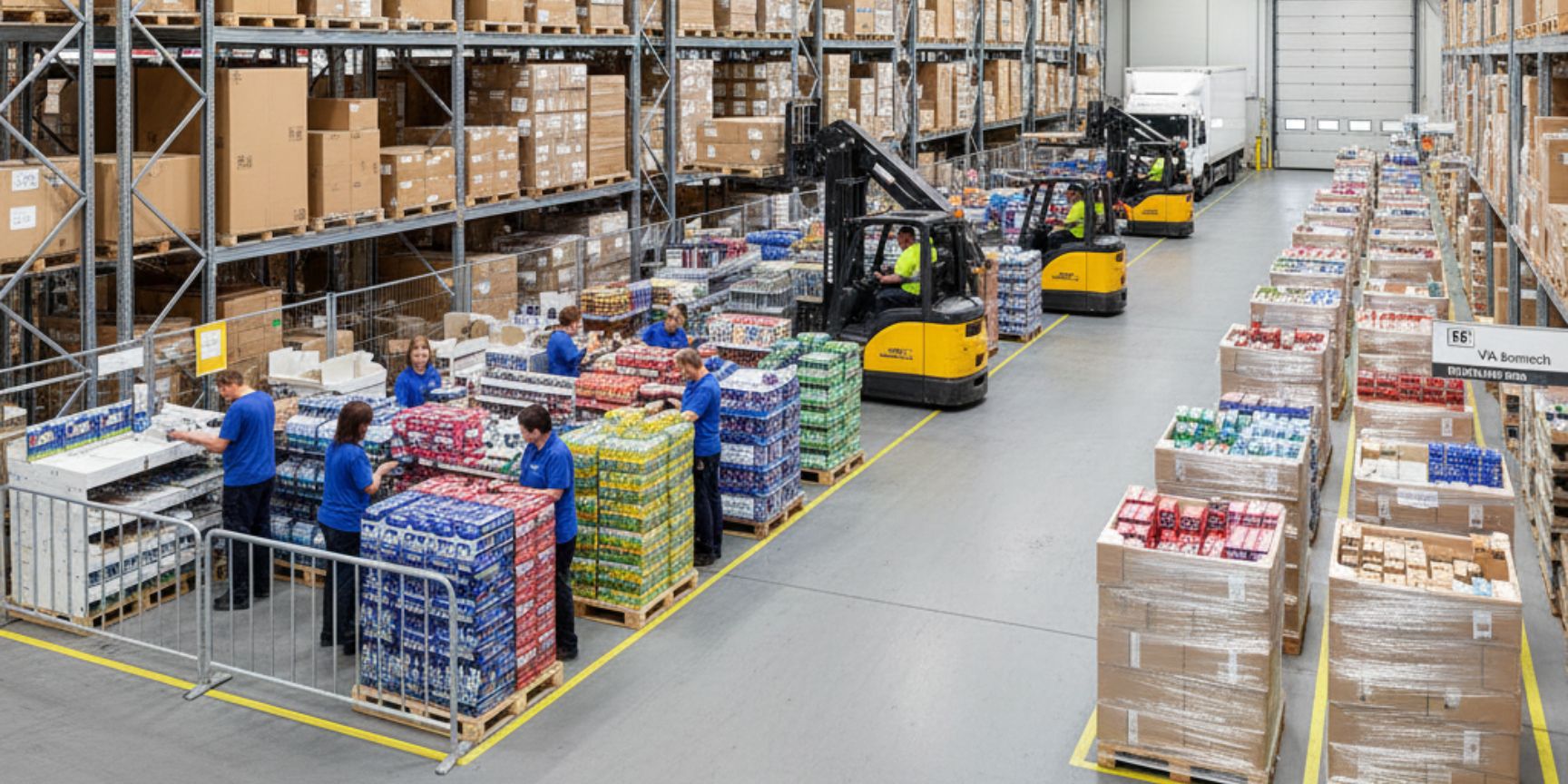
Even in the best hall, people are the decisive factor. The staff must be trained in the handling of the sensitive materials. Process reliability is ensured by clear work instructions, packing patterns (planograms) and strict quality controls. Random checks check that the display is correctly and stably constructed, that the equipment has been fully and correctly placed, and that the entire unit is securely packed for transport.
Question: How do you ensure that every store gets the right display?
Answer: This is done through modern warehouse management systems (WMS). Each display pallet is given a unique number (e.g. NVE/SSCC) that is linked to the delivery order for a specific store. This code is scanned during loading, which ensures complete traceability and the minimization of incorrect deliveries.
Conclusion: A Symbiosis for Success at the POS
Successful display construction is an inseparable symbiosis of creative design and excellent logistics. The best sales campaign fails when the logistics chain breaks. Choosing the right logistics partner with the right infrastructure, the necessary know-how in contract logistics and suitable logistics real estate is therefore not a downstream cost factor, but a strategic decision that directly determines the success or failure of a campaign at the point of sale.