




Drive-in racks in warehouse logistics
Table of contents
- The drive-in rack: Static compactness meets operational density
- Design basics and functionality
- Target groups: Contract logistics and storage goods typology
- The "honeycomb effect" and utilization rates
- Requirements for the logistics property and technology/a>
- Security and risk management
- Facts & Figures: A Comparison
- Questions and answers (Q&A) for practice
- Conclusion: Niche or necessity?
The drive-in rack: Static compactness meets operational density
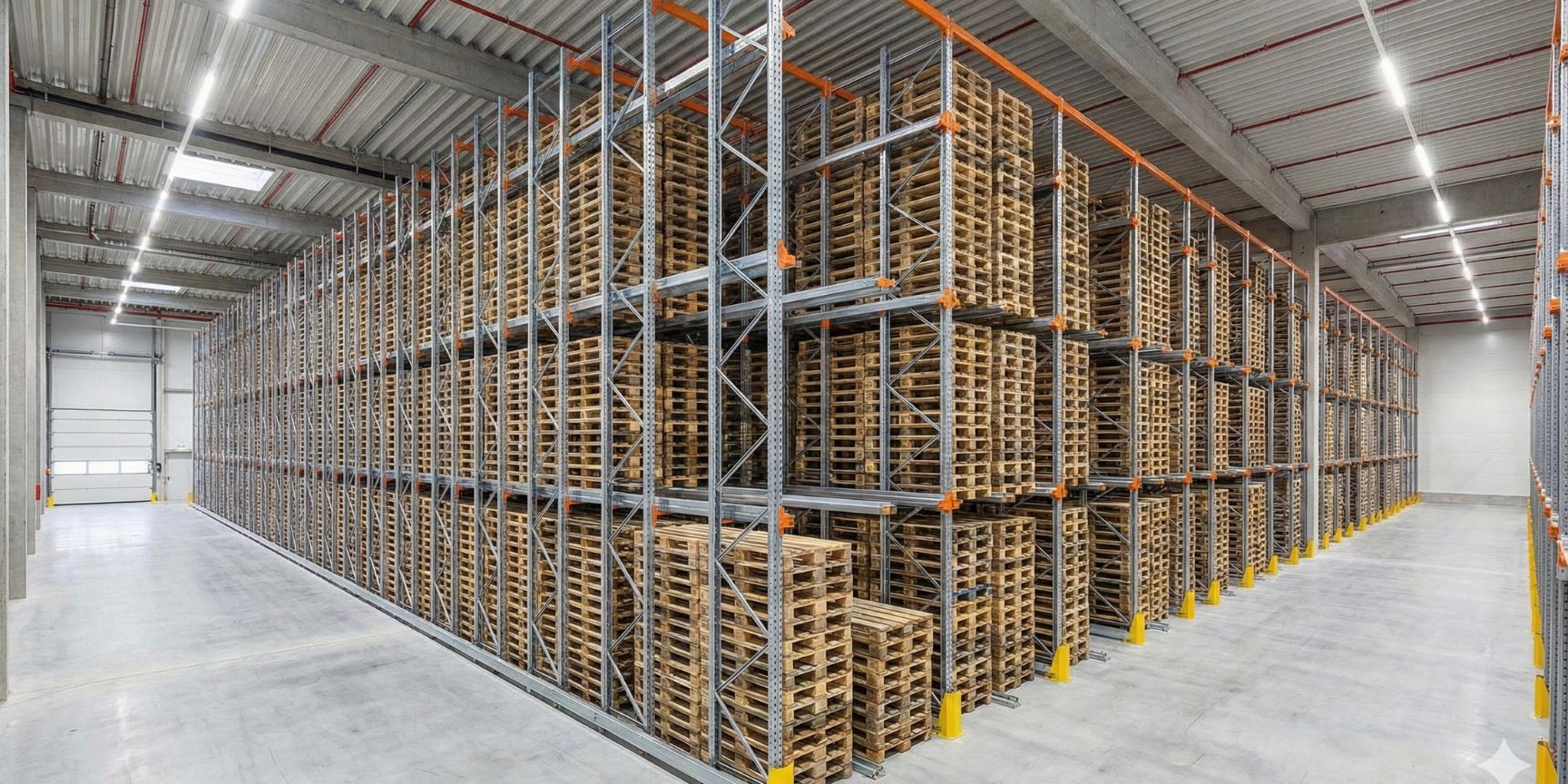
Drive-in racking is a synonym for maximum space densification while at the same time protecting the stored goods. In contrast to the classic pallet racking, where direct access to each pallet is possible, the drive-in racking sacrifices selectivity in favor of the use of space.
In logistics real estate and contract logistics, it is considered the technological bridge between simple floor block storage and complex channel storage systems (such as shuttle systems). It eliminates operations between rows of racks, as the forklift drives directly into the rack.
Design basics and functionality
The characteristic feature of the drive-in rack is the absence of classic rack trusses (longitudinal beams) in the storage channels. Instead, the pallets lie on continuous support consoles (shelf rails) that are mounted on the uprights frames.
- Channel structure: The shelf consists of several channels (tunnels) arranged next to each other and on top of each other.
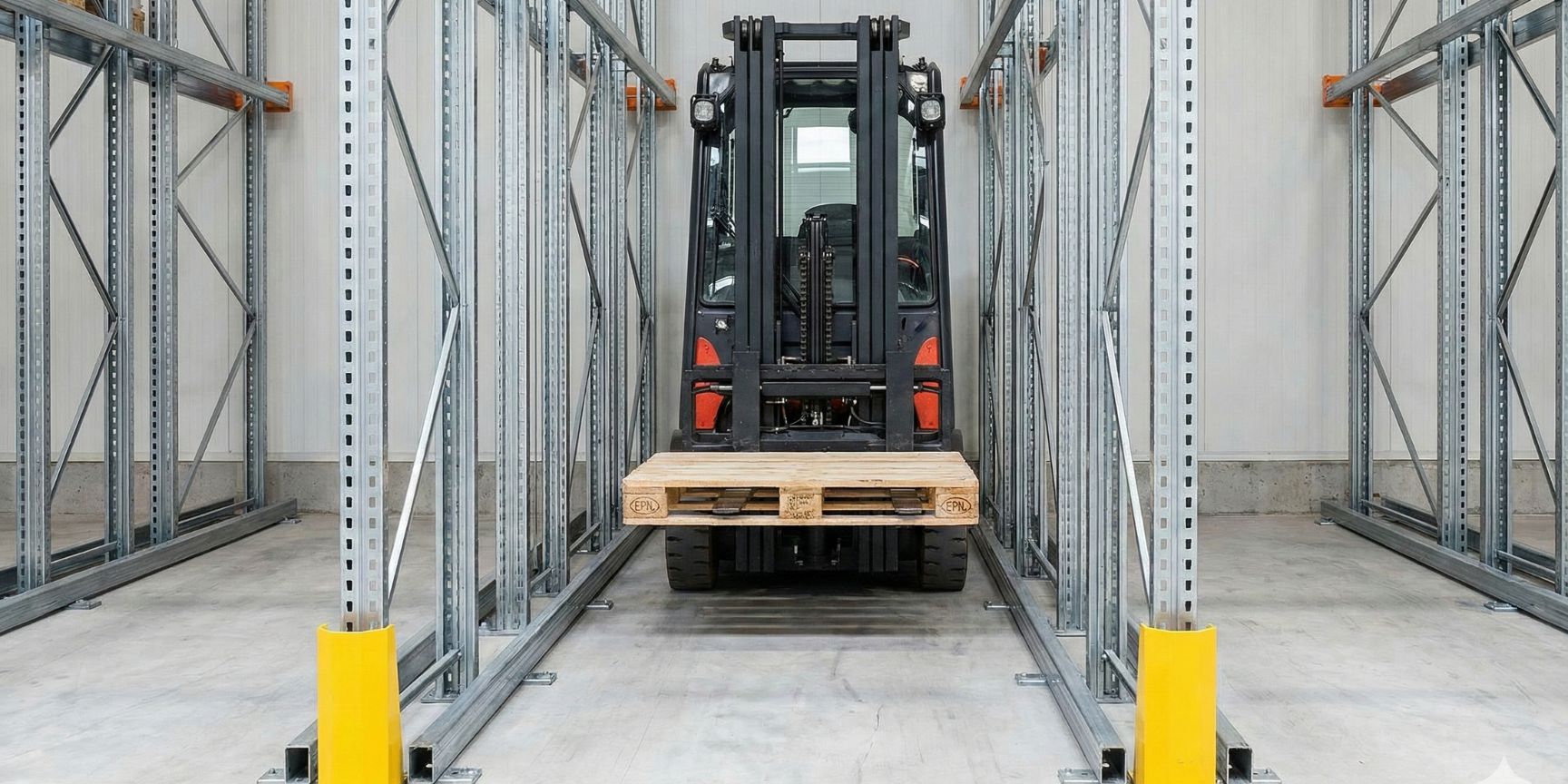
- Loading: The forklift lifts the pallet to the desired level and enters the channel to place the goods in the rearmost free space.
- Differentiation:
- Drive-in racking: Operation only from one side (wall installation). Principle: LIFO (Last In, First Out).
- Drive-through: Operation from both sides possible. Principle: FIFO (First In, First Out) is feasible, but requires the forklift to pass through or a strict separation of the storage and retrieval sides.
Target groups: Contract logistics and storage goods typology
For whom is this investment worthwhile? The drive-in rack is not an all-rounder, but a specialist. In contract logistics, it is often used when large quantities of identical items (item-only storage) have to be stored for a longer period of time.
Ideal scenarios:
- Pressure-sensitive goods: Goods that may not be stacked (block storage is not possible), but still need to be highly compacted.
- Seasonal items: Buffer storage for seasonal peaks (e.g. Christmas cookies, beverage industry), where quick individual access is secondary.
- Refrigerated and deep-freeze logistics: Since every cubic metre of refrigerated space is extremely expensive, the high compression of the drive-in rack pays for itself most quickly here.
Technical note: The profitability tips if the variety of articles (number of SKUs) is too high. A drive-in rack with too many different SKUs leads to massive filling level losses, the so-called "honeycomb effect".
The "honeycomb effect" and utilization rates
A critical term in the planning of drive-in racks is the honeycomb effect. It describes the white space that occurs when channels are only partially filled, but cannot be filled with other items due to the LIFO principle.
- Theoretical filling level: 100%
- Practical filling level: Realistically, often only 70% to 85%.
For example, if a channel is 10 pallets deep, but only 3 pallets of that item are left in stock, 7 slots remain empty ("air storage"). For the operator of a logistics property, this means that the rental income per square metre must take this inefficiency factor into account in the calculation, if billing is based on parking spaces.
Requirements for the logistics property and technology
From the point of view of the logistics property, the drive-in rack places high demands on the building fabric, especially on the hall floor.
- Ground conditions: Since the forklifts are constantly accelerating, braking and manoeuvring in the aisles, the ground abrasion is high. A high-quality industrial floor (often with a special hard-grain coating) is mandatory.
- Point loads: The uprights frames support the entire weight of the pallets above plus the dynamic forces. The point loads under the uprights are significantly higher than with wide-aisle racks, which often requires reinforced foundations.
- Forklift technology: Reach trucks or counterbalance forklifts are usually used. The decisive factor is that the overhead guard is narrower than the clear width between the pallet supports (note the chassis width!).
Security and risk management
The drive-in rack is considered to be more accident-prone than conventional racks, as the forklift driver is "trapped" in the rack and has hardly any manoeuvring distance to the uprights.
Key security features:
- Floor guide rails: Strongly recommended. They mechanically guide the forklift into the lane and protect the stands from collision damage.
- Entry aids: Optical markings or funnel-shaped rails at the sewer entrance.
- Rear panel locks: To prevent the pallet from pushing through at the back (during drive-in).
Statistically speaking, the repair costs of uprights are significantly higher for drive-in racks without guide rails.
Facts & Figures: A Comparison
To classify the dimensions, here is a comparison between a standard pallet rack and a drive-in rack (example values):
| Feature | Standard pallet racking (wide aisle) | Drive-in rack (drive-in) |
| Land | approx. 40 % (a lot of traffic space) | Up to 85% |
| Access | 100% (Any pallet directly) | Low (front pallet only) |
| Cost per pitch | Low (Standard Components) | Medium (more steel, more complex assembly) |
| Investment forklift | Standard | Standard (narrower cab if necessary) |
| Handling capacity | High | Medium (longer distances in the canal) |
Questions and answers (Q&A) for practice
Question: Is a drive-in rack suitable for perishable food?
Answer: Only to a limited extent. Since the LIFO principle prevails in the classic drive-in rack (first stored, last removed), there is a risk that old goods will "forget" at the back of the sewer and exceed the best-before date (best-before date). For goods that are critical to the best-before date, the drive-through racking (FIFO) or a pallet shuttle system is more suitable.
Question: What is the maximum depth of a canal that should be planned?
Answer: That depends on the handling of goods. In practice, channel depths of 6 to 12 pallets have proven to be effective. Deeper channels drastically increase the "honeycomb effect", unless they are extremely fast-moving ones with huge batches.
Question: Can I automate a drive-in rack?
Answer: Yes, but... The classic automation of the drive-in rack is the canal vehicle (shuttle). Here, it is no longer the forklift that drives into the rack, but a "satellite" (shuttle) transports the pallet in the canal. This massively increases the handling speed and safety, but is a different investment class.
Question: What clear height is necessary in the hall?
Answer: Drive-in racks make efficient use of height. Heights of up to 10–12 meters are common. In addition, the storage by the driver becomes extremely demanding (visibility, fluctuations of the mast), which is why camera systems on the fork carriage are often necessary here.
Conclusion: Niche or necessity?
In modern logistics planning, the drive-in rack is not a discontinued model, but a conscious decision for cost efficiency with homogeneous assortments. While e-commerce and small parts logistics often take a different approach, the drive-in rack remains indispensable in industrial and production logistics as well as in cold stores .
For the contract logistics company, it offers the lever to accommodate up to 50% more pallets in the same hall area than in the wide-aisle warehouse – provided that the customer structure allows batch-only storage. Those who can manage the disadvantages (honeycomb effect, LIFO) operationally get the best price-performance ratio per cubic metre of storage space with the drive-in rack.