



Dark Store
Table of Contents
What is a Dark Store?
A dark store is a warehouse that is designed exclusively for processing online orders. In terms of structure, it often resembles a supermarket or a specialty store with shelves and aisles, but is not accessible to the public – hence the name "dark". These facilities are the logistical backbone of quick commerce (Q-commerce), i.e. the delivery of goods (typically food and drugstore items) within minutes to a few hours. It can be understood as a hybrid of a classic supermarket layout and a highly efficient small parts warehouse that is fully geared towards process speed.
Functionality and Differentiation from Traditional Retail
The processes in a dark store are radically optimized for efficiency and speed. In contrast to retail, where the customer's shopping experience is in the foreground (wide aisles, attractive product placement, checkout areas), here everything is subordinate to logistics.
Question: How does an order in a dark store work in concrete terms?
Answer:
- Order receipt: A customer's online order is received digitally in the dark store's system.
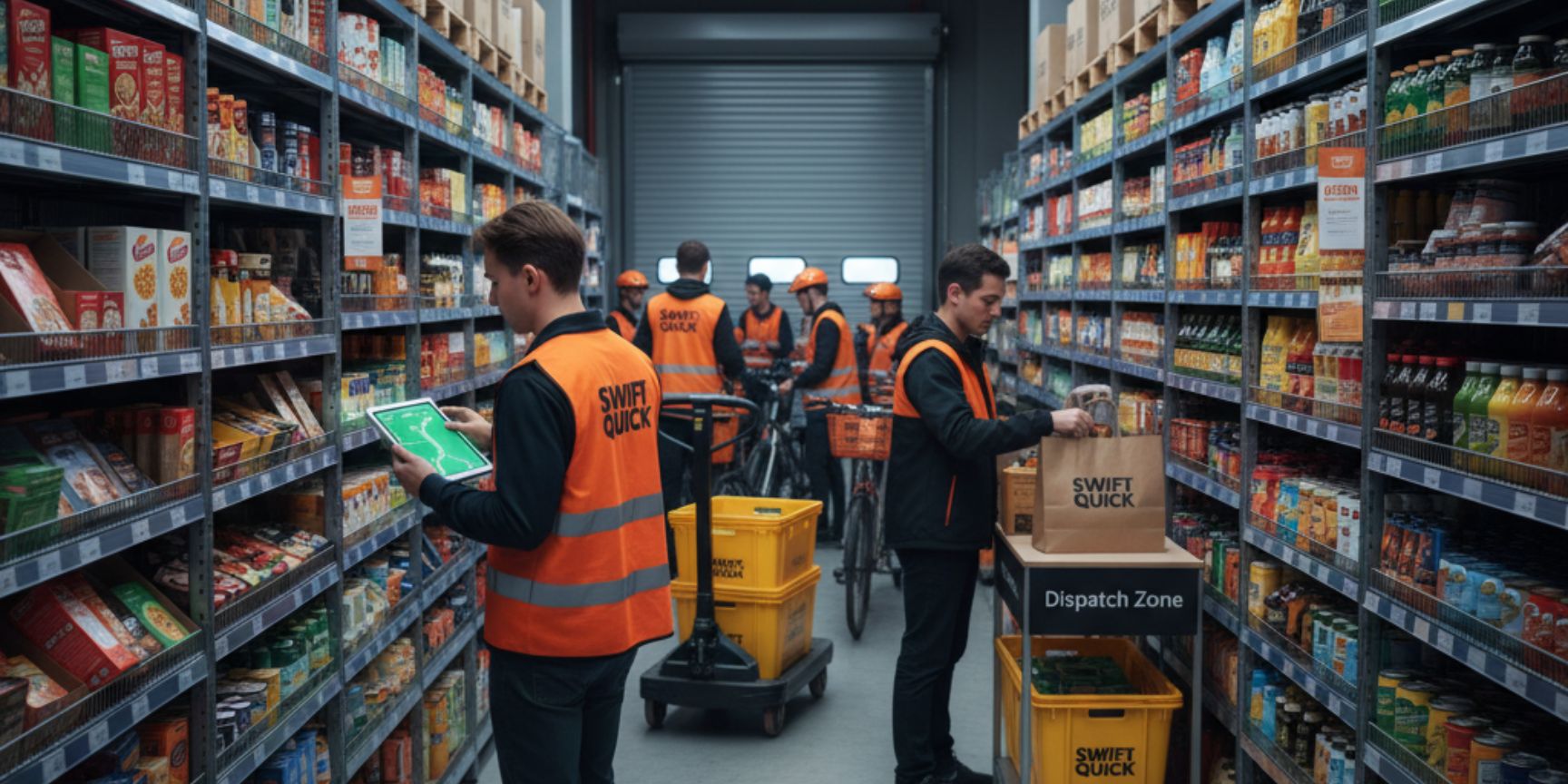
- Picking: An employee, often referred to as a "picker" or "shopper," receives the order on a handheld device (such as an MDE scanner or smartphone). The software calculates the route-optimized route through the warehouse so that the picker can collect the items in the shortest possible time. The arrangement of the products does not follow the customer-friendly logic of a supermarket, but criteria such as turnover frequency (fast-moving at the front) and gripping height.
- Packaging: At a packing station, the picked items are checked and packed in paper bags or transport boxes.
- Handover: The finished order is handed over to a courier (often a bicycle or e-scooter driver), who is ready in a waiting area and takes care of the delivery on the "last mile".
The entire process from order receipt to handover to the courier ideally takes only two to five minutes.
Warehouse Logistics: A Microcosm of Efficiency
Warehouse logistics in a dark store is a prime example of lean processes under high time pressure. The turnover rate of the items is extremely high, which requires precise inventory management.
- Warehouse layout: Standard shelving systems are usually used. The aisle arrangement is as narrow as possible to make maximum use of the storage space. Fast-moving items (e.g. milk, bananas) are stored in easily accessible positions to minimize picking times.
- Technology: A powerful warehouse management system (WMS) is essential. It controls goods receipt, storage, picking routes and inventory management in real time. The seamless integration with the ordering platform and the courier app is critical to success.
- KPIs: The most important metrics are the pick time per item (often under 10 seconds) and the lead time per order. Every process step is measured and continuously optimized.
The Logistics Property: Requirements for Location and Hall
Dark stores place completely new demands on logistics properties. They are a classic example of urban logistics.
Question: What criteria does a property have to meet in order to be suitable as a dark store?
Answer: The most important factors are:
- Location: The location in a densely populated urban area is decisive. This is the only way to meet the short delivery times of 10-30 minutes. Ground floor areas in inner-city residential or mixed areas, often in former shops, small workshops or supermarkets are being sought.
- Size: The space is small compared to classic logistics halls. Typically, they are between 200 and 1,000 square meters.
- Requirements for the hall: A ground-level delivery for goods receipt is important. Inside, an open area with few columns is required for flexible shelf installation. In addition, zones must be created for incoming goods, storage, refrigerated areas, packing stations and a staging and waiting zone for couriers.
- Legal hurdles: Use as a warehouse in purely retail or residential locations can pose a challenge under building law (change of use). In addition, the noise and traffic congestion caused by arriving and departing couriers often lead to conflicts with residents and municipalities.
Role in Contract Logistics: Opportunities for 3PL Service Providers
Dark stores open up a new business area for contract logistics service providers (3PL). Instead of Q-commerce providers building their logistics completely themselves, they can outsource them to a specialized 3PL. Its service will then include the complete operation of the dark store: from goods receipt and storage to picking and packaging to the management of the interface to the courier fleets. This enables retail companies to scale quickly without having to make high investments in their own real estate and personnel. The 3PL contributes its expertise in process optimization, personnel management and warehouse management and operates the site on behalf of the dealer.
Challenges and Future Outlook
Despite the hype, dark stores face significant challenges. The high operating costs in inner-city locations (rent, personnel) and the enormous competitive pressure make profitability difficult. Many cities, such as Amsterdam or Paris, have already enacted strict regulations for the establishment of dark stores in order to reduce the burden on local residents.
The future could lie in hybrid models, in which parts of existing supermarkets are used as mini-dark stores for online processing. In addition, automation, for example through small picking robots, will play an increasingly important role in reducing personnel costs and further increasing efficiency. An expansion of the product range beyond food (e.g. electronics, pharmacy supplies) is also a likely development step.