




Long goods racking in warehouse logistics
Table of contents
- Definition and systematics: What is a long goods rack?
- The perspective of warehouse logistics: efficiency and handling
- Contract Logistics: Flexibility and Billing Models
- The logistics property: Structural requirements for the hall
- Safety and regulations: DGUV 108-007
- Facts, figures, data: an overview
- Expert Q&A: Frequently asked questions from practice
- Conclusion for practice
Definition and systematics: What is a long goods rack?
A long goods rack is used to store goods whose length significantly exceeds the standard dimensions of a Euro pallet (1,200 mm). In practice, a length of 2,000 mm or more is referred to as long goods, although systems are often designed for lengths of 6,000 mm to 12,000 mm.
Technically, we primarily distinguish between two construction methods:
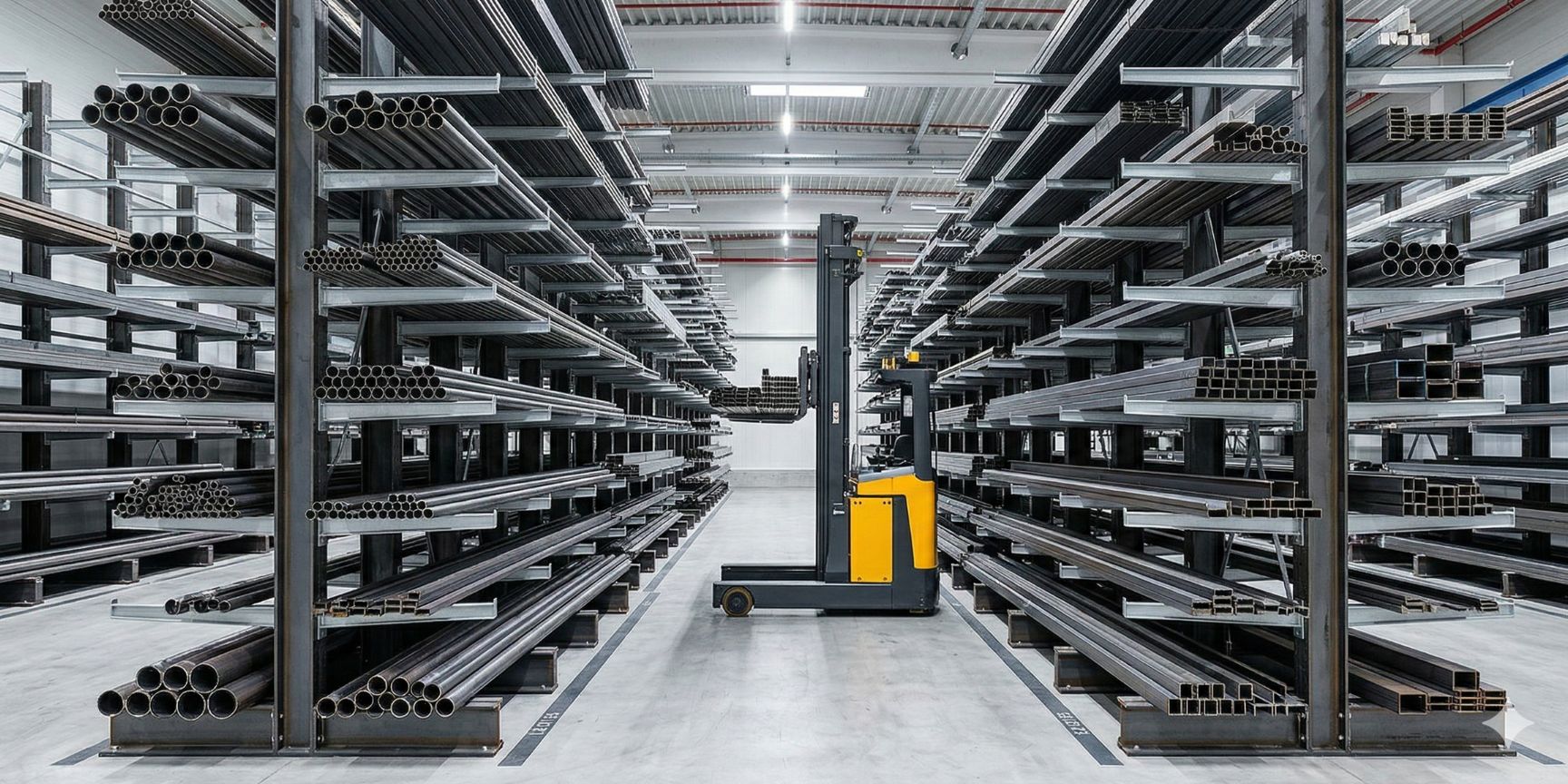
- Cantilever racks: Consisting of vertical uprights and horizontally cantilevered arms. They offer barrier-free horizontal storage without annoying front supports.
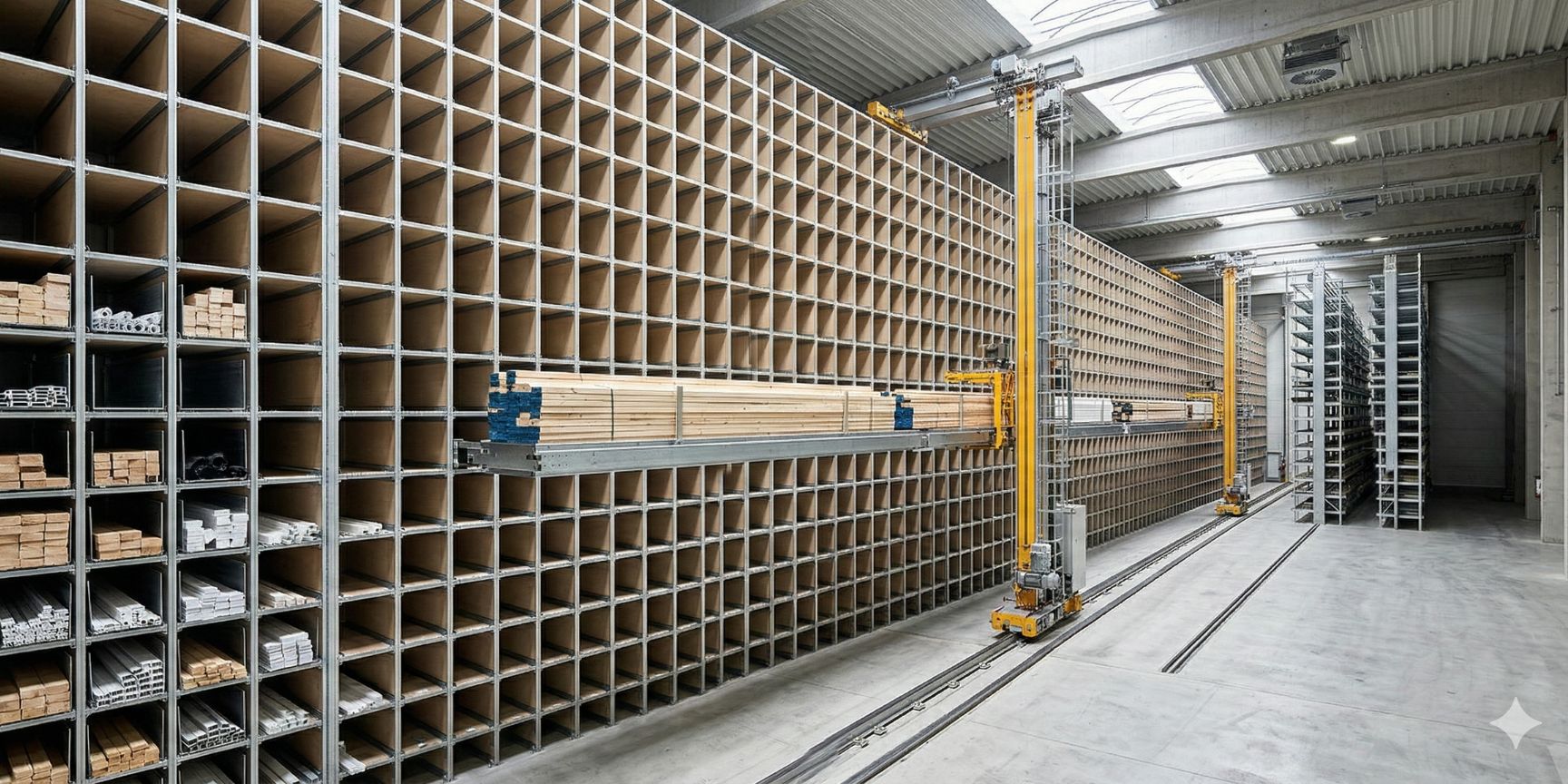
- Honeycomb shelves/cassette shelves: Here, the goods are pushed into compartments (honeycombs) at the front. This is particularly space-saving and protects sensitive surfaces, but requires more depth in hall planning.
The perspective of warehouse logistics: efficiency and handling
In operational warehouse logistics, the focus is on access speed. While cantilever racking allows random access to any level, the storage of profile bundles often requires specialized industrial trucks.
- Equipment selection: Standard forklifts reach their limits here. Four-way forklifts or multidirectional sideloaders are used, which can pick up loads laterally and maneuver them in narrow aisles.
- Degree of space utilisation: The use of mobile racking systems (cantilever racks on rails) can increase storage capacity by up to 80% for the same area, as only one aisle has to be opened at a time.
Contract Logistics: Flexibility and Billing Models
For contract logistics companies, long goods represent a challenge in the calculation. In contrast to standardised pallet spaces, the volatility of the stocks is high.
- Multi-user capability: Long goods racks often have to be modular (adjustable cantilever arms in increments of usually 50 to 100 mm) in order to be able to react to changing customer products (e.g. from lightweight plastic pipes to heavy steel beams).
- Billing: In contract logistics, billing is often not per parking space, but per linear meter or per ton. The long goods rack must support precise inventory management and batch separation in order to avoid incorrect picking in the case of visually similar profiles.
The logistics property: Structural requirements for the hall
A long goods rack places extreme demands on the infrastructure. A planning error in the hall can massively limit the usability of the shelving system.
- Floor conditions: Cantilever racks cause enormous point loads on the floor slab. A floor load capacity of 5 to 10 tonnes per square metre is often a minimum. In addition, flatness according to DIN 18202 (Table 3, line 4) is essential, especially in narrow-aisle applications.
- Column grid: In a logistics hall for long goods, the column grid should be wide (e.g. 12 x 24 meters) so as not to obstruct the long transport routes of the forklifts with concrete supports.
- Clear height: Since long goods racks are often up to 10 meters high, a hall height (UKB) of at least 12 meters is ideal to maintain the necessary safety distances from the sprinkler system.
Safety and regulations: DGUV 108-007
Long goods racks are subject to strict safety requirements. Since the loads often hang on one side, the statics are more complex than with pallet racks.
- Rack inspection: According to DIN EN 15635 , long goods racks must be inspected by a qualified person at least every 12 months.
- Load signs: Each shelf must carry signs that indicate the maximum load capacity per arm and per stand.
- Fall protection: Roll-off protection (plug-in bolts or fixed stops) are usually required at the ends of the cantilever arms to prevent the round materials from falling.
Facts, figures, data: an overview
| Parameters | Typical values (cantilever racking) |
| Arm length | 400 mm to 2,500 mm |
| Payload per arm | 200 kg to over 5,000 kg |
| Stand height | 2,000 mm to 12,000 mm |
| Wheelbase | Usually 1,000 mm, 1,250 mm or 1,500 mm |
| Material | Hot-rolled IPE profiles (for heavy duty) |
Expert Q&A: Frequently asked questions from practice
Question: Can I also set up a long goods rack outdoors?
Answer: Yes, but this requires hot-dip galvanizing of the components. In addition, the statics must take wind and snow loads into account. Cantilever racks are often provided with a roof structure outdoors, with the rack itself acting as a load-bearing structure for the roof.
Question: What is the biggest mistake in planning?
Answer: The underestimation of the swivel range. Long goods often have to be turned during storage and retrieval. The aisle width must therefore take into account not only the forklift width plus load depth, but also the manoeuvring space for the entire length of the goods.
Question: Is automation worthwhile for long goods?
Answer: In high-performance centers (e.g. steel trading), automatic cassette warehouses are the standard. They minimise damage and utilise the height of the hall down to the last centimetre, but are 5 to 10 times more expensive to purchase than manual cantilever racks.
Conclusion for practice
The long goods rack is much more than just a "frame for pipes". It is a highly specialized logistics tool that requires synergistic planning of racking equipment, industrial trucks and real estate structure. Anyone who saves on the floor slab or aisle width here will pay for it later through inefficient processes and safety risks. For specialist planners, the following applies: first define the load and handling, then build or search for the hall around it.