




Fire walls in logistics
Table of contents
- Fire walls in logistics: The invisible protective shield of the supply chain
- Definition: What distinguishes a fire wall from a fire wall?
- The Model Industrial Building Directive (MIndBauRL) as a set of rules
- The challenge of warehouse logistics: When the wall disrupts the flow?
- Special case of intralogistics: conveyor technology and fire wall
- Materials compared: concrete vs. sandwich vs. masonry
- Profitability and Insurance (FM Global / VdS)
- Q&A – Frequently asked questions from practice
- Conclusion for decision-makers
- Checklist: Fire walls in logistics properties
Fire walls in logistics: The invisible protective shield of the supply chain
In the world of contract logistics and hall construction, the fire wall is much more than just a wall made of concrete or sand-lime brick. It is a highly complex component that decides on the total loss of a property or the preservation of its operability in an emergency. Especially in times of just-in-time deliveries and gigantic e-commerce hubs, an understanding of structural fire protection theory is essential.
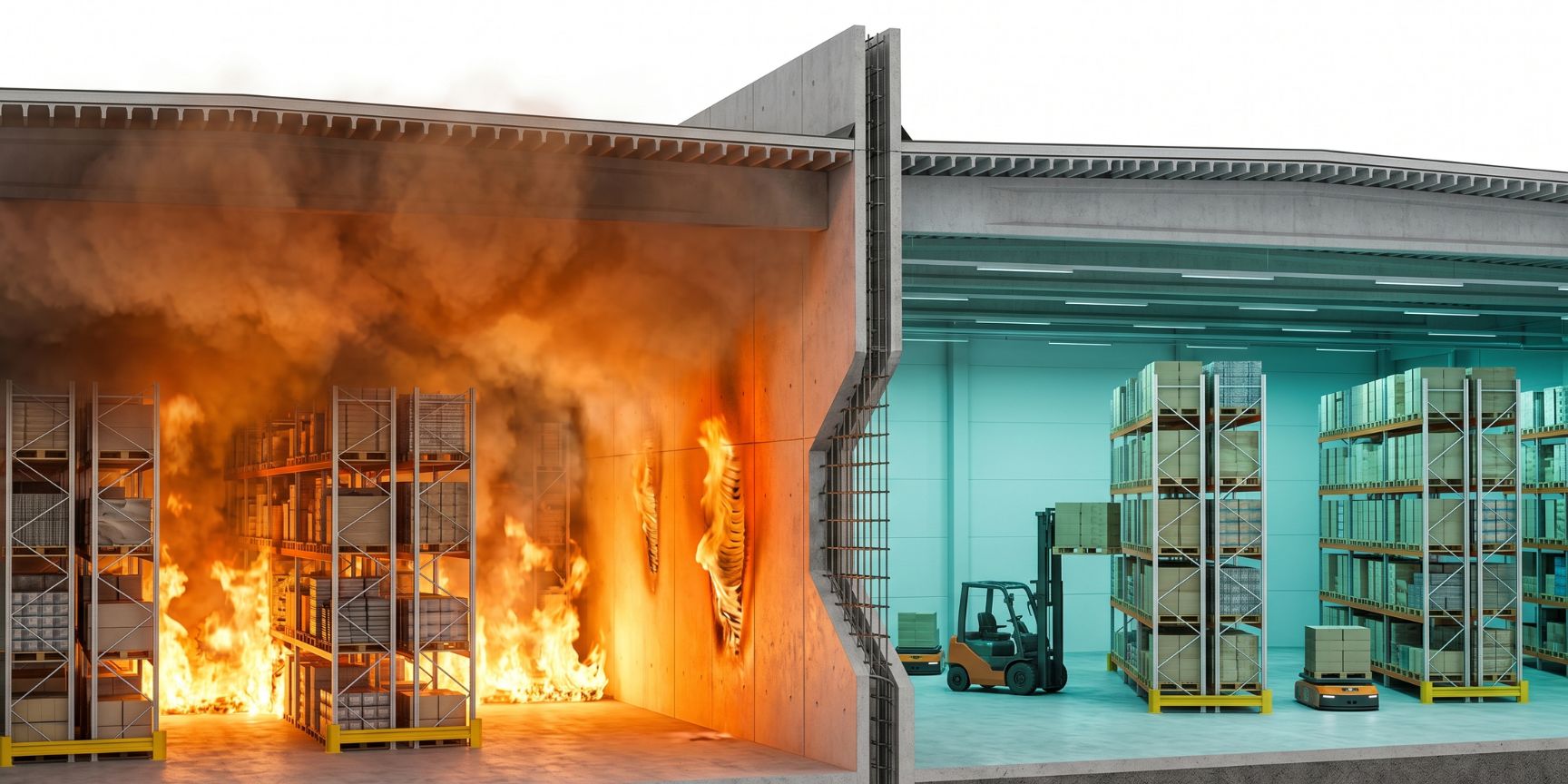
Definition: What distinguishes a fire wall from a fire protection wall?
In common parlance, the terms are often used synonymously, but there are serious differences in building law. A fire wall (according to DIN 4102-3 or DIN EN 13501-2) must retain its stability under the influence of fire and also withstand mechanical stress. This means that if shelves collapse or debris crashes into the wall in the neighboring section, the fire wall must not give way.
- Facts about the figures: As a rule, a real fire wall must be designed in such a way that it can withstand an impact of 3,000 Nm (impact test according to DIN 4102).
- Classification: In Germany, the designation F90-A (fire-resistant made of non-combustible materials) or according to the European standard REI-M 90 (load-bearing capacity, room closure, insulation plus mechanical load) is the standard.
The Model Industrial Building Directive (MIndBauRL) as a set of rules
For logistics real estate, the MIndBauRL is the authoritative set of rules. It defines the area size from which a fire compartment must be formed.
- Without extinguishing system: Here, the fire compartments are often limited to approx. 2,500 to 3,000 m².
- With sprinkler system: With modern ESFR sprinkler systems (Early Suppression Fast Response), fire compartments in logistics halls can be extended to up to 10,000 m² or more before a fire wall is absolutely necessary.
These fire walls must be routed at least 0.5 metres above the roof or prevent the flames from spreading over the roof by means of a corresponding overhang ("fire wall crown").
The challenge of warehouse logistics: When the wall disrupts the flow
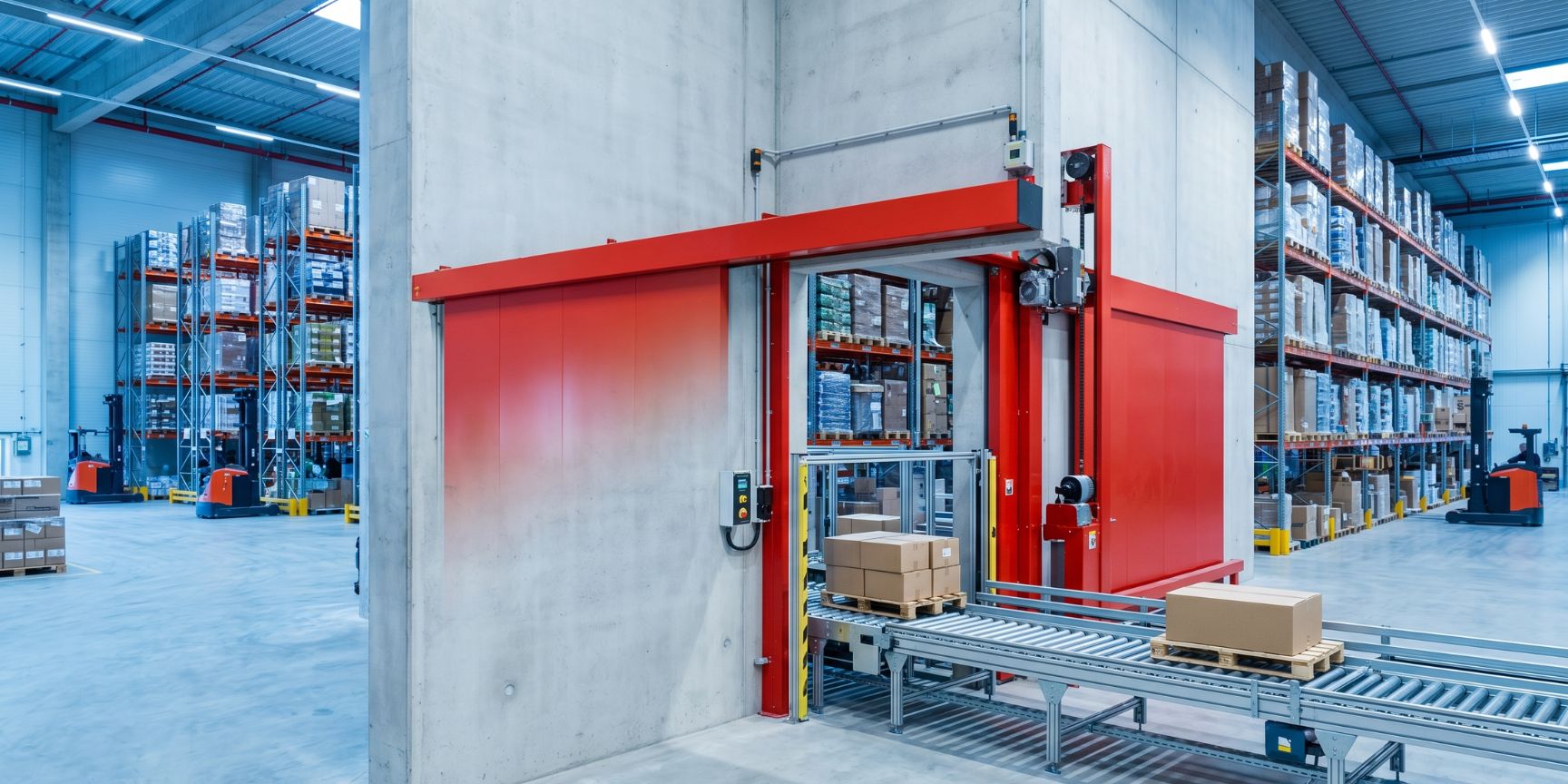
In contract logistics, efficiency is everything. Fire walls often act as barriers for the flow of materials. This is where fire protection closures come into play. When forklifts or automated guided vehicles (AGVs) move from one fire compartment to the next, the openings in the fire wall must be secured by fire protection doors (sliding gates, sectional doors). In the event of an alarm, these close automatically via smoke switches and hold-open systems.
Special case of intralogistics: Conveyor technology and fire wall
A critical point in automated high-bay warehouses is the penetration of the fire wall by conveyor belts or sorters. Highly specialized conveyor system terminations (FAA) are used here. These must ensure that at the moment of the alarm, the goods to be conveyed are moved out of the swivel area of the door ("freeing") so that the door can close unhindered.
- Practical tip: The maintenance of these interfaces between fire protection and IT/control is essential for insurance compliance.
Materials compared: Concrete vs. sandwich vs. masonry
Three construction methods dominate the construction of logistics properties:
- Prefabricated reinforced concrete elements: The gold standard. Quick to assemble, extremely resilient and low-maintenance.
- Sand-lime brick/masonry: Often found in smaller halls or office extensions. High thermal inertia.
- Sandwich panels (special design): Today, there are mineral wool-filled panels that can serve as a fire barrier set (highly fire-retardant), but often do not achieve the mechanical strength of a real fire wall.
Profitability and Insurance (FM Global / VdS)
Anyone who develops a logistics property looks at the TCO (Total Cost of Ownership). Fire walls are expensive and reduce the net storage space. However, the insurance industry (e.g. according to VdS guidelines or FM Global Standards) often requires stricter measures than building law. A "complex separation" by a fire wall can drastically reduce insurance premiums, as the risk of a maximum loss (PML – Probable Maximum Loss) is limited to one fire compartment.
Q&A – Frequently asked questions from practice
Question: Can I place shelves directly against the fire wall?
Answer: In principle, yes, as long as the stability of the wall is not endangered. However, a safety distance of at least 20-50 cm is recommended in order not to transfer deformations of the shelf directly to the wall when exposed to heat.
Question: What happens if pipes (electrical/water) have to pass through the wall?
Answer: Any penetration must be sealed with an approved fire protection bulkhead (cable or pipe bulkhead) of the same fire resistance class (e.g. S90).
Question: Can a fire wall be moved at a later date?
Answer: In logistics properties, this is extremely time-consuming and expensive, as the foundation and roof construction are usually adapted to the position of the wall. Flexibility should therefore be taken into account as early as phase 0 of planning (grid layout).
Conclusion for decision-makers
The fire wall is not an annoying obstacle in logistics, but a life insurance policy for the business model. Intelligent planning that harmonizes fire protection sections with the logistical processes (incoming goods, picking, outgoing goods) saves costs in the long term and ensures official acceptance security.
Checklist: Fire walls in logistics properties
| Criterion | Requirement/Detail |
| Fire resistance | At least F90-A / REI-M 90 |
| Canopy guide | 50 cm above roof or 1.5 m collared on both sides (firewall replacement) |
| Openings | Must be secured by closures approved by the building authorities |
| Mechanical Load | Must withstand the collapse of parts of the hall |
| Maintenance | Annual inspection of fire protection gates and bulkheads mandatory |
Your Ideal Logistics Warehouse
Browse listings for warehouse space, logistics real estate, industrial land, and contract logistics solutions.
Browse Exposés
Maximize Exposure for Your Warehouse Space
Showcase your logistics properties and attract qualified inquiries.
Discover Products