



Barcode Scanner in Warehouse Logistics
Table of contents
- Definition and technological basis of Auto-ID
- Laser Scanner vs. Linear & Area Imager: A Technology Comparison
- Designs and ergonomics in the warehouse
- Requirements for logistics property and infrastructure
- Special case of high-bay warehouses: Long range and retro reflection
- Robustness: IP classes and drop protection
- Questions and answers (FAQs) for practice
- Result
Definition and technological basis of Auto-ID
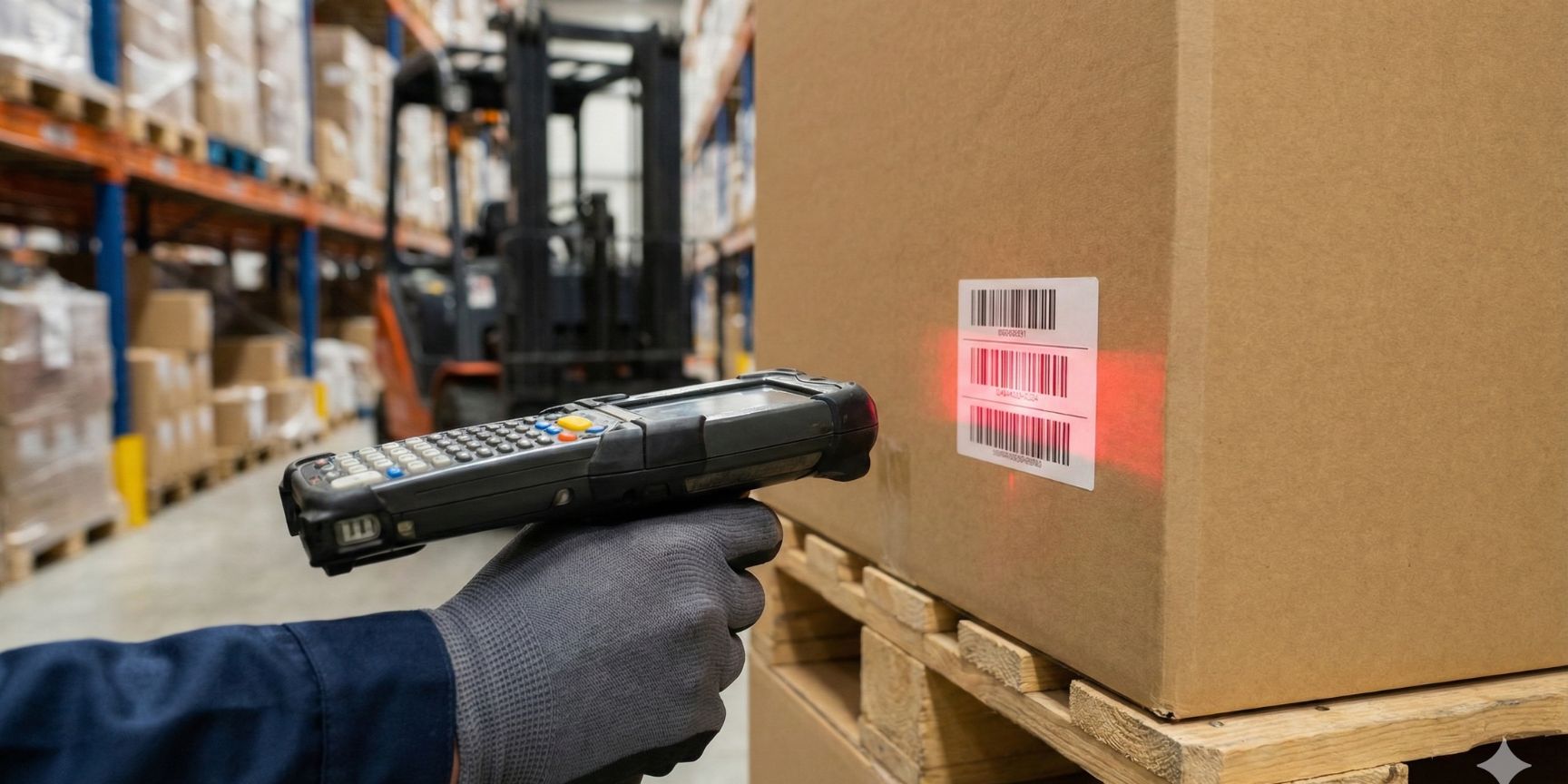
A barcode scanner (or barcode reader) is an optoelectronic capture device that decodes data records encoded as bars (1D) or matrix (2D) and forwards them to a processing system – usually a warehouse management system (WMS) or ERP. In logistics practice, people often speak not only of the pure "scanner", but also of mobile data collection devices (MDE). These combine the scan engine with a full-fledged computer and display to provide real-time feedback to the warehouse worker.
The core task is to convert the analogue information (the label on the pallet) into digital data (goods booking) as quickly as possible without errors. Reading distance, lighting conditions in the hall and the contrast of the barcode play a decisive role.
Laser Scanner vs. Linear & Area Imager: A Technology Comparison
For specialist decision-makers in contract logistics, the choice of scanning technology is essential, as it determines which barcodes can be read under which conditions.
Laser scanner:
The classic version. A laser beam is projected onto the code via a vibrating mirror (oscillator).
Advantage: Long range with special optics, very aggressive reading behavior with standard 1D codes.
Disadvantage: Mechanically more susceptible due to moving parts; cannot read 2D codes (QR, DataMatrix); Problems with corrupted codes.
Linear Imager (CCD):
Works like a single-line camera.
Advantage: Very robust (no moving parts), inexpensive, also reads from screens.
Disadvantage: Limited range (usually only up to approx. 50 cm).
Area Imager (2D):
A digital camera that takes a photo of the code and analyzes it digitally.
Advantage: Today's industry standard. Reads 1D and 2D codes omnidirectionally (no alignment required), captures codes from displays and corrupted codes. Also enables document capture (e.g. signatures, delivery notes).
| Feature | Laser Scanner | Area Imager (2D) |
| Code Types | Only 1D (barcode) | 1D, 2D (QR, Matrix), OCR |
| Robustness | Medium (mirror mechanism) | High (Solid State) |
| Reading success | Good at high contrast | Excellent (even with poor pressure) |
| Future-proofing | Sinking | High |
Designs and ergonomics in the warehouse
The choice of design depends directly on the process in the logistics property. Ergonomics is not a "nice-to-have" here, but a factor in the pick rate (picks per hour).
- Handheld scanner (pistol grip): The classic for sporadic scanning or inventories.
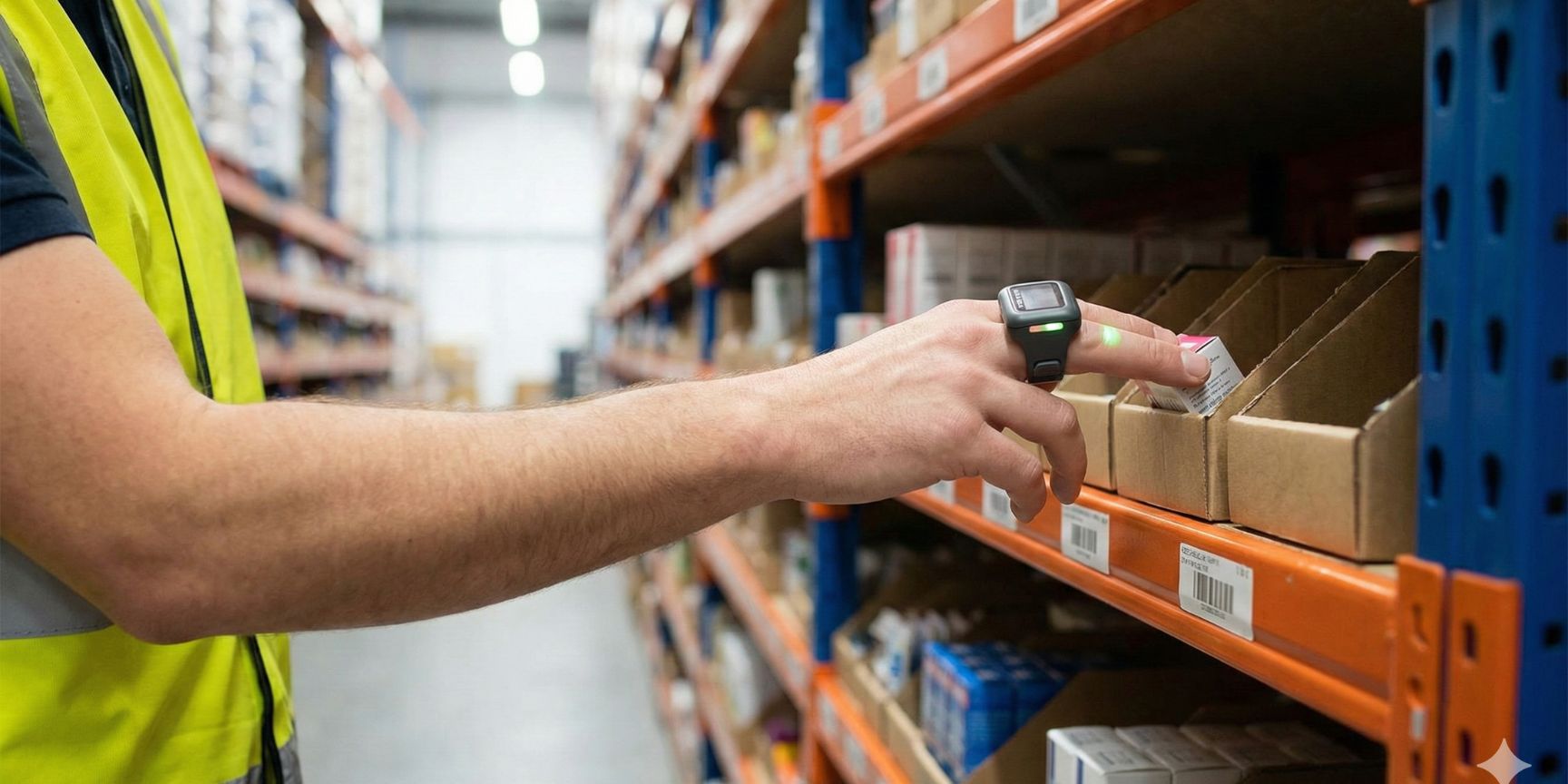
- Wearable scanner (backhand/ring): Indispensable in high-performance order picking. The employee has both hands free ("hands-free scanning"). Studies show time savings of up to 4 seconds per scan compared to pistol scanners.
- Forklift terminals & long-range scanners: Permanently installed terminals on industrial trucks, coupled with handheld scanners that have extended range.
Requirements for logistics property and infrastructure
In contract logistics and in the planning of logistics properties , the scanner is often viewed in isolation. However, it is part of an ecosystem.
- Connectivity: Modern scanners use Wi-Fi (IEEE 802.11 a/b/g/n/ac/ax) or 4G/5G private networks. In large halls with steel shelves, radio shadows can occur. The scanners must have good roaming behavior in order to switch seamlessly between access points without losing the session to the WMS.
- Lighting conditions: In dark corners of logistics halls or alternating between bright ramp (sunlight) and dark truck interior, imagers have to work with strong self-illumination and aiming device (green spot, crosshair).
- Reflection: Be careful with foiled pallets. Conventional laser scanners are often dazzled by the reflection of the stretch film. Modern imagers calculate reflections on the software side.
Special case of high-bay warehouses: Long range and retro reflection
The high-bay warehouse poses a particular challenge. A forklift driver must be able to scan a barcode at a height of 10 to 15 meters from the vehicle.
This is where Auto-Range or Extended Range Imagers come into play. These optics can focus codes at close range (20 cm) to far range (up to 21 meters).
- Important factor: For extreme distances, special retro-reflective labels are necessary at the parking spaces. These reflect the light of the scanner in bundles and make it possible to read over long distances. Standard paper labels are often inadequate here.
Robustness: IP classes and drop protection
In the harsh environment of a transshipment hall, equipment must survive falls onto concrete.
- IP rating: For warehouse environments, IP65 (dustproof and jet-proof) is the standard. For cold stores (-30°C), special cold store variants with heated displays and scan windows are required to prevent fogging.
- Drop Spec: An important parameter is the drop height. Industrial scanners should survive several falls from 1.8m to 2.4m onto concrete without damage. Housings are often made of polycarbonate with rubber coating.
Questions and answers (FAQs) for practice
Question: What is the difference between DPM and standard barcodes?
Answer: DPM (Direct Part Marking) refers to the direct application of the code to the workpiece by lasering, dot peening or etching (often in automotive contract logistics). Standard scanners cannot read these codes, which are often low-contrast. This requires specialized DPM scanners with special lighting and decoding algorithms.
Question: Why doesn't my device scan the barcode at the top shelf level?
Answer: This is usually due to three factors:
- The resolution (mil size) of the barcode is too low for the distance.
- The label is not retro-reflective (it "swallows" the light).
- The scanner does not have auto-range optics. A standard range scanner rarely manages more than 1-2 meters.
Question: What influence does Android have on modern barcode scanners?
Answer: In the past, MDEs ran on Windows CE/Mobile. Since the end of support for these systems, Android Industrial has established itself as the standard. The advantages are intuitive operation (like a smartphone), high security through regular patches and the simple development of apps. Important for companies: Look for "Android Enterprise Recommended" (AER) certification to ensure long-term support.
Question: Are wearable scanners worth it compared to handhelds?
Answer: Yes, as soon as the pick frequency is high. If an employee makes 1,000 picks per shift and saves 2 seconds per pick because they don't have to pick up and put down the scanner, this adds up to over 30 minutes of productivity gain per shift. It also reduces fatigue and the risk of dropping equipment.
Result
The barcode scanner is much more than a simple peripheral device in logistics. It is the tool that translates the physical reality of the hall into the data world of IT. For operators of logistics properties and contract logistics companies, the key to success is not in the purchase of the most expensive device, but in the coordination of scanning technology (imager), device form factor (ergonomics) and environmental conditions (light/distance). Those who invest here and rely on modern 2D area imagers will secure flexibility for future requirements such as 2D codes and digital image documentation.
Your Ideal Logistics Warehouse
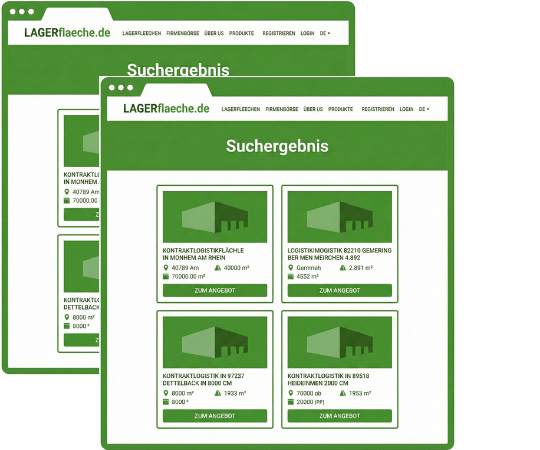
Browse listings for warehouse space, logistics real estate, industrial land, and contract logistics solutions.
Browse Exposés
Maximize Exposure for Your Warehouse Space
Showcase your logistics properties and attract qualified inquiries.
Discover Products