




Batch picking in the warehouse
Table of contents
- Batch Picking: The Efficiency Turbo for Modern Warehouse Logistics
- What is batch picking? A definition from an expert's point of view
- The mechanics of the process: One-stage vs. two-stage
- Why batch picking? Facts, figures and figures on efficiency
- Requirements for the logistics property: More than just a hall
- Batch Picking in Contract Logistics: Flexibility as a Competitive Advantage
- Questions and answers (Q&A) for practice
- The role of automation: sorters and robots
- Conclusion: A must for the niche segment of high-performance logistics
Batch Picking: The Efficiency Turbo for Modern Warehouse Logistics
In the world of intralogistics, time is the hardest currency. While traditional methods often reach their limits, batch picking (also known as batch picking) has established itself as the gold standard for warehouse operators seeking high throughput rates while maintaining low error rates. But what exactly does this term mean, and what structural requirements does the process place on a logistics property?
What is batch picking? A definition from an expert's point of view
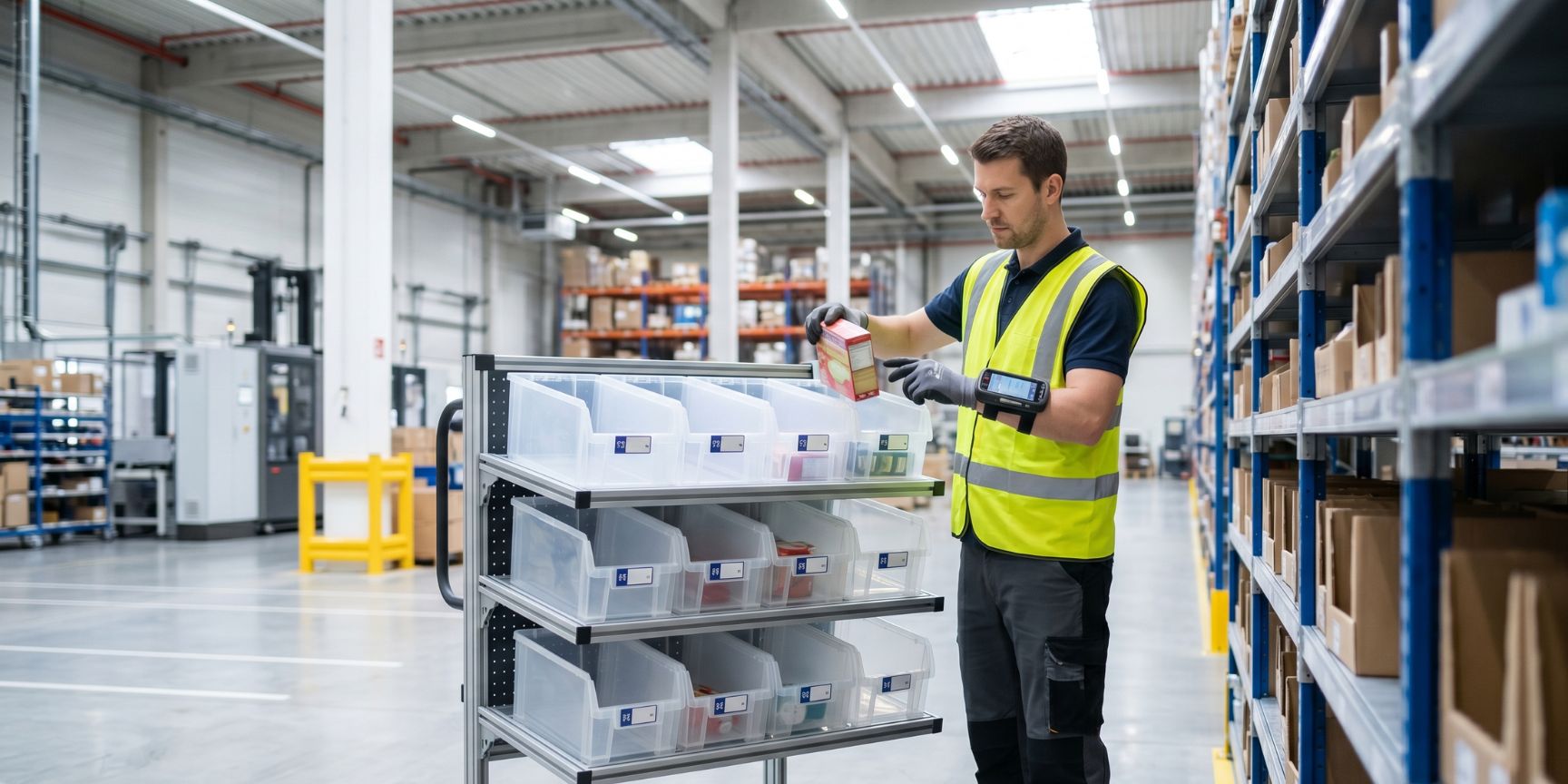
Batch picking describes a picking process in which an employee does not process a single order after the other (single-order picking), but removes parts for several orders at the same time. These orders are combined into a group – the so-called "batch".
The decisive difference to other methods is that the removal is carried out on an item-by-item basis. If five customers have each ordered the same product, the picker will only go to the bin once and remove all five units at once.
The mechanics of the process: One-stage vs. two-stage
Batch picking is closely linked to multi-stage picking. In practice, a distinction is usually made between two processes:
- Pick-and-Sort (two-stage): The picker collects all items in the batch into one large container. Only in a second step (consolidation) are the items assigned to the individual orders at the packing station or via a sorter.
- Pick-and-Pack (single-stage/cluster): Here, the employee carries a cart with several boxes. The items are placed in the correct customer box immediately upon removal.
Why batch picking? Facts, figures and figures on efficiency
In a manual warehouse, travel time often accounts for up to 50% to 70% of the total picking time. This is exactly where batch picking comes in. By bundling orders, travel times per pick can be massively reduced.
- Performance Improvement: Increase picks per hour by an average of 30% to 50% compared to single-order picking.
- Distance reduction: Reduction of driving or walking distances by up to 60%, depending on the batch size and the article structure.
- Scalability: Particularly effective with a high number of small units and a small number of items per order (typical for B2C e-commerce).
Requirements for the logistics property: More than just a hall
In order for batch picking to develop its full potential, the logistics property must meet certain infrastructural requirements. A standard hall quickly reaches its limits here.
- Aisle widths and layout: Optimized aisle widths are required for manual batch picking with picking trolleys in order to enable encounter traffic without loss of time.
- Soil conditions: Since heavy collection trucks or electric pallet trucks are often used for batch picking, a high flatness tolerance of the floor (according to DIN 18202) is essential.
- IT infrastructure & WLAN: Batch picking only works with a powerful warehouse management system (WMS). The hall must be equipped with high-performance Wi-Fi across the board in order to support pick-by-voice, pick-by-light or mobile data acquisition (MDE) without latencies.
- Consolidation areas: Since two-stage batch picking is a downstream sorting process, the property requires sufficient buffer space and space for sorting systems (sorters) or put walls.
Batch Picking in Contract Logistics: Flexibility as a Competitive Advantage
For contract logistics companies (3PL), batch picking is a strategic tool to cushion fluctuating order volumes. In contracts with strict service level agreements (SLAs) and late cut-off times, batch formation allows for a huge compression of work during peak times (e.g. Black Friday).
The multi-client capability of the WMS plays a role here: a batch can theoretically be formed across orders across different clients, provided that the goods are stored in the same zone – an enormous lever for the profitability of the space.
Questions and answers (Q&A) for practice
Question: From which order structure is batch picking worthwhile?
Answer: It is especially worthwhile if the items in the orders have a high match (high-runner) and for shipments with only 1-3 items (single-item orders).
Question: What are the risks?
Answer: The main risk is the mispick rate when sorting. If the assignment is incorrect in the two-stage process, the error often affects several customers at the same time. A scanning process on the put wall is therefore mandatory.
Question: What role does artificial intelligence (AI) play?
Answer: Modern WMS use AI algorithms to form batches in real time in such a way that the distances are mathematically minimized (Traveling Salesman Problem). Priorities such as express shipping are also taken into account.
The role of automation: Sorters and robots
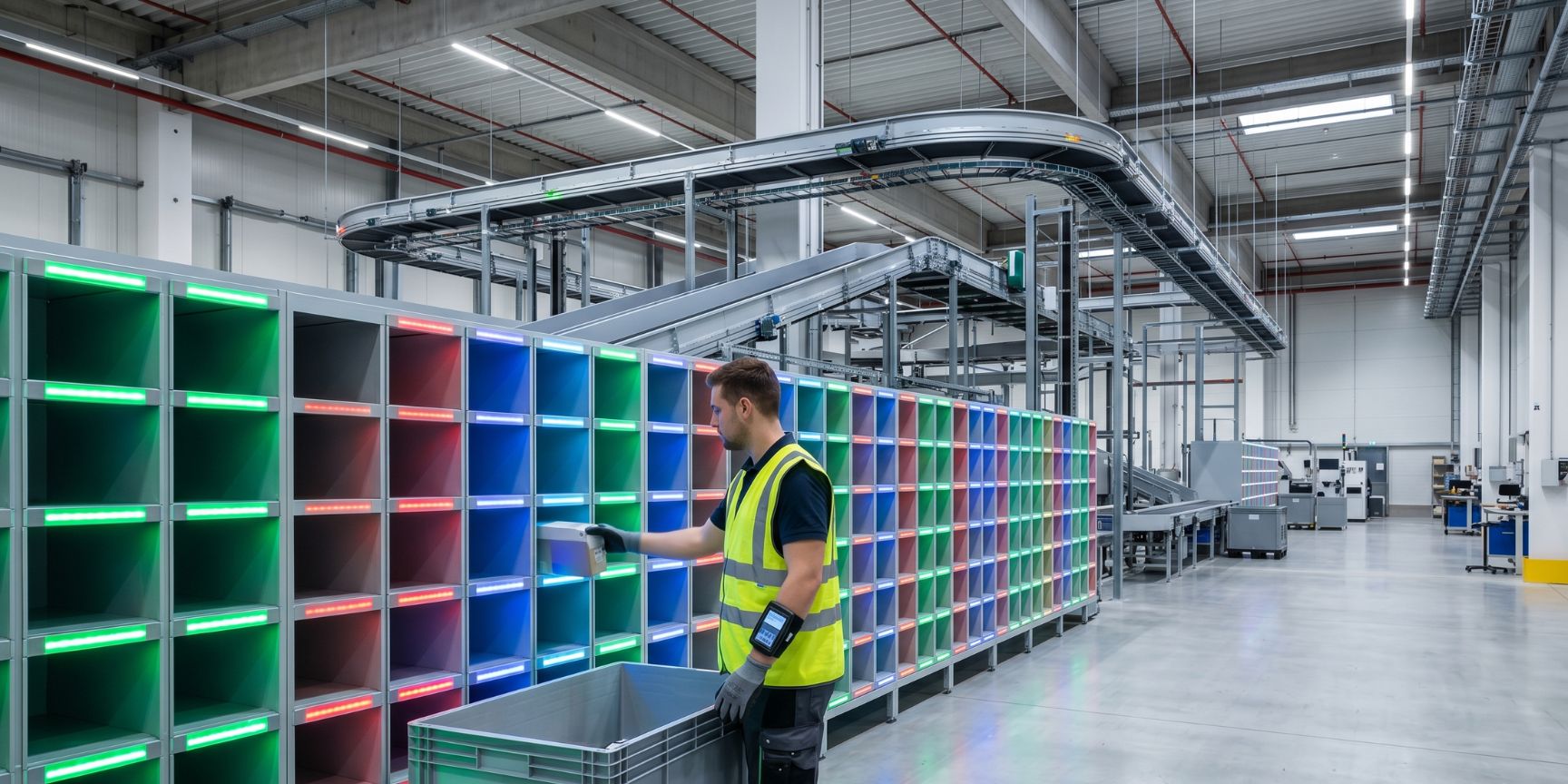
In state-of-the-art logistics centers, batch picking is increasingly automated. Automated small parts warehouses (AS/RS) or AutoStore systems bring the goods to the man (goods-to-person). The "batch" is formed here on the system side, and the employee at the port picks directly into a batch structure.
Sorter systems are also used in large halls . These take over the entire second stage of batch picking: The collected items are placed on a conveyor belt and automatically fed into the respective customer shipping cartons. This enables throughput rates of several thousand parts per hour.
Conclusion: A must for the niche segment of high-performance logistics
Batch picking is much more than a simple work instruction; it is a highly complex interplay of software intelligence, process engineering know-how and the appropriate physical infrastructure of the logistics property. Those who exploit the potential of route optimisation and equip their hall accordingly not only reduce their process costs, but also create the necessary scalability for the market of tomorrow.
For operators and owners of logistics properties, this means that the flexibility of space for modern picking strategies such as batch picking is now a decisive criterion for the third-party usability and long-term value of a property.
Your Ideal Logistics Warehouse
Browse listings for warehouse space, logistics real estate, industrial land, and contract logistics solutions.
Browse Exposés
Maximize Exposure for Your Warehouse Space
Showcase your logistics properties and attract qualified inquiries.
Discover Products