




Gas storage
Table of Contents
- Basics of gas storage in the logistics context
- Logistics Property: Structural Requirements for Gas Warehouses
- Storage concepts: From compressed gas cylinders to tank farms
- Regulatory and legal: The importance of TRGS 510 and ADR
- Contract logistics for gases: Outsourcing as risk management
- Technical FAQ: Practical knowledge for gas logistics
- Facts, figures, data: Key figures in gas logistics
- Conclusion and Outlook: The Future of Gas Storage
Basics of Gas Storage in the Logistics Context
Gases differ from solid or liquid goods primarily in their physical property of completely filling the available space. In warehouse logistics, we usually encounter gases in three forms: compressed (compressed gas), liquefied (by pressure or cooling) or dissolved.
For warehouse logistics, this means that the "container" – usually compressed gas cylinders, bundles or tanks – is an integral part of the safety concept. While contract logistics often handles the handling of bottled goods (general cargo), specialized warehouse logistics focuses on compliance with Technical Rules for Hazardous Substances (TRGS 510), which lays the foundation for the operation of such facilities in Germany.
Logistics Property: Structural Requirements for Gas Warehouses
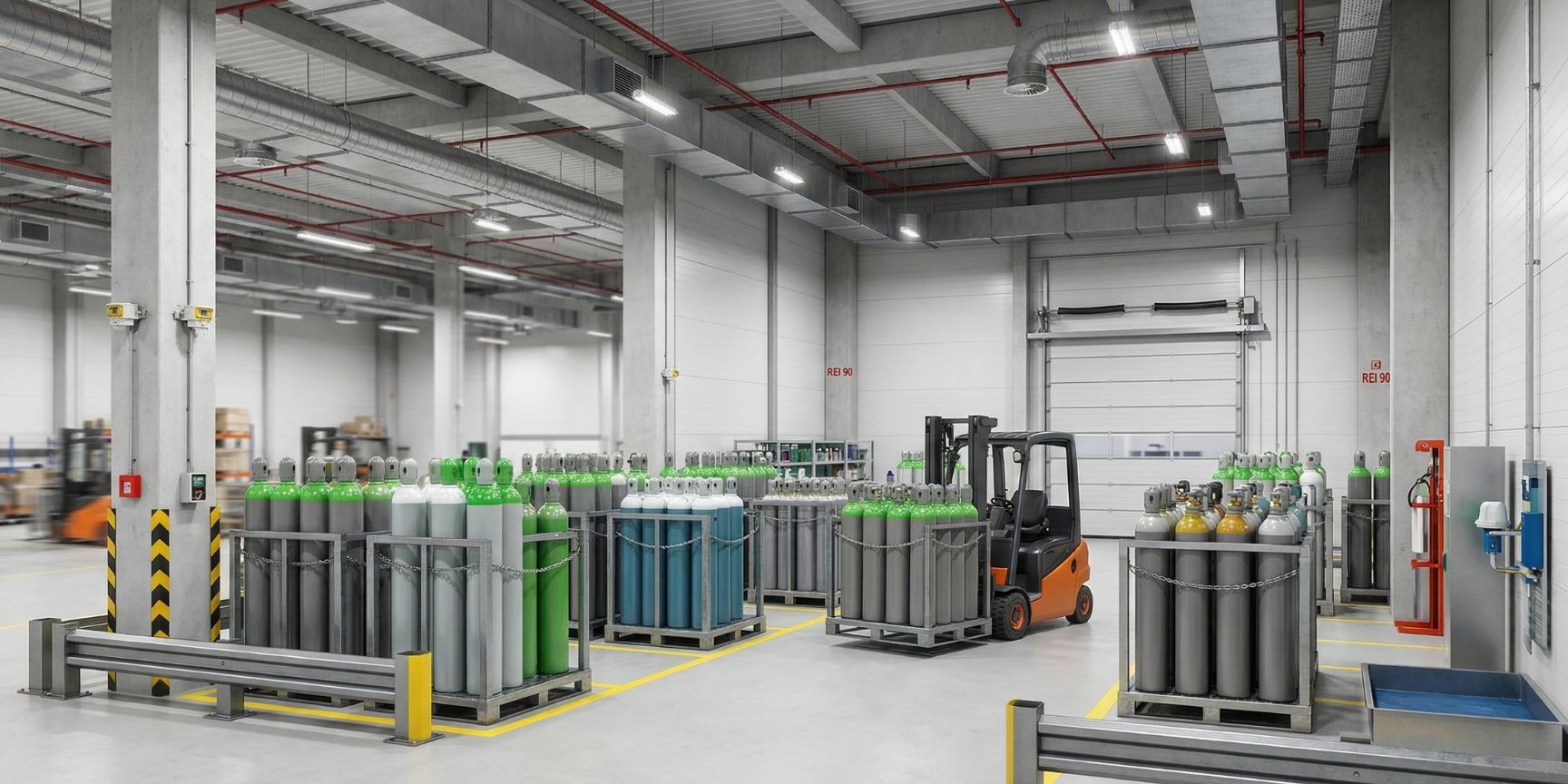
A standard logistics hall is usually unsuitable for the storage of gases in larger quantities. The property must meet specific protection objectives:
- Ventilation concept: Gases must not accumulate in the event of leaks. A distinction is made here between natural ventilation (openings in the roof and floor) and technical ventilation. For many gases, at least two air changes per hour are required.
- Explosion protection (ATEX): In the case of flammable gases, electrical systems (lighting, forklift charging stations) must be designed in appropriate Ex zones.
- Fire protection: Fire walls (usually F90 or REI 90) must separate the gas storage facility from adjacent areas. Particular attention is paid to cooling the containers in the event of a fire in order to prevent bursting due to overpressure.
- Soil conditions: The floor must be mechanically resistant to heavy steel cylinders and must not allow sparks to form (electrostatic dissipation) in the case of flammable gases.
Storage concepts: From compressed gas cylinders to tank farms
In the practice of contract logistics, three types of storage dominate:
- Bottle storage: Here, gas cylinders are stored upright in racks or pallets. It is important to protect against falling over.
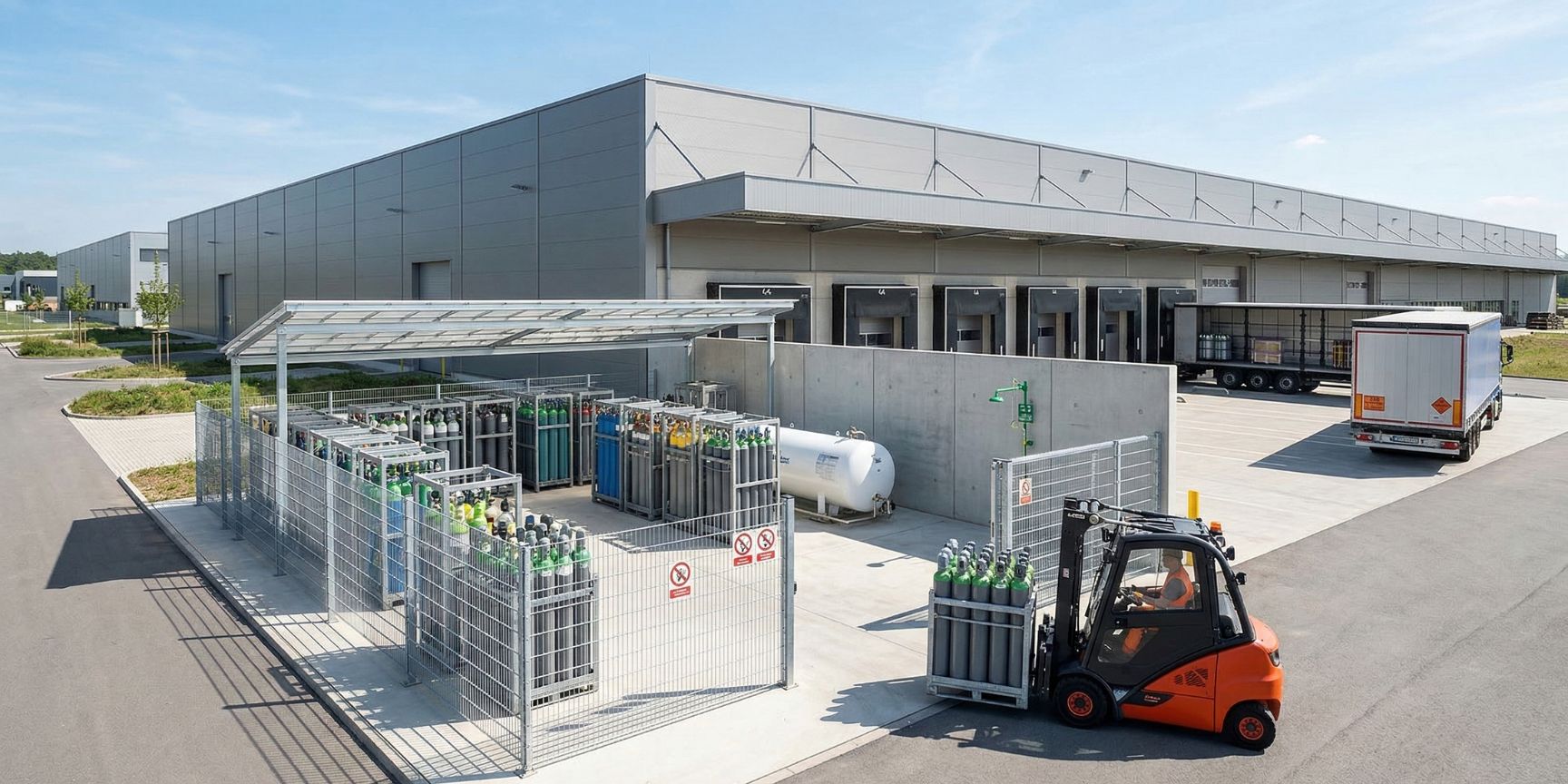
- Outdoor storage: Due to natural ventilation, many gases may preferably be stored outdoors, provided that they are protected from sunlight (over 50 °C) and access by unauthorized persons.
- Special containers: Modular fire protection containers enable smaller gas storage facilities to be integrated into existing logistics centres without having to upgrade the entire building in terms of fire protection.
Regulatory and legal: The importance of TRGS 510 and ADR
Anyone who stores gases is within the framework of the Hazardous Substances Ordinance (GefStoffV). TRGS 510 defines clear quantity thresholds. From a storage quantity of more than 2.5 tons (often significantly less in the case of extremely flammable gases), stricter requirements apply.
In addition, the ADR (European Agreement concerning the International Carriage of Dangerous Goods by Road) plays a role as soon as the warehouse acts as a transshipment point. The labelling of the storage areas with the corresponding hazard symbols (e.g. class 2: gases) is mandatory.
Contract logistics for gases: Outsourcing as risk management
Many manufacturing companies outsource their gas logistics to specialized contract logistics companies. The reason: The complexity of the approval procedures according to BImSchG (Federal Immission Control Act) is almost impossible for companies from outside the field.
A competent logistics partner not only takes care of the storage, but also the inventory management of the rental containers, the inspection of the inspection periods of the gas cylinders (TÜV) and the legally compliant loading of the trucks (load securing for cylindrical bodies).
Technical FAQ: Practical knowledge for gas logistics
Question: Can gases and liquids be stored together?
Answer: In principle, strict bans on joint storage apply in accordance with TRGS 510 (Annex 1). Flammable gases, for example, must not be stored in a fire cut with oxidizing substances or flammable liquids, unless specific protective distances or barriers are observed.
Question: Are empty gas cylinders considered safe?
Answer: No. In logistics, "emptied" compressed gas containers are treated as full containers, as they usually still contain residual quantities under pressure. They are subject to the same storage and labelling obligations.
Question: What role does temperature play?
Answer: The critical limit is 50 °C. The logistics property must ensure that the containers are not exposed to direct thermal radiation that exceeds this value in order to keep the internal pressure stable.
Facts, figures, data: Key figures in gas logistics
The following guidelines help to understand the dimensions:
- Pressure: Industrial standard bottles usually have a filling pressure of 200 to 300 bar.
- Safety distances: When storing outdoors, distances of 5 meters from potential sources of ignition or neighboring buildings must often be maintained.
- Ventilation: In the case of natural ventilation, at least 1% of the floor area must be available as a ventilation opening (near the floor and near the roof).
Conclusion and Outlook: The Future of Gas Storage
With the decarbonisation of industry, the storage of hydrogen is becoming massively more important. For logistics real estate, this means an evolution: hydrogen is extremely light, volatilizes upwards and has a very wide explosion range. Future hall concepts will have to be tested more intensively for "H2 readiness", which places even higher demands on the sensor technology and the roof construction.