




Location assessment in warehouse logistics
Table of contents
- What is a location assessment?
- Why is location analysis so crucial in warehouse logistics?
- Macro Location vs. Micro Location: The Two Levels of Analysis
- Hard Location Factors: The Facts for Logistics Real Estate
- Soft location factors: The lever for success in contract logistics
- Q&A: Frequently Asked Questions (FAQ) on Location Assessment
- Practical utility: Data sources for your own analysis
- Conclusion: Strategic settlement secures competitive advantages
What is a location assessment?
Location assessment (also known as location analysis) is a systematic process for examining and assessing potential locations for companies. The aim is to determine the optimal geographical and physical location for a business activity. For niche and specialist areas such as logistics, this means finding a place that offers the perfect balance between cost structures, accessibility, property quality and staff availability. A well-founded site survey minimizes investment risks and forms the foundation for future-proof business.

Why is location analysis so crucial in warehouse logistics?
In logistics, there is an unwritten law: the location dictates the costs. Transport and distribution costs account for between 50% and 70% of total logistics costs in many supply chains. A suboptimally positioned hall inevitably leads to long pre- and on-carriage, higher tolls and increased CO₂ emissions.
In addition, the requirements for logistics real estate have changed massively. They have long since ceased to be mere "warehouses", but highly complex, data-driven transshipment hubs. The right location assessment determines whether a property can meet these modern requirements of just-in-time or just-in-sequence delivery.
Macro Location vs. Micro Location: The Two Levels of Analysis
A professional valuation is always carried out according to the top-down principle, i.e. from the rough regional location to the exact property.
- The macro location: Here the large-scale region is considered (e.g. Rhine-Ruhr, logistics region Leipzig/Halle). Important criteria are the central location in the European network, the general economic dynamics, demographic developments and the large-scale transport infrastructure.
- The micro-location: This is the precise valuation of the property and its immediate neighborhood. What are the access roads like? Are there conflicts with adjacent residential areas? What is the topographical nature of the soil for heavy loads?
Hard Location Factors: The Facts for Logistics Real Estate
Hard factors are objectively measurable and often the knock-out criterion in the search for the right hall. The following figures and data are essential in warehouse logistics:
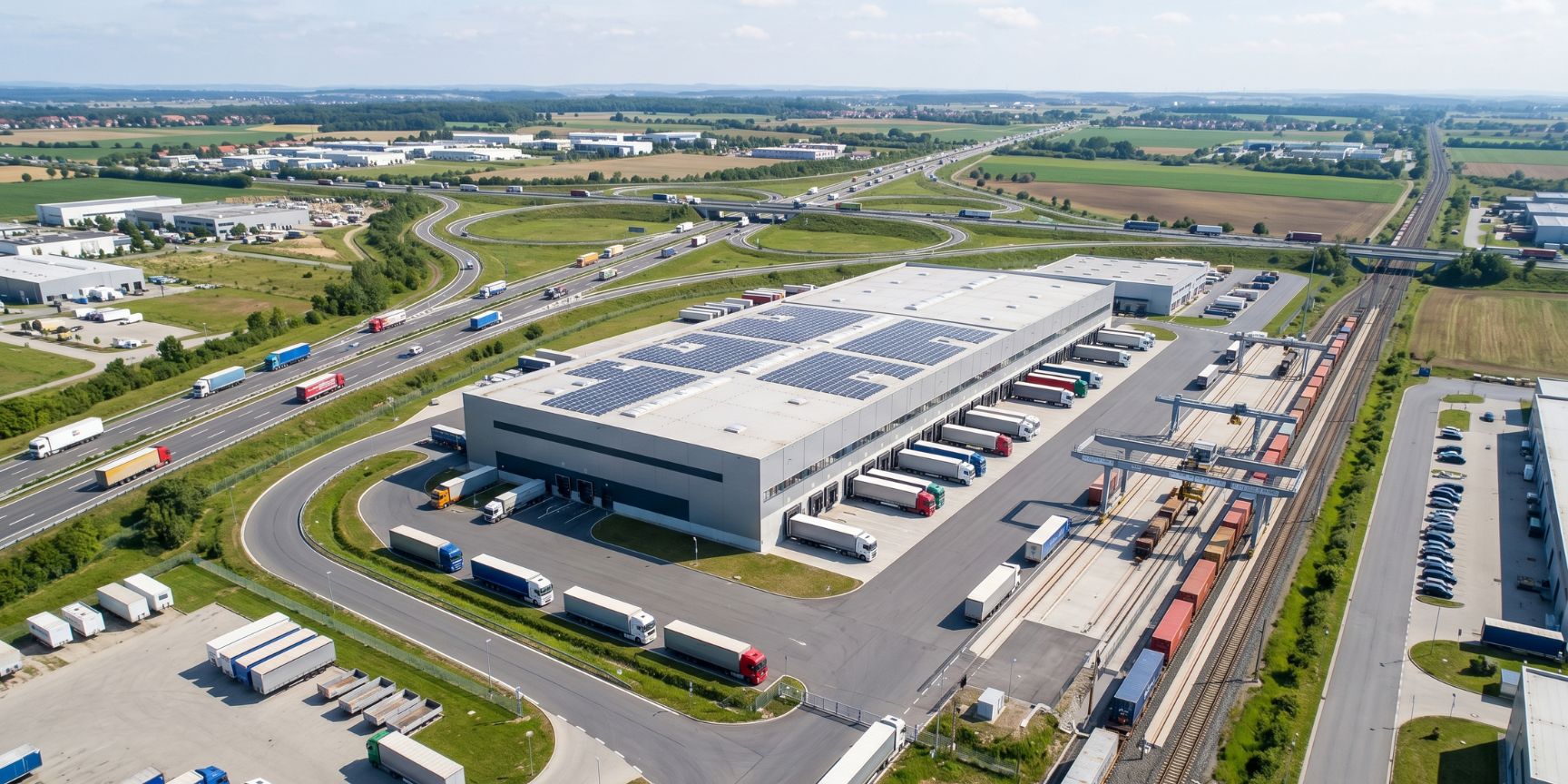
- Transport connections: The distance to the nearest motorway entrance should ideally be less than 5 kilometers without burdening local thoroughfares. Trimodal connections (road, rail, water) significantly increase the value of the property.
- Space and building specifications: Modern logistics halls require a clear height of 10 to 12 meters (UKB) and a floor load capacity of at least 50 kN/m² (equivalent to 5 tons).
- Licensing situation: Can the hall be used 24/7? Designated industrial areas (GI) are clearly superior to commercial areas (GE) with night work restrictions.
- Energy and IT infrastructure: High-performance transformer stations for charging infrastructure (e-trucks) and a nationwide fiber-optic connection for automated warehouse management systems (WMS) are mandatory today.
Soft location factors: The lever for success in contract logistics
While hard factors determine feasibility, soft factors often determine long-term profitability – especially in labor-intensive contract logistics. Here, logistics service providers take on complex value-added services such as quality controls, assembly or returns management.
- Availability of skilled workers and workers: The best hall is useless without staff. The analysis of the regional unemployment rate, the wage level and the commuter balance is elementary.
- Public transport connections: Since contract logistics often work in shifts, the location must also be accessible by bus or train (even at off-peak times) for employees without their own car.
- Political climate and acceptance: The settlement of logistics companies often meets with resistance from the population. Municipalities that see logistics as an economic engine offer clear strategic advantages.
Q&A: Frequently Asked Questions (FAQ) on Location Assessment
Question: What role does the topic of sustainability (ESG) play in the choice of location?
Answer: A huge role. Investors and tenants are increasingly demanding ESG-compliant (environmental, social, governance) properties. Factors such as the possibility of installing photovoltaic systems, heat pumps or the proximity to rail networks are directly included in the site scoring.
Question: Greenfield or brownfield – which is the better choice?
Answer: Due to the increasing shortage of land and the soil sealing problem, brownfields (brownfields, former industrial sites) are becoming increasingly important. They often score points with existing infrastructure and permits, but require a strict check for contaminated sites in advance. Greenfields (new developments on greenfield sites) offer planning freedom, but are politically more difficult to enforce.
Question: What is the best methodological approach to evaluation?
Answer: In practice, the utility analysis (scoring model) has proven its worth. All relevant criteria are defined, weighted according to their importance for the specific logistics project (e.g. staff availability 30%, proximity to the motorway 25%, etc.) and then evaluated with points.
Practical utility: Data sources for your own analysis
Reliable data must be used for a well-founded assessment. Experts use the following for location benchmarking, among other things:
- Standard land value maps of the municipal appraisal committees for cost calculation.
- Federal traffic interdependence forecasts to avoid future traffic jam hotspots.
- Demographic data from the statistical offices of the Länder for the assessment of the future labour force potential (age structure).
- Isokronen analyses (travel time analyses) to calculate exactly how many millions of end customers can be reached from a given hall within 2 or 4 hours of driving time.
Conclusion: Strategic settlement secures competitive advantages
A detailed site assessment is much more than just looking at the map. Especially in warehouse and contract logistics, it is a complex, multidimensional undertaking in which hard infrastructure data and soft socio-economic factors must mesh seamlessly. Anyone who invests time and expertise in a methodically clean location analysis when locating or renting a logistics property not only reduces their operating costs, but also secures the decisive strategic competitive advantage in a competitive market.
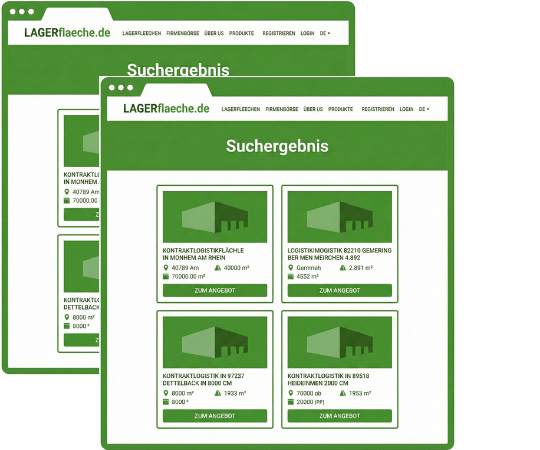
Your Ideal Logistics Warehouse
Browse listings for warehouse space, logistics real estate, industrial land, and contract logistics solutions.
Browse Exposés
Maximize Exposure for Your Warehouse Space
Showcase your logistics properties and attract qualified inquiries.
Discover Products